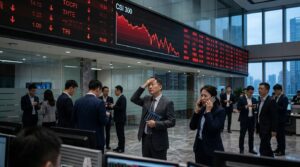



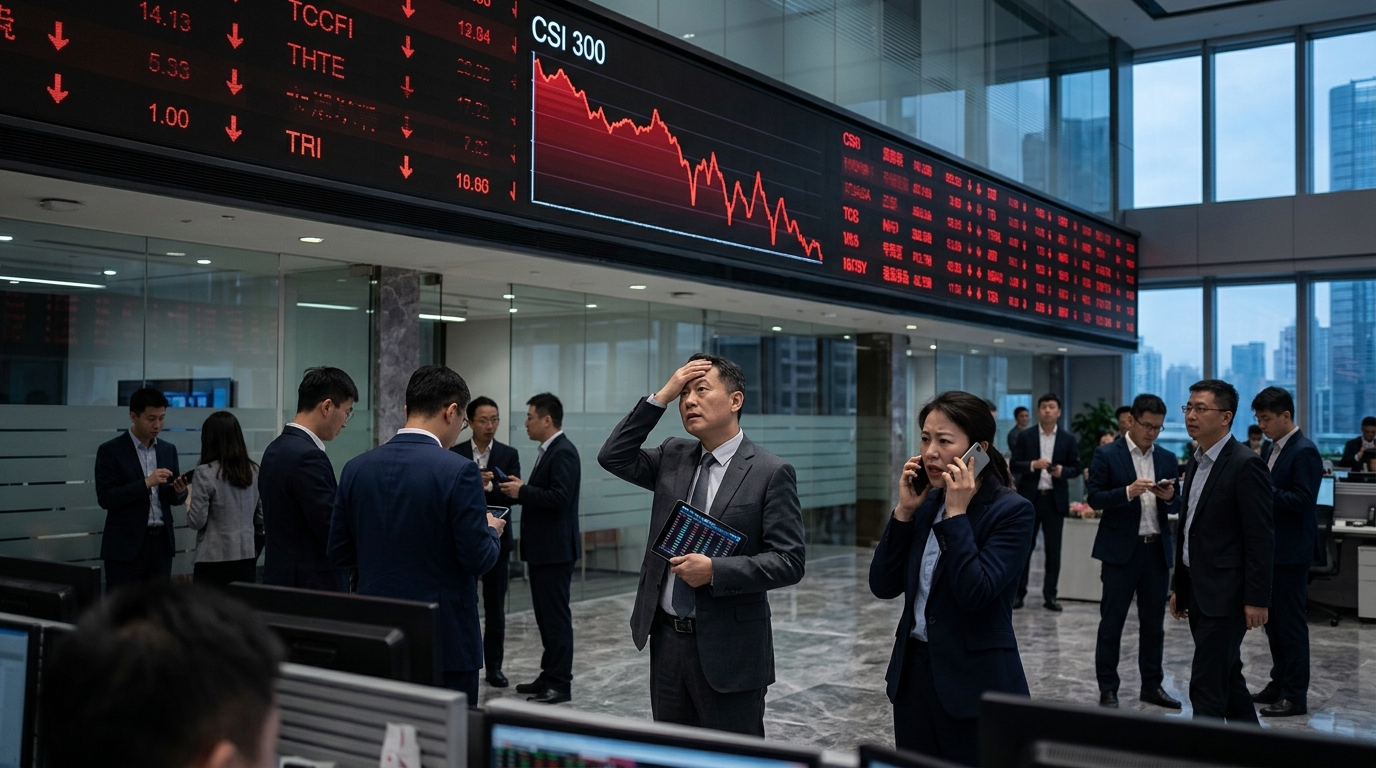
Every investment committee running emerging-market exposure is looking at the same number this morning: 20. That is the percentage the CSI 300 has fallen from its June peak, confirmed intraday Thursday in a session that saw the index drop as much as 1.7%. LSEG data shows the index has declined for ten consecutive weeks. The question is no longer whether China is in a bear market. The question is whether that fact is a buy signal or a warning.
Why the State Rescue Failed
Bloomberg Intelligence said Thursday that the national team may need to accelerate purchases after the record losing streak, but noted that state-backed buying alone may not be enough to sustain a recovery. Central Huijin, the state-backed investor leading stabilization efforts, raised $231 billion through ETF sales in the first half of the year.
What is less clear is how much of that has been put back to work since purchases resumed in July. Analysts warned that state buying alone may not deliver a lasting recovery. The math matters because the national team’s prior interventions succeeded by changing market psychology. This time, ten weeks of sustained selling suggest the psychology has not shifted. The national team can slow forced selling and punish aggressive shorts, but it cannot manufacture earnings, repair household confidence, or reverse the broader AI unwind.
The Bull Case
Forward valuations on the CSI 300 have contracted to roughly 13 times earnings. That is cheap in any historical context, and it is cheaper still relative to US equivalents. The correlation argument has also strengthened: the CSI 300’s selloff is being driven by domestic factors, not mirroring the S&P. An allocator looking for genuine diversification from the US AI trade could make the case that Chinese equities offer exactly that.
Shaun Rein of China Market Research called it “a crisis of confidence right now, not a crisis in the economy,” predicting a strong rebound in Chinese equities in 2027. Export data and Q3 GDP, which came in at 4.5%, support the idea that the underlying economy is not collapsing even as the equity market does.
The Bear Case
The domestic earnings picture tells a different story. CATL, the world’s largest EV battery maker, reported Q3 net profit rising just 14.5% against analysts’ estimates of a 41.2% increase. The profit growth rate was the slowest in nearly two years.
CATL’s stock has nearly halved since May, as investors fret over expiring tax carve-outs and a trend dubbed “de-CATLization,” whereby former customers like Xiaomi and Li Auto source batteries from cheaper alternatives.
The property sector remains the more structural drag. Investment in China’s property sector fell 20.6% year-on-year in January through September 2026, to 5.3364 trillion yuan, and that figure widened from the 19.9% drop recorded through August. Beijing set an October 22 offshore trust tax declaration deadline that Reuters reported may have prompted additional share sales to raise cash, adding near-term mechanical pressure to a structurally weak market.
What the Mavens Think
Bloomberg attributed the selloff to the unwinding of the global AI trade and the lack of stimulus ahead of a crucial earnings season. Pella Funds chairman Jordan Cvetanovski told CNBC Thursday that years of overinvestment and excess industrial capacity were undermining profitability, including in industries where Chinese companies remain globally competitive. That is the bear case in its most direct form: the structural problems are not priced yet, and cheap multiples can get cheaper.
Stocks to Watch
FXI and MCHI are the liquid instruments most allocators reach for first. FXI tilts toward large, Hong Kong-listed Chinese companies with heavy weights in financials and other legacy sectors, which makes it the less volatile vehicle if the thesis is a policy-driven floor. MCHI carries broader exposure and is down roughly 19% over one year.
Alibaba (BABA) sits at the center of the debate. Alibaba has reported cloud revenue growth of about 40% and triple-digit AI-related product revenue growth for the eleventh consecutive quarter. The structural bear case is that the VIE discount and weak consumer spending cap the re-rating. Both arguments are live and neither is obviously wrong.
CATL carries the most specific risk. Profitability has been hit by low-margin energy-storage deliveries, a new 2% consumption tax on some lithium battery products, and reduced export VAT rebates. At this point, CATL’s recovery depends on management’s ability to pass tax costs through to customers, which is harder in a price-war environment. That is a 2027 story at the earliest.