



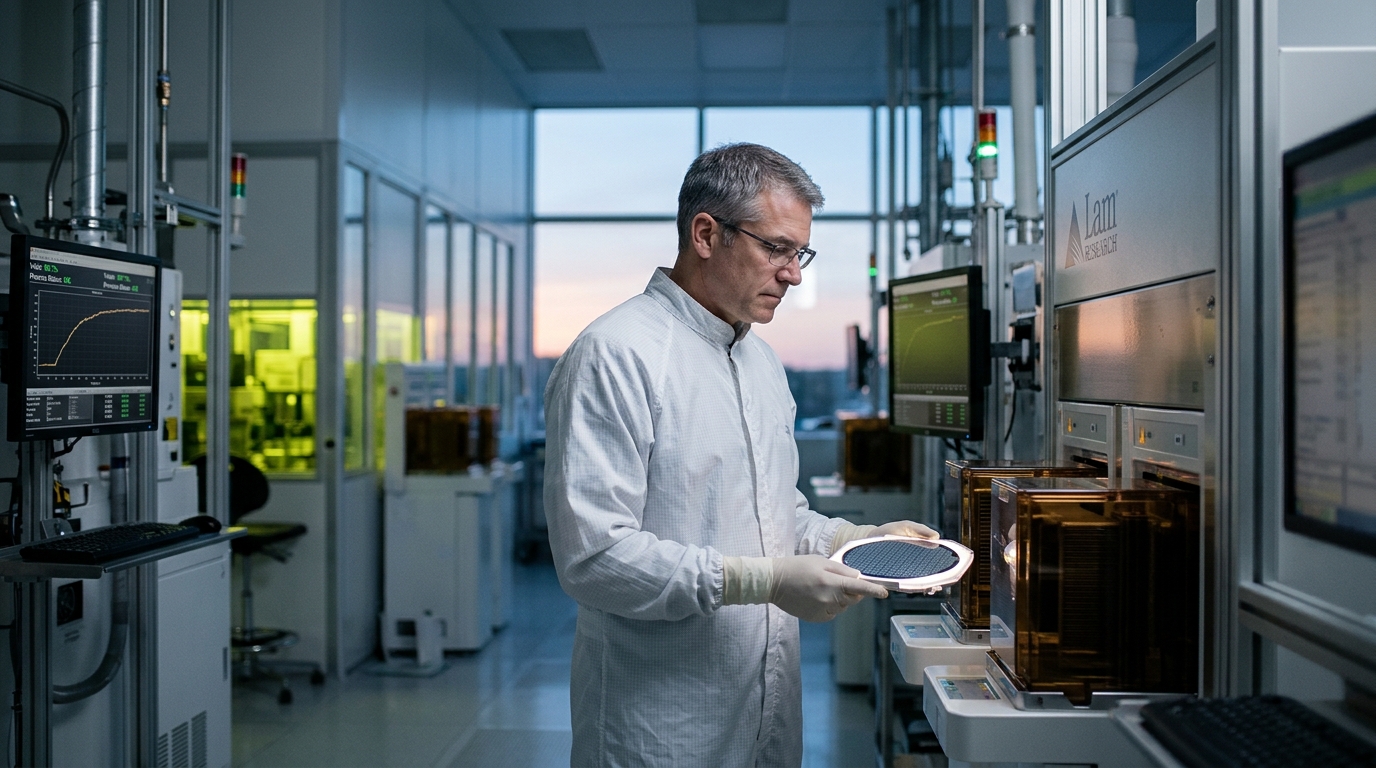
The numbers Lam Research put on the table Wednesday afternoon were, by any conventional measure, extraordinary. Revenue rose 54% year over year to $8.22 billion, non-GAAP gross margin hit a record 52.4%, and non-GAAP operating margin reached 40.2%, the first time it has cleared 40%. December-quarter guidance called for $8.6 billion in revenue (plus or minus $400 million) and non-GAAP EPS of $2.33 (plus or minus $0.15), both slightly ahead of where the street sat. The stock fell about 6% in extended trading and carried Asian semiconductor names lower overnight.
So what, exactly, did the market want?
The honest answer is that the market wanted something Lam couldn’t provide: a meaningful surprise. The beat was real but thin. Non-GAAP EPS of $2.20 topped the $2.18 consensus, and revenue beat the $8.13 billion estimate by about 1%. Lam has beaten estimates in each of the last four quarters, and the June quarter’s EPS surprise was 8.33%. A 1% beat looks like deceleration against that pattern. When momentum is the reason investors own a stock, a slowing beat is functionally a miss.
The Crowded Equipment Trade
This is not the first time Lam has sold off on good news in 2026. As recently as October 13, Applied Materials sank 7% and Lam fell 4% as investors locked in profits after year-to-date gains of roughly 80% and 74%, respectively. The equipment selloff dwarfed the broader chip market, with the SOXX ETF down about 1%, signaling targeted fabrication-budget fears. A stock that has already embedded a strong cycle in its price needs acceleration, not strength.
Lam stock peaked near 57 times forward earnings in July. It now trades at about 27.5 times, less than half that level. The market stopped paying a perfection premium months ago.
The guide itself carried its own friction. On the earnings call, CFO Doug Bettinger said supply-chain constraints for certain components are still limiting how quickly chipmakers and equipment companies can meet end demand. CEO Tim Archer noted that constraints for certain components remain a near-term risk to the timing of deliveries and revenue. For a position sized around a beat-and-raise cycle, a guide that reads as constrained by parts rather than demand is an uncomfortable detail.
What the $200 Billion WFE Forecast Actually Means
Lam’s management was not bashful about the longer arc. The company estimated wafer fabrication equipment spending in the mid-$150 billion range for calendar 2026 and issued a preliminary expectation for more than $200 billion in 2027. That 2027 outlook expects growth led by DRAM, followed by leading-edge foundry logic and NAND. The structural case is intact. The debate is entirely about what is already in the stock.
Lam has strong upside leverage but is more sensitive to HBM, DRAM, and NAND cycles than its equipment peers. That concentration cuts both ways. If memory capital spending continues to move higher, Lam may look cheap at current levels. But if HBM supply-demand conditions move toward balance, or DRAM and NAND pricing weakens, the valuation discount could widen quickly.
Stocks to Watch
LRCX is the clearest read on whether this selloff is a valuation flush or a cycle signal. Non-GAAP operating margin hit a record 40.2% in the September quarter, above the 39.7% analysts expected. Operations are not the problem. The question is how much of 2027’s WFE growth the stock needs to price in before it finds a floor.
AMAT reports next and carries more balanced exposure across logic, advanced packaging, and memory, which may insulate it from the memory-cycle anxiety weighing on Lam. Applied Materials has said it expects leading-edge foundry logic, DRAM, and advanced packaging to account for more than 80% of the year-over-year growth in total WFE spending in 2026, with a similar profile in 2027.
KLAC is the most defensible position in the equipment group. KLA’s inspection revenue is the most recurring and least cyclical in the equipment stack. Chips can be made with different deposition or etch tools, but they all need inspection. If institutional investors continue rotating within the equipment sector rather than out of it entirely, KLA is where the quality premium holds longest.
TSM is the demand anchor for everything above. Taiwan Semiconductor’s quarterly capex commentary will either validate or complicate Lam’s $200 billion WFE forecast. If TSM trims its 2027 spending view, every equipment multiple comes back under pressure, regardless of how well individual names executed on the quarter they just reported.