


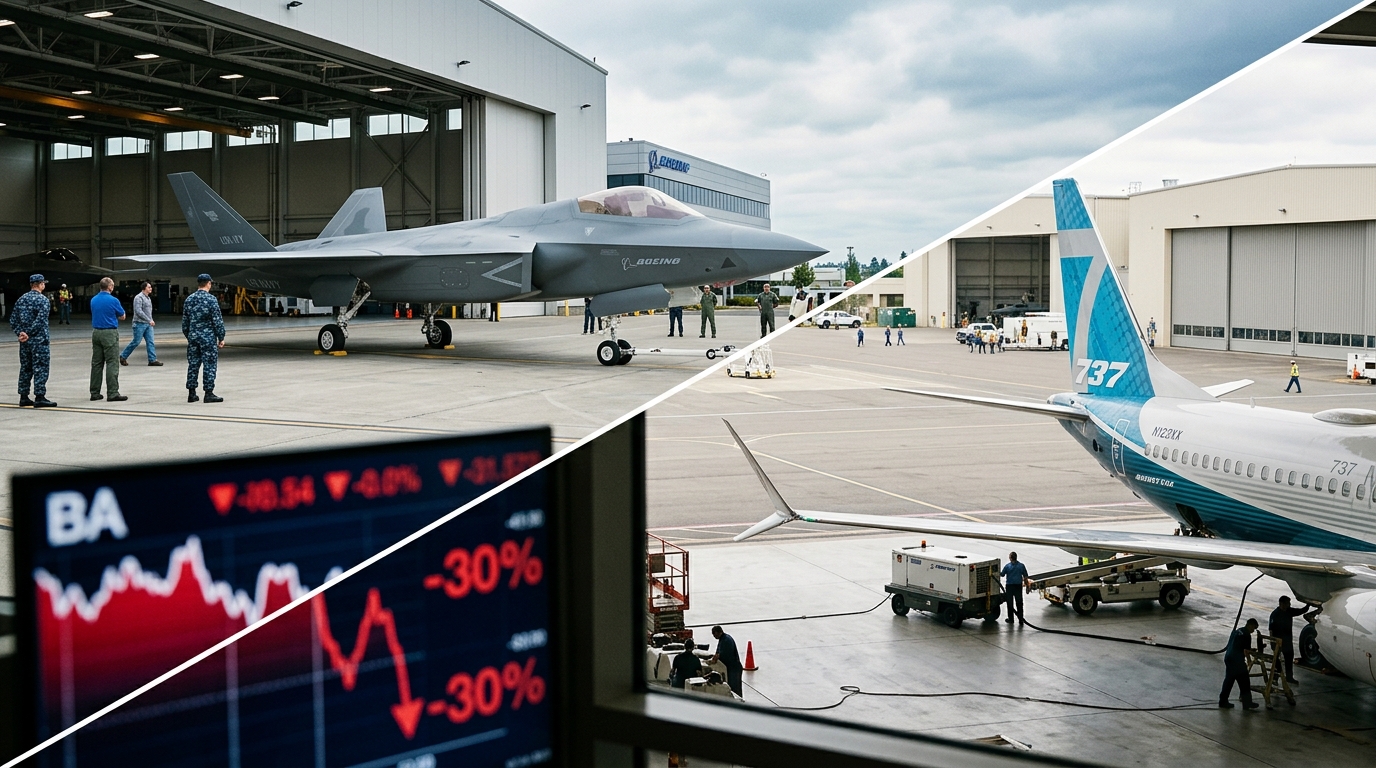
Boeing closed Wednesday at $192.28, roughly 30% below its 52-week high of $254.35. In the same week it secured the most strategically significant defense contract of the decade, the stock was nursing a nearly 7% selloff triggered by a software glitch in a commercial jet. That disconnect is the investment question worth sitting with.
On September 29, the Navy announced that Boeing had won the F/A-XX competition against Northrop Grumman, with a full-scale development contract valued at more than $20 billion. The F/A-XX will initially augment and eventually replace legacy combat aircraft such as the F/A-18E/F Super Hornet and the EA-18G Growler, starting in the 2030s. The deal gives Boeing its second sixth-generation fighter program, following its selection for the Air Force’s F-47 in March 2025.
No other American defense company has ever simultaneously held both legs of a country’s sixth-generation fighter architecture. Northrop Grumman, which lost the F/A-XX competition, and Lockheed Martin, which lost the F-47 race in 2025, are now watching Boeing consolidate the two longest-duration, highest-value weapons franchises in U.S. aviation history.
What the Defense Win Actually Means
The contract pays for development and multiple test aircraft for ground, airworthiness, systems and weapons integration testing, but does not cover series production, and the Navy has not said how many F/A-XX fighters it plans to buy. That matters: the production tail is where the real money lives. Boeing’s St. Louis facility is expected to be the main production hub for the F/A-XX as its 1.1 million square foot expansion moves through its multi-phase build-out.
In the second quarter of 2026, Boeing’s Defense, Space and Security segment revenues increased 13% year over year to $7.5 billion, and BDS ended the quarter with approximately $85 billion of backlog. The F/A-XX contract pushes that backlog higher, locking in revenue visibility that most commercial aerospace peers cannot match.
Why the Market Is Ignoring It
On September 28, FAA Administrator Bryan Bedford said the agency would hold off on certifying the 737 MAX 10 while it evaluates a newly disclosed software issue in the jet’s flight management system. Boeing shares fell about 6.9% that day.
The timing could not have been worse for investor perception. The delay came less than two weeks after Boeing CEO Kelly Ortberg said MAX 10 certification was expected “very soon,” speaking at the Morgan Stanley Laguna Conference on September 16 and noting the program was focused on completing final certification documentation. The issue involves versions 14 and 14.1 of the flight management computer software; under a specific sequence of events following a missed approach, the aircraft’s vertical navigation mode can disengage.
The setback disrupts Boeing’s timeline for delivering the MAX 10, a key variant designed to compete with Airbus’s A321neo, and could affect near-term cash flow and customer commitments while intensifying scrutiny on the company’s ongoing production recovery.
The Risks
The FAA has said MAX 10 certification will be delayed while it reviews the issue, without offering a new target date. Alaska Airlines has said it expects its first 737-10 delivery in spring 2027 and plans to take 22 of the jets in 2027. Slippage on that schedule compounds cash flow pressure at a company still posting negative free cash flow. The defense contracts are long-duration and milestone-gated. Commercial cash is what funds the bridge.
What Investors Should Watch
Two things will determine whether the defense premium eventually flows through to the stock. First, the pace of the FAA’s review of the MAX 10 software issue. Bedford said a fix might come relatively quickly, but could take days, weeks, or months, and the agency will convene a Corrective Action Review Board to decide whether the software poses an unreasonable safety risk. Second, the trajectory of Boeing’s free cash flow recovery. In Q1 2026, Boeing recorded revenue of $22.2 billion but operating cash flow of negative $0.2 billion and free cash flow of negative $1.5 billion.
Bottom Line
Twenty-seven analysts rate BA a Strong Buy, with a consensus 12-month price target of $273.50, implying more than 42% upside from the October 1 close of $192.28. The gap between what analysts think Boeing is worth and what the market is paying for it reflects exactly the tension this week crystallized: a defense franchise of historic scale, dragged down by a commercial business still fighting for credibility with regulators. Until the MAX 10 clears the FAA, the defense wins stay in the footnotes.