




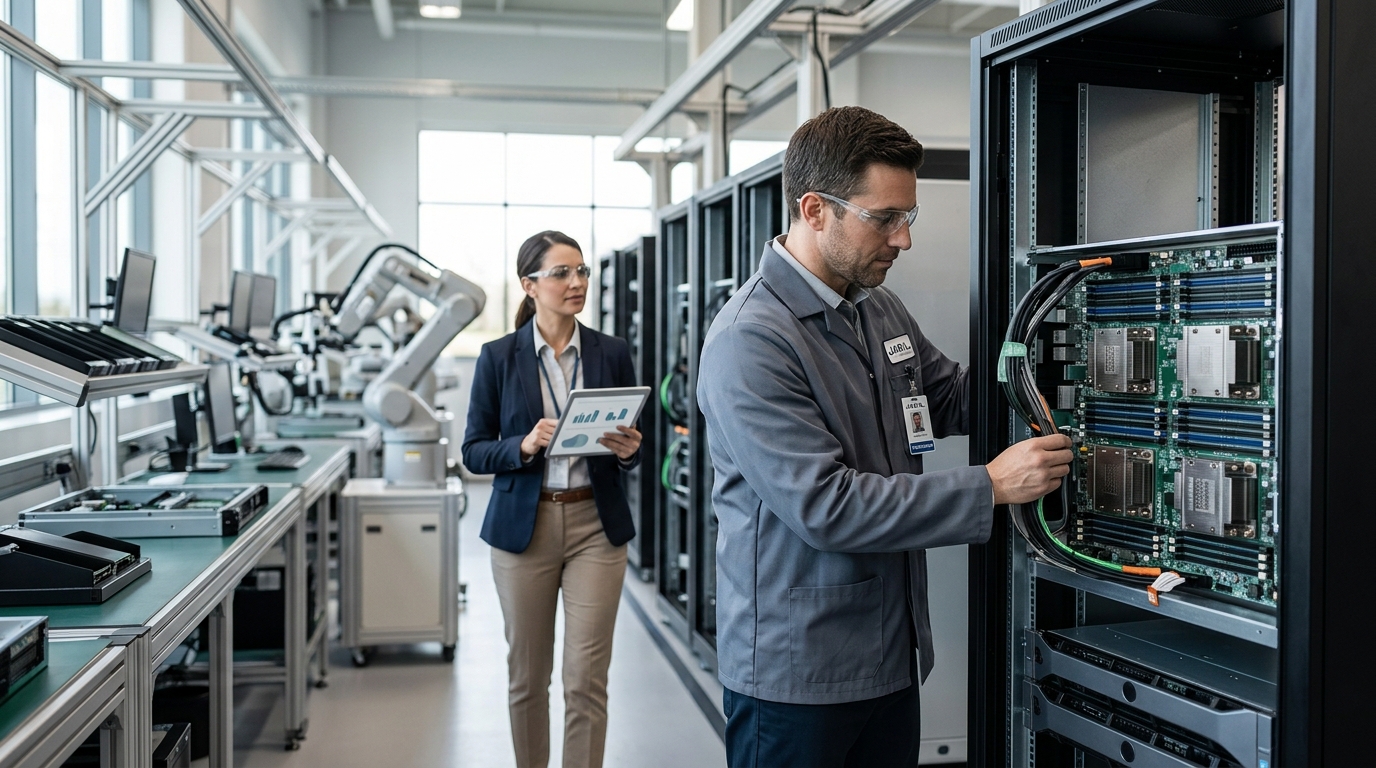
The market sold Jabil off about 7% Wednesday morning. That reaction deserves scrutiny, because what the company actually reported was one of the cleanest beats in the AI infrastructure trade this quarter.
Why This Stock Now
Jabil reported core earnings of $4.40 a share on revenue of $10.6 billion, topping Wall Street’s forecasts of $4.06 a share and $9.69 billion in sales. Revenue landed about $1.0 billion above the midpoint of the company’s June outlook. That is not a narrow beat. It is a signal that demand is running faster than even management expected three months ago, and the Q1 fiscal 2027 guidance range of $10.6 billion to $11.4 billion says the momentum is not slowing.
The Business
Jabil’s teams supported significant growth in AI infrastructure, delivered strong performance across several other end markets, and brought critical new capacity online, all while maintaining an asset-light model. The company builds the physical infrastructure that hyperscalers need: compute assemblies, power systems, liquid cooling, high-speed interconnects. It is not a component maker. As CEO Mike Dastoor put it, “We are not a contract manufacturer competing with low-cost EMS companies, nor are we a product company competing with our customers. We build a diverse set of capabilities and deploy them in whatever combination the customer needs.”
Why Wall Street Is Paying Attention
Intelligent Infrastructure revenue jumped 56% to about $5.8 billion, roughly $900 million above Jabil’s June outlook. Jabil ended fiscal 2026 with four customers generating more than $1 billion each in annual AI-related revenue. The forward picture is larger still. For fiscal 2027, Jabil expects Intelligent Infrastructure revenue of approximately $25.6 billion, up 43%, with AI-related revenue of about $22.1 billion, up 54%, and five customers expected to generate more than $1 billion of AI-related revenue.
The company expects robust growth in fiscal 2027, with total revenue projected at $44.5 billion, up 24%, and core EPS of $17.55, up 34%, fueled by AI infrastructure demand and diversification. That $17.55 core EPS figure came in above the analyst consensus, which Reuters cited at $16.87. At Wednesday’s post-selloff price near $297, the stock trades at roughly 17 times those forward earnings. That is a meaningful discount to peers. Recent data shows Flex and Celestica both trading at higher valuations than most investors would associate with old-school electronics manufacturing services, and Jabil’s multiple still looks restrained by comparison. On a forward basis the gap widens further.
What’s Driving the Opportunity
Jabil’s fiscal 2027 revenue forecast of $44.5 billion, up 24%, came in above the Street, and core EPS guidance of $17.55 also exceeded consensus. Management strongly asserts the asset-light model is intact, with capital expenditure expected near 1.5% to 2% of revenue and no immediate need to raise additional funds. Capacity investments planned for fiscal 2027 could also support further growth in fiscal 2028. The demand pipeline is not a single-year event.
What Could Go Wrong
Jabil warned that memory availability is becoming a growing supply-chain constraint as capacity shifts toward AI and hyperscale customers, with management describing “real constraints” in memory and tightening supply across several end markets. Execution challenges, ramping costs causing back-end loaded margins, potential component constraints in memory and working capital, and higher-than-target inventory days are noted as primary margin risks. The selloff Wednesday also suggests investors are skeptical about whether 6%-plus core operating margins can arrive on schedule, or whether rack ramp costs will push them further out.
The Bottom Line
Jabil beat by roughly $910 million on revenue and delivered EPS about 8% above consensus. Its fiscal 2027 guidance for about $22.1 billion in AI-related revenue is a number that would be headline news if Nvidia or Micron said it. Instead, the stock fell because investors focused on what might go wrong rather than on what already has. According to data compiled by S&P Global and surfaced by StockAnalysis, 10 analysts rate JBL “Strong Buy” with an average 12-month price target of about $427. The memory constraints are real. So is the demand. And at about 17 times forward earnings, Jabil is pricing in very little credit for either.