



October 2, 2026
That’s not nostalgia. It’s the most honest thing any hyperscaler has said about the AI power crunch.
The most telling detail in the Amazon-Constellation deal announced September 30, 2026 is not the size of the contract. It is the nature of the asset being purchased.
Rickards: “Trump’s Gold Mine” to Deliver 10X Gains In a Few Months
According to Jim Rickards – the world’s #1 gold expert and a man with close ties to Donald Trump’s “inner circle”…
The president is about to unleash a major new gold initiative…
One that opens up the largest gold deposit in the entire world – right here on U.S. soil…
And that is valued at over $1 TRILLION.
Today, Jim has revealed one of his favorite ways to play this gold boom – 100% FREE.
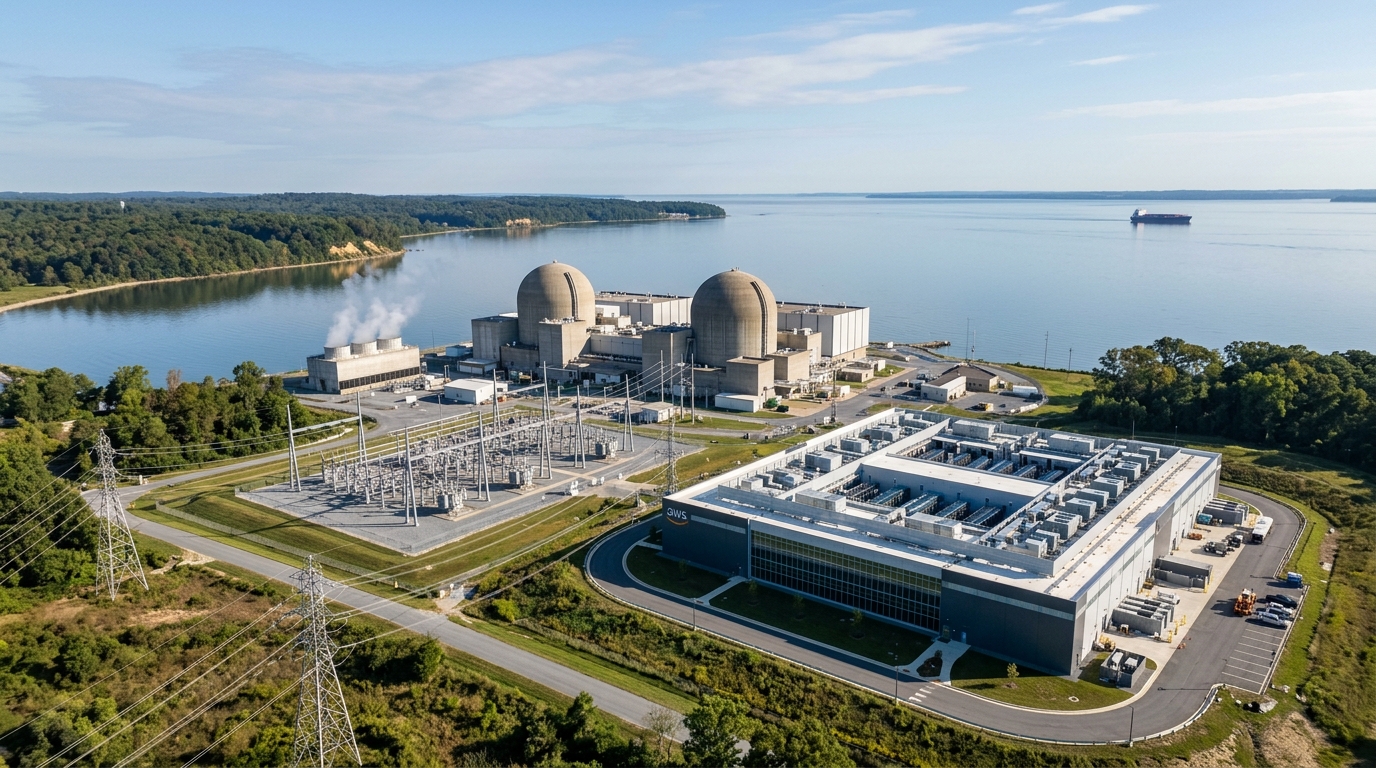
A 20-year power purchase agreement signed by Amazon will enable Constellation to add 190 MW of capacity and support continued investment in and expansion of the Calvert Cliffs Clean Energy Center in Maryland.
The agreement is expected to support more than $3 billion in Maryland infrastructure investment, including improvements across the 1,790-megawatt plant and approximately 190 megawatts in total of new, emissions-free generating capacity coming online between 2030 and 2032.
None of that power is coming from a new reactor. Calvert Cliffs began commercial operation in 1975 (Unit 1) and 1977 (Unit 2). Amazon is essentially paying to keep a half-century-old plant running, uprate it, and pursue another 20 years of licensed operation. If subsequent license renewal were approved, that could keep the reactors operating into the 2050s.
That is the investment thesis hiding inside this agreement: the scarcest asset in American energy is not megawatts that might arrive from a new-build nuclear project in 2035 or beyond. It is firm, carbon-free generation that already exists and can be contracted today.
Why This Business Matters
Calvert Cliffs is Maryland’s only nuclear power plant. Constellation says the facility produces approximately 80% of Maryland’s clean energy, and other Maryland energy analyses have put nuclear at about 40% of Maryland’s in-state electricity generation. Replacing that output with wind or solar is not a straightforward substitution: neither delivers power on demand at 3 a.m. when a data center’s GPU cluster is running flat out. Nuclear does.
“What’s happening in NYC will spread…”
Last year I ran for Mayor of New York City… and lost to a 34-year-old Democratic Socialist. Now he wants to spend $70 million just to study government-run grocery stores. Raise property taxes 9.5%. And hike taxes on every corporation and high earner. I’ve spent 30 years on Wall Street. And I’m convinced what’s starting in New York is just the beginning. I’ve put together a free analysis explaining exactly what’s coming, and what you can do about it.
Unlike controversial behind-the-meter co-location models that physically bypass the grid, Constellation said the Amazon agreement is structured as a front-of-the-meter transaction. All electricity generated by the Calvert Cliffs facility will continue flowing directly to the regional PJM grid.
Amazon then receives that power through a related retail supply agreement across the 13-state PJM market. The grid stays whole. The hyperscaler gets its clean electrons.
The Mogul Mindset
A disciplined long-term investor examining this deal would notice that Amazon did not go looking for a startup reactor developer or a promising SMR concept. It went to a plant that has been running reliably for five decades and offered to pay for its continuation. That is the behavior of a buyer who has concluded that reliable baseload power is genuinely scarce, not merely expensive.
Uprate projects are generally categorized by the amount of capacity increase they involve. Constellation has described the Calvert Cliffs plan as an uprate that would require significant balance-of-plant equipment work. That is serious capital commitment, and Amazon is funding it with a 20-year revenue guarantee.
For Constellation, the business logic compounds. The company said Amazon’s long-term commitment helps provide the revenue certainty needed to pursue an additional 20 years of licensed operation and make progress toward the development of new clean energy power plants at the site. The companies also said they will jointly explore on-site development of small modular reactors.
5 Nasdaq Stocks Under $5 That Aren’t What You Think
Most stocks under $5 come with a reputation. These don’t.
Each company on this list is tied to major trends like AI, cybersecurity, and next-gen infrastructure.
They may not have the spotlight yet, but they are building real businesses in real markets. That combination is not always easy to find at this price level.
The PPA is therefore not just a power contract. It is a platform option on the entire future of the site.
What Could Go Wrong
Regulatory timelines on both major power uprates and subsequent license renewal are long and uncertain. Any delay compresses the window between contract execution and licensed operating life. Construction cost overruns on the uprate work are also a real risk on a project of this complexity.
And the broader trend cuts both ways. If hyperscalers collectively bid up the value of existing nuclear plants, the owners of those plants gain enormous pricing power. That is good for Constellation shareholders but raises the question of what Amazon pays for electrons in decade two of this agreement relative to alternatives that may exist by then.
The Long-Term Verdict
The Calvert Cliffs deal is a pricing signal, not just a power contract. It confirms that large technology companies have concluded that firm, dispatchable, clean generation is worth paying a 20-year premium to secure. Existing nuclear plants sit at the intersection of every trend driving that conclusion: AI power demand, decarbonization mandates, and the simple physics of round-the-clock load. Constellation owns the largest portfolio of operating nuclear plants in the United States. The scarce asset is already on its balance sheet.