


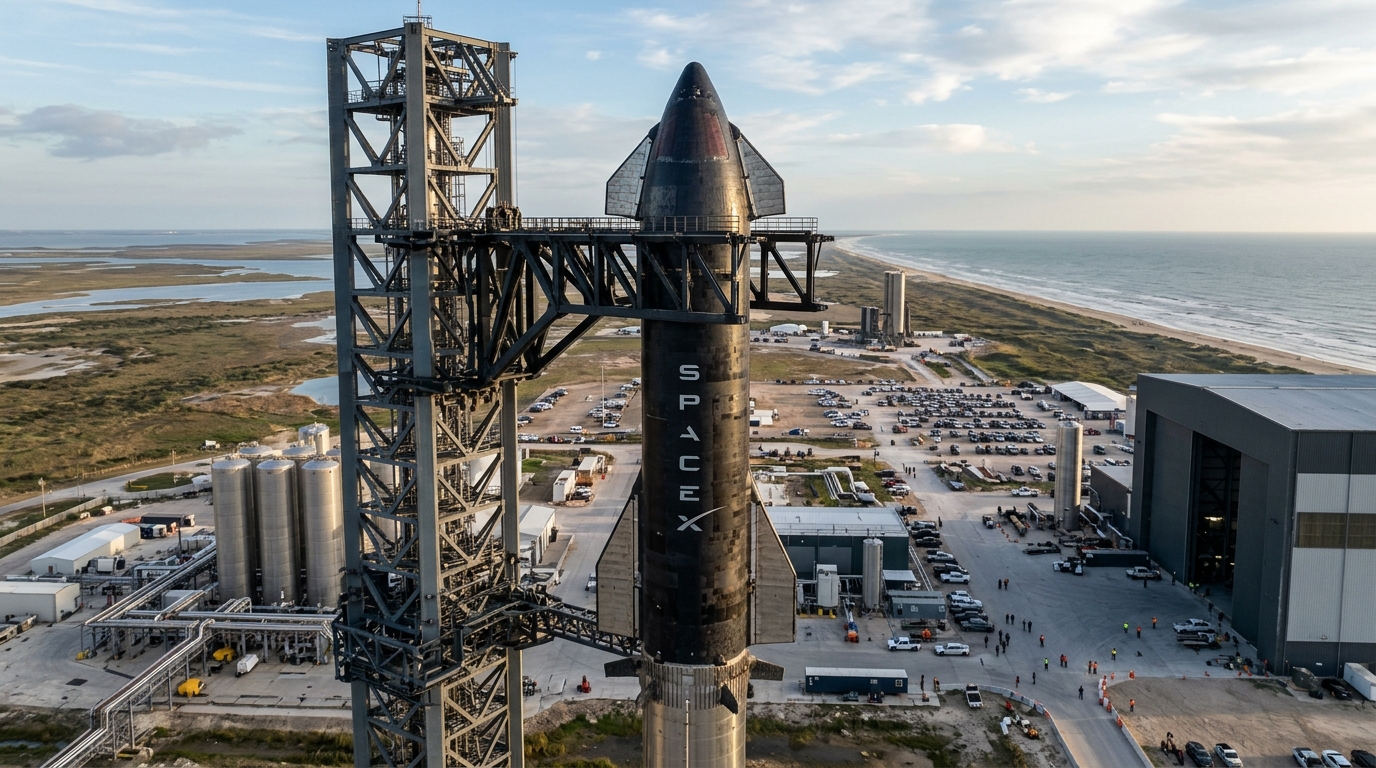
On the afternoon of November 14, SpaceX’s Starship Ship 42 descended from orbit and was caught mid-air by the mechanical arms of its own launch tower at Starbase, Texas. The spacecraft had reached low Earth orbit, deployed 26 Starlink V3 satellites, and remained aloft for more than 22 hours before returning to be caught by the tower at Pad 2, the first recovery of a Starship upper stage from orbit. Twenty-four hours later, a Vulcan VC6L lifted off from Cape Canaveral’s SLC-41 and failed to reach orbit. The Vulcan, carrying 40 Amazon Leo internet satellites, suffered an anomaly during the climb to space, dooming its payload and throwing a costly wrench into the launch schedules of both companies.
The juxtaposition was not subtle. SpaceX is now catching orbital spacecraft with robot arms. ULA, the Boeing-Lockheed joint venture that was once the unquestioned backbone of American launch capability, just recorded its first outright failure since the company was formed in 2006. ULA has said the vehicle suffered an anomaly about 10 minutes into the flight and failed to deliver the Amazon mission to orbit. The root cause is not yet known. Vulcan now faces a potentially significant pause while engineers review telemetry and implement fixes.
What makes this sting for Amazon is the arithmetic. Before Sunday’s failure, Amazon Leo had launched 396 satellites, with counts of active satellites in orbit reported in the low 390s. The failed mission would have added 40 more. Amazon is still required to deploy all 3,232 of its planned Gen 1 satellites by July 30, 2029. From the end of November to that deadline there are about 32 months remaining, in which Amazon would need to put roughly 2,836 additional satellites into orbit, or about 89 per month. That math was already strained before Sunday. It is worse now.
Sunday’s mission was the first of 38 planned Vulcan launches for Amazon, and the remaining flights now face uncertainty pending the investigation. It was only the fifth Vulcan flight overall, and the first in nine months. That prior pause took the better part of a year. A second one, following a full mission loss, could last longer.
Amazon does have other launch vehicles contracted. In 2022, Amazon said it had secured up to 83 launches across Arianespace, Blue Origin, and ULA. It has also booked three launches aboard SpaceX’s Falcon 9. But New Glenn has yet to fly an Amazon Leo mission, and Ariane 6 cannot bridge a gap of this magnitude alone.
The gap between Amazon’s contracted launch capacity and its deployment math points to a broader reshaping of the commercial launch market. Rocket Lab’s shift toward satellite manufacturing revenue suggests smaller launch providers are repositioning around the same constellation build-out pressure.
The investor question here is not whether Amazon Leo survives Sunday’s failure. It will. The question is whether it can still hit the July 2029 deadline at a scale that matters commercially, and whether a Vulcan pause forces Amazon into a renegotiation with the FCC that dilutes the competitive threat to Starlink. SpaceX’s constellation already includes about 11,000 satellites in low Earth orbit. Amazon is at roughly 400. That is not a gap that closes on a delayed schedule.
The infrastructure gap between the two constellations is not just a satellite count. SpaceX’s vertical-integration strategy is designed to make its launch cost structure permanently unreachable by any competitor operating on a conventional timeline.
For Boeing and Lockheed Martin shareholders, the failure compounds an already difficult period for ULA. The joint venture was formed partly to stabilize American access to space, and Vulcan was supposed to represent its next generation of that promise. A first total loss on a commercially critical mission is not the kind of event either parent company absorbs without scrutiny. The investigation will determine whether this was a manufacturing defect, a design flaw, or an integration error. Each answer carries a different recovery timeline, and Amazon’s 2029 clock does not stop for any of them.