



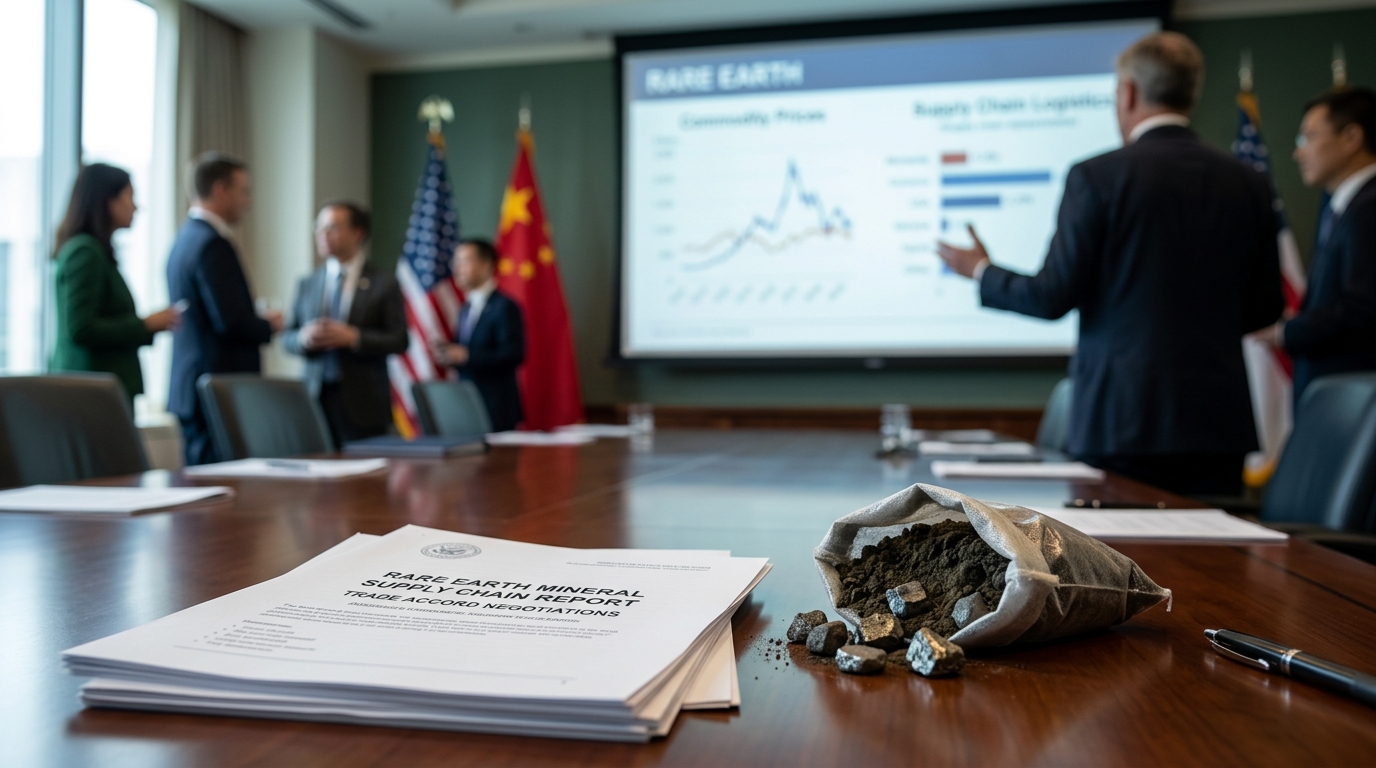
Two days before Xi Jinping lands in Washington, the question professional investors should be asking is not whether Trump and Xi will shake hands on Thursday. They will. The question is whether the handshake means anything for the rare earth controls that are strangling supply chains from Detroit to Tokyo.
US Trade Representative Jamieson Greer blamed China on Monday for creating “uncertainty” over the truce extension, saying Beijing was still holding back on rare earth and other critical-mineral exports to the United States. Greer indicated the two sides remain divided on terms, suggesting three to six months as a range Washington could support. That gap on duration is the visible dispute. The structural one runs deeper.
What the Japan Ban Reveals
On January 6, 2026, China announced new export restrictions aimed at Japan on dual-use technologies, including rare earth elements, permanent magnets, and other critical minerals. China has doubled down on those restrictions despite reports that the US asked Beijing to lift them. Beijing’s refusal to budge even under direct American pressure is the clearest signal of how much coercive leverage it intends to retain heading into Thursday’s talks.
Japan remains heavily reliant on Chinese rare earth supply, but the scale matters: CSIS estimates China supplied 63% of Japan’s rare earth metal imports in 2024, not 80%. Separately, USGS data indicates China supplied 76% of Japan’s imports of rare-earth compounds, based on Japanese government figures. The January 2026 controls elevated supply risk for Japan’s EV and renewable energy manufacturers, reinforcing rare earths as a critical geopolitical vulnerability rather than a purely commercial input. A country Beijing is willing to target directly, on a product the US has explicitly asked it to restore, is not a country signaling it views the truce as mutual.
Has the Market Priced a Deal?
The short answer is: partially, and selectively. MP Materials fell 5% and USAR dropped 4% on earlier summit optimism, as hopes for a thaw eroded the scarcity premium driving domestic rare earth valuations, with the sector’s ETF sinking 5% versus a 0.5% dip in broader markets. But Greer’s remarks this morning reintroduce the possibility that no extension gets signed before Xi boards his plane home. That is not priced.
China’s one-year suspension of expanded rare earth export controls, announced in October 2025, is due to expire on November 10, 2026, giving Beijing significant leverage as the two sides negotiate a truce extension. That November 10 deadline is the real forcing function, and the seven weeks between Thursday’s dinner and that expiration are not long enough to build alternative supply at scale.
What Investors Are Missing
The summit agenda is wider than rare earths. Bessent and He Lifeng concluded talks in New York with the US side proposing a new AI safety notification mechanism, covering AI-related incidents that rise to a national security level. Fentanyl precursors are also on the table. The proliferation of agenda items is actually bearish for resolution on minerals: the more each side has to trade, the more each item becomes a chip to be held rather than conceded.
The overlooked implication sits inside the automaker supply chain. China’s restrictions could affect GM, which has partnered with MP Materials to develop a domestic supply chain for rare earth magnets, with MP building magnet manufacturing facilities in Fort Worth, Texas that are intended to supply GM electric vehicles. Ford had to temporarily idle plants in late June 2025 due to a shortage of magnet supplies tied to China-related export disruptions. A truce extension that leaves the licensing regime intact solves nothing for the next procurement cycle.
Stocks to Watch
- MP Materials (MP): MP operates Mountain Pass and its Independence magnet facility in Fort Worth, and delivered Q2 2026 revenue of $108.5 million, up 89% year over year. A durable truce compresses the scarcity premium; a failed extension is a direct catalyst.
- Lynas Rare Earths (LYSCF): The Pentagon signed a binding letter of intent to source supplies from Lynas, one of the few producers outside China to separate heavy rare earth products. Global appetite for dysprosium and terbium runs into thousands of tons annually; Lynas is ramping heavy rare earth capability, but output remains small relative to global demand. The gap between what it supplies and what the world needs is the investment case.
- Nvidia (NVDA): Nvidia guided for $108 billion in fiscal third-quarter revenue, with a notable caveat: the company assumes no data center compute revenue from China in that outlook. CEO Jensen Huang is scheduled to attend Trump’s state dinner for Xi on Thursday. Any softening of chip export controls is upside not in the number.
- Ford (F) and GM: Both carry unresolved magnet procurement exposure. The auto industry faces a magnet supply chokepoint, not a mining shortage. A summit that produces a handshake but leaves the licensing regime intact offers these companies no near-term relief.
The investment committee question for Thursday is not whether the leaders smile for cameras. It is whether Beijing allows the rare earth licensing machine to keep running as a tool of coercion while collecting the diplomatic credit for showing up. History since January suggests yes.