




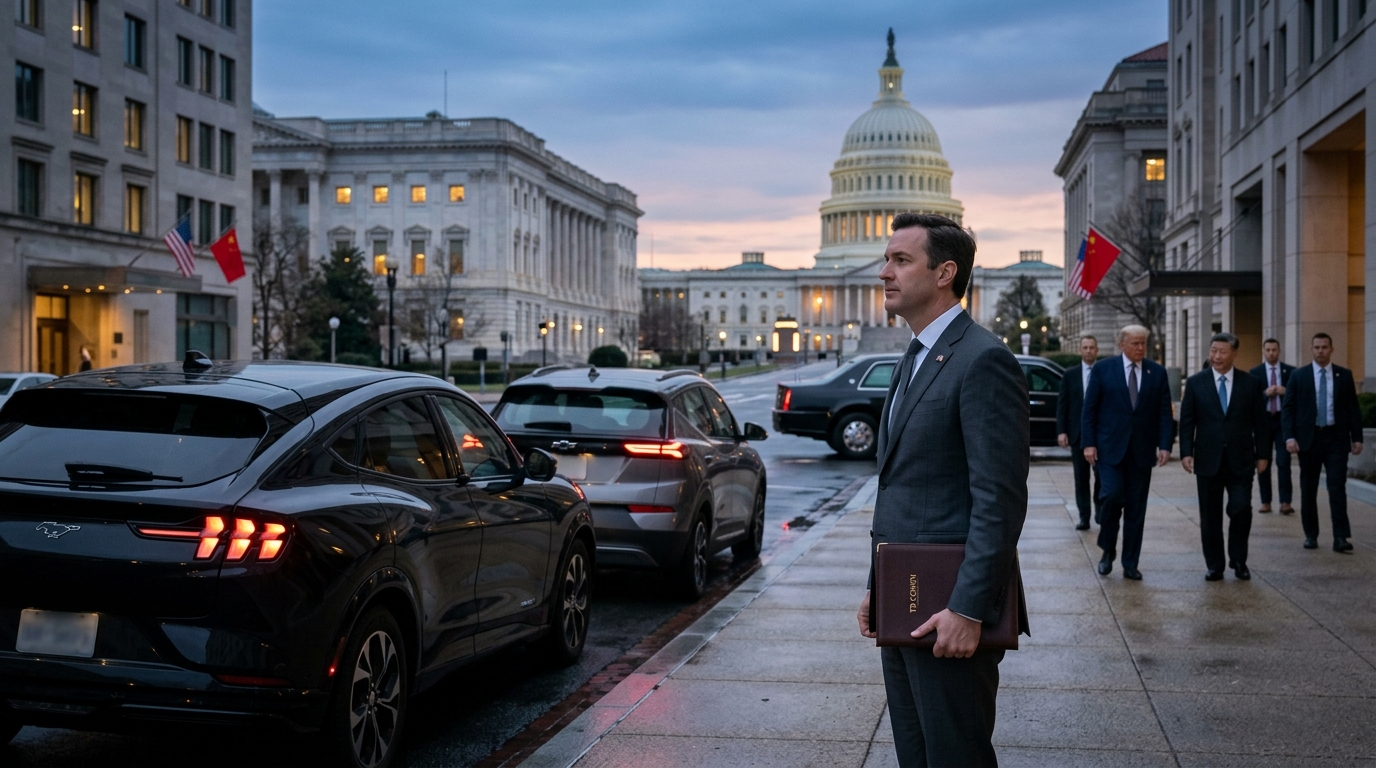
With Xi Jinping arriving in Washington on September 24 for a summit with President Trump, auto stocks have spent the past week absorbing a worst-case scenario that TD Cowen analyst Itay Michaeli says the market has no real basis to price yet. His call, issued to clients Tuesday: the recent selloff in auto stocks on Chinese-entry fears is “overdone.”
The fear has a concrete origin. Last week, Trump told Fox News he would accept Chinese car companies building cars in the United States. That comment landed in a market already on edge after Canada opened its doors. Canadian Prime Minister Mark Carney agreed to allow up to 49,000 Chinese EVs per year into the Canadian market under a January 16, 2026 arrangement with China. Investors drew a straight line from Ottawa to Detroit.
The line is shakier than it looks.
Cars are unlikely to be the main event at the summit. TD Cowen advised clients that a shift in US import policy at the meeting is “very unlikely,” even as it urged investors to prepare for the eventuality anyway. The structural barriers in place are substantial. A Commerce Department rule finalized under the Biden administration in January 2025 restricts connected-vehicle software and hardware tied to China or Russia, and it is designed to block connected vehicles from China-linked manufacturers from being sold in the US starting with later model years. On top of that, US Section 301 tariffs on imported Chinese EVs are set at 100%, piled on top of other applicable duties.
What TD Cowen’s Scenario Map Actually Says
The big question, in Michaeli’s framing, is how China’s entry would be structured. The firm laid out likely guardrails: Chinese automakers could be forced through minority-owned joint ventures with domestic players, and would probably be barred from building full-size trucks, the products that generate the vast majority of Big Three North American profits.
That second point is the one traders should hold onto. F-Series and Silverado margins are not on the table in any scenario that involves BYD or Chery entering through a politically palatable joint-venture structure. The doomsday read assumes unrestricted access. That is not what any credible scenario produces.
TD Cowen sees outright beneficiaries in EV infrastructure, naming ChargePoint and EVgo as likely winners if Chinese entry accelerates US EV adoption. Parts makers with existing Chinese OEM ties, including BorgWarner and Aptiv, would be “better positioned” than most. For pure-plays like Tesla, Rivian, and Lucid, the math is mixed: more EV demand, but more competition.
The BYD Question
Chinese officials are considering BYD for a possible business delegation joining Xi’s summit with Trump. Senior officials, including Xi’s chief of staff Cai Qi, are reviewing a list of Chinese business figures for the state visit, though the list is not final. The US has imposed 100% tariffs on Chinese EVs, and the Pentagon added BYD to its list of Chinese military companies in June.
BYD’s presence in the room matters symbolically, but it does not change the regulatory math. The Alliance for Automotive Innovation, representing GM, Ford, Stellantis, Toyota, Volkswagen, Honda, and others, has urged House and Senate leadership to enact a permanent ban on the sale, import, and manufacture of Chinese connected vehicles before the 119th Congress concludes. The House’s Connected Vehicle Security Act of 2026 is advancing, but the draft’s specific co-sponsor count should be treated as fluid.
What to Watch After the Summit
- Joint-venture language. Any communiqué referencing localized Chinese auto manufacturing in the US is a negative for Ford and GM, a positive for tier-one suppliers and charging networks.
- Tariff silence. If the 100% EV tariff goes unmentioned, the selloff reverses quickly. Thursday’s summit is a hard catalyst with a binary outcome for the sector.
- Ford’s standalone fundamentals. August US vehicle sales fell to 170,681 units, down 10.3% year over year. The China fear is layered on top of genuine domestic weakness that does not disappear regardless of what Xi and Trump agree to.
Chinese automakers are expected to reach 10 million export vehicles this year. Their European market share has exceeded 11% in some recent monthly snapshots, and China-built vehicles have become a major share of Mexico’s imported-vehicle sales in 2026, with estimates varying by source and definition. The competitive pressure is real and long-dated. Whether this week’s summit accelerates or delays the US chapter of that story is the only question that matters for auto stocks right now, and TD Cowen’s answer is that the market already overshot the answer.