
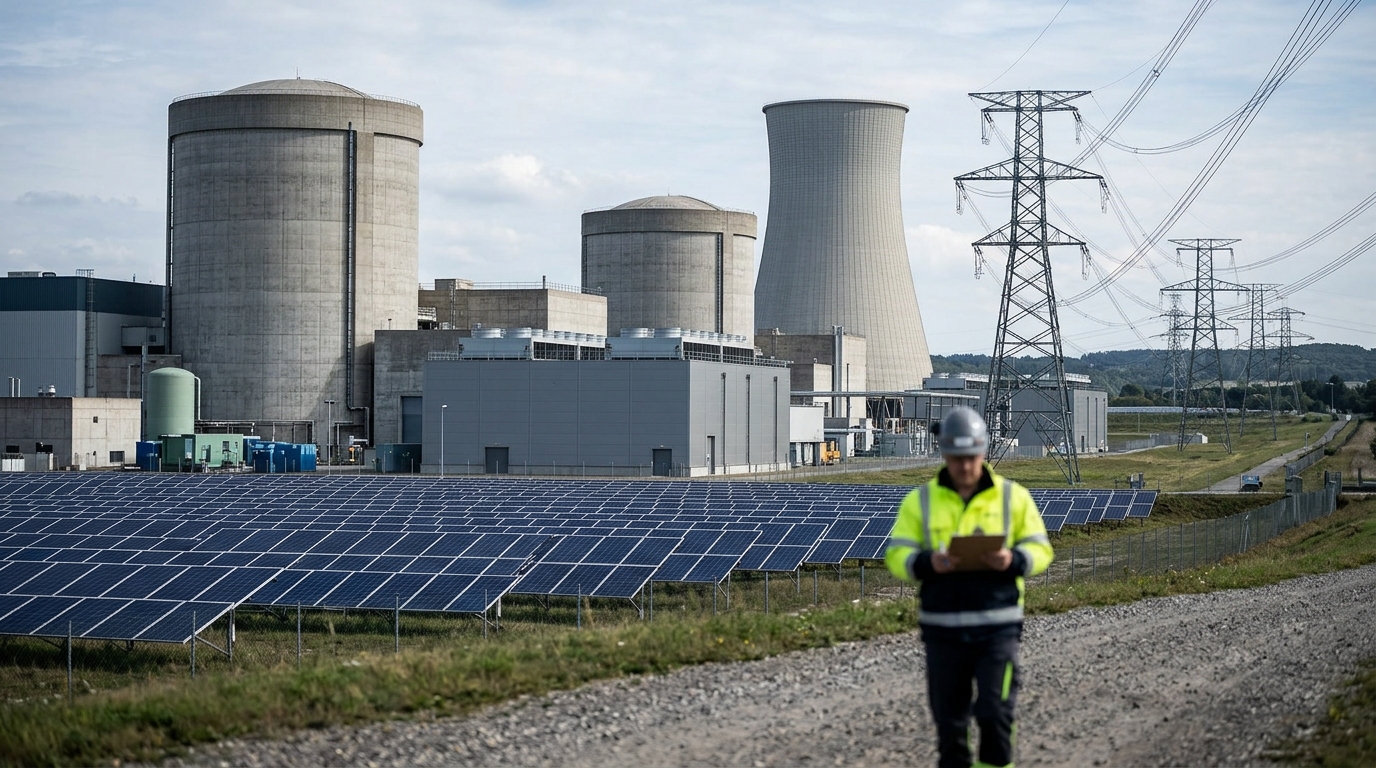
There is a financing model taking shape inside the American power grid, and Constellation Energy’s third-quarter results, reported on November 9, 2026, make its outlines unmistakable. The company is not simply selling electrons to tech companies. It is using long-term purchase commitments from Google and Amazon to fund the physical expansion of the nuclear fleet, locking in revenues for years while adding generation capacity that otherwise would have taken a decade to permit and finance through conventional means.
The numbers from the quarter frame the scale of what is being assembled. Adjusted operating earnings reached $5.06 per share, up from $3.04 per share in the third quarter of 2025. Adjusted operating earnings for the quarter totaled $1,792 million, against $952 million a year earlier. Full-year guidance was raised to $12.50 to $12.80 per share. Revenue came in at $9.55 billion, up 45% year over year. These are not the numbers of a utility grinding out 3% earnings growth. They reflect a business model in structural transition.
The centrepiece is the Google collaboration announced in October 2026. Constellation signed a 20-year power purchase agreement with Google that the companies said would enable more than $4.3 billion in investment across 11 nuclear units in Illinois, Pennsylvania, and New Jersey, adding approximately 890 MW of incremental generation capacity to the PJM grid, with the first uprate expected in 2028. Constellation also entered into a 15-year energy supply agreement with Google for an additional 2,700 MW in PJM. The two layers matter: the uprate agreement is tied to new capacity, while the 2,700 MW structure is designed to support ongoing delivery of energy and capacity into PJM.
What makes this structurally different from a standard power contract is the technology dimension running alongside it. As part of the deal, Constellation said it selected Google Cloud and Gemini Enterprise under an expanded five-year technology alliance to establish an “AI for energy” blueprint that will accelerate capacity delivery, optimize asset dispatch, and protect critical infrastructure. Google is not merely a buyer of power here. It is embedding itself in Constellation’s operational infrastructure, creating the kind of dependency that compounds switching costs over time.
The Amazon agreement, signed in September 2026, adds another layer. That 20-year, 690 MW power purchase agreement supports more than $3 billion in investments at Calvert Cliffs, including approximately 190 MW of additional output expected to come online between 2030 and 2032. Collectively, the Amazon and Google agreements enable more than $7.3 billion in infrastructure investment and add over 1,000 MW of incremental clean generation capacity. To put that in physical terms, the 890 MW from the Google deal alone is comparable to the output of a large new reactor.
Constellation is not the only utility Google has locked into a long-term supply structure. AEP’s 20-year, 702 MW fuel cell agreement with Google raises the question of which utility actually captures more value from hyperscaler demand.
The DOE is underwriting the execution risk. Constellation and the U.S. Department of Energy said in October 2026 that the DOE issued a conditional loan commitment of up to $5 billion to finance nuclear uprates and modernization across Constellation’s nuclear fleet.
The DOE commitment does not exist in a vacuum. PJM’s capacity auctions have cleared at the price ceiling two years running, leaving the grid structurally undersupplied and making Constellation’s contracted megawatts durably scarce.
Investors should weigh two honest risks. Nuclear uprates are complex engineering projects; delays or cost overruns at any of the 11 units would pressure the return on the $4.3 billion the companies described. And the concentration of revenue in a small number of hyperscale counterparties, however creditworthy Google and Amazon are today, is a dependency worth monitoring.
What disciplined long-term investors will find compelling is the earnings visibility being manufactured here. On its November 9, 2026 earnings call, Constellation said year to date it had contracted more than 8,500 megawatts well into the 2040s, enhancing earnings visibility and duration. That is not a utility story. It is a capital-allocation story built on the intersection of two irreversible forces: AI-driven electricity demand and the scarcity of dispatchable, carbon-free baseload power. Constellation owns that intersection in a way competitors will find difficult to replicate quickly.