




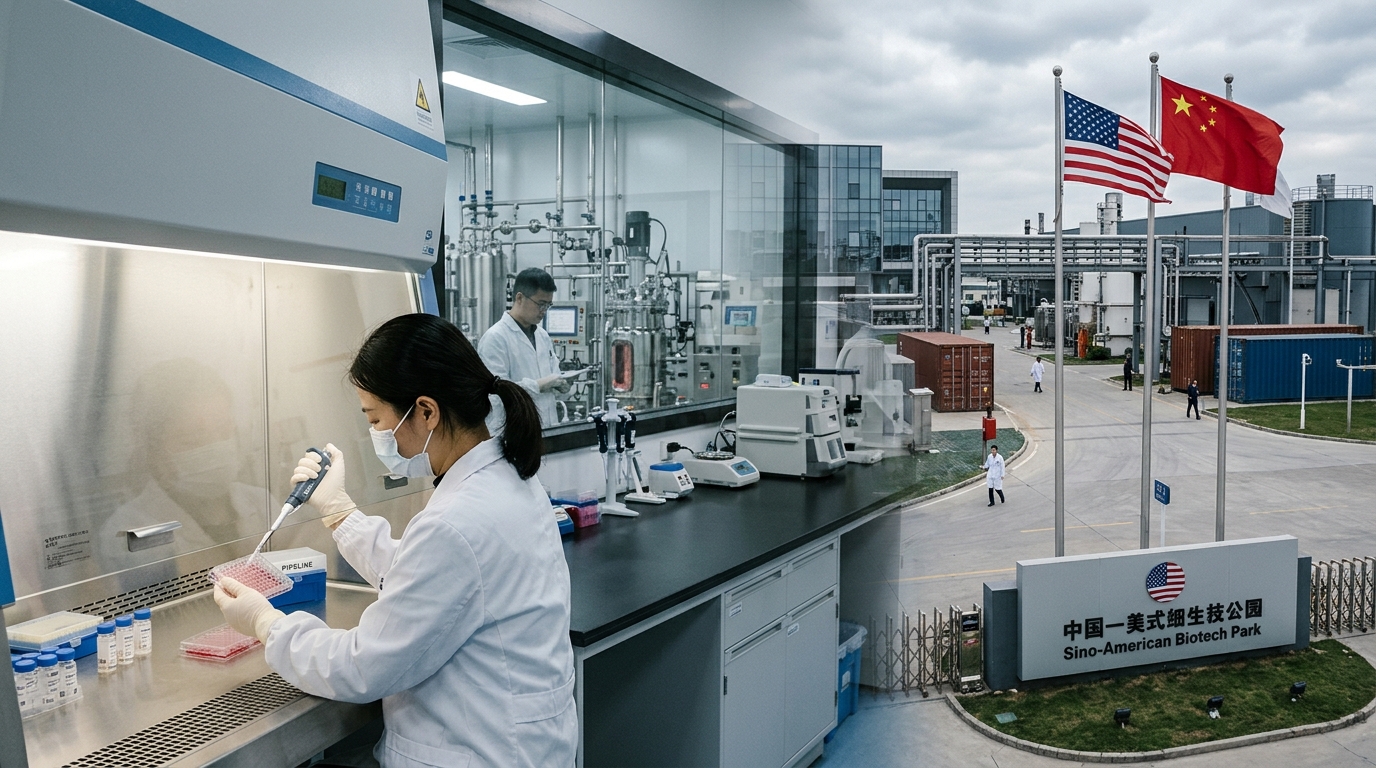
For most of the past decade, the defining question in pharmaceutical dealmaking has been which American or European company wins the race to license the next Chinese drug candidate. Treasury just proposed making that question harder to answer.
The US Treasury Department on Thursday, October 22, 2026, proposed adding biotechnology to a list of sensitive technologies subject to restrictions on American investment in foreign adversaries, citing national security concerns. Draft outbound investment rules would sharply limit US deals for certain Chinese drug and biotech assets and opened a 45-day comment period. The proposal sits inside a broader rulemaking implementing the Comprehensive Outbound Investment National Security (COINS) Act, passed as part of the National Defense Authorization Act for fiscal year 2026. Biotech is the addition that could reshape pharma capital flows.
Why the Stakes Are This High
The Chinese licensing channel has become load-bearing for Western drug pipelines. China has become a dominant source of licensed pipeline assets for Western pharma, with Chinese assets widely tracked as being on course to account for more than two-thirds of total licensing deal value in 2026, compared with under 5% five years ago. ING has estimated that China will account for about a third of all innovative molecules in pharma companies’ pipelines globally in 2026, up from 4% in 2014.
The dollar figures are no longer marginal. Bristol Myers Squibb signed a partnership with Jiangsu Hengrui Pharma worth up to $15.2 billion, while Pfizer announced a collaboration with Innovent Biologics covering 12 oncology programs worth up to $10.5 billion. US and Chinese drugmakers struck at least 32 licensing deals through the end of July, putting 2026 on track to surpass last year’s record of 45, according to Bloomberg Intelligence data.
The Structural Shift Washington Is Targeting
The investment restrictions do not merely slow deal velocity. They threaten to close off a primary method by which US venture capitalists and pharma companies have been accessing Chinese molecules: equity stakes in the Chinese platforms that generate them. Under the draft rules, US investors would have to notify the government of certain transactions involving foreign firms developing sensitive technologies, while other deals would be barred outright. Publicly traded stock purchases are generally excluded from the program, and the Treasury proposal would generally apply only to investments that exceed $50,000. The proposed regulations also contemplate certain national-interest exemptions, and reporting has noted that the rule text does not specifically call out pharma licensing as a covered transaction category.
That carve-out for licensing matters. But the investment restrictions on equity stakes could still choke the VC funding model that has been incubating the next generation of Chinese assets. Without US capital feeding early-stage Chinese biotechs, the pipeline that Western pharma is racing to access becomes thinner at the source.
Who Becomes Scarcer and More Valuable
This is where patient investors should slow down and think carefully. If the Chinese licensing channel narrows, the companies that already own deep Western-developed drug platforms sit in a structurally improved position. US pharmaceutical companies are increasingly licensing high-quality drug assets from China to replenish pipelines amid a looming patent cliff, a strategic shift involving billions in deal value that highlights China’s growing role as a global innovation hub. Remove or restrict that source, and the value accrues to whoever has built the drug-generation capacity inside friendlier jurisdictions.
Western pharma companies are already demonstrating how much they will pay to secure pipeline assets built inside non-restricted jurisdictions. Vertex paid a 101% premium to acquire a platform whose peak sales potential management pegs above $5 billion annually.
Large Western pharma companies with proprietary discovery platforms, namely Eli Lilly’s small-molecule and peptide capabilities, AstraZeneca’s biologics infrastructure, and Merck’s oncology platform, become less substitutable. Contract research organizations such as IQVIA, which process clinical data and trial logistics regardless of where molecules originate, benefit from any scenario that slows efficient deal flow and forces more internal work. A PitchBook analysis noted that China’s biotech ecosystem has “gained the lead” in generating early promising drug candidates, and that edge will “likely persist” as those prospects are “underfunded” in other markets including the US. That structural reality does not disappear with a Treasury rule; it migrates.
The Honest Risks
The proposal is not yet a final rule. The 45-day comment period will draw fierce industry lobbying. Pfizer CEO Albert Bourla has argued that trying to slow China down is not the right way to compete, urging instead that the US focus on improving its own biotech ecosystem. Carve-outs may widen before a final rule lands. And even a broad restriction that survives comment may take years to reshape pipeline composition, given how far deals already in progress have advanced.
The deeper risk for investors is assuming that restriction equals opportunity in a straight line. Pharma pipelines are long. Scarcity in drug sourcing takes years to show up in revenue. Buying a Western platform today on the theory that the Chinese channel is closing requires both the regulation to hold and the timeline to compress. Neither is guaranteed.
The Treasury biotech proposal does not exist in isolation — it sits inside a broader realignment of how Western governments are treating Chinese economic output. Nineteen G20 members aligned against China’s export model signals a structural shift that extends well beyond any single rulemaking.
The Long-Term Verdict
History’s best capital allocators have consistently profited from structural supply constraints that the market prices with a lag. If Treasury’s biotech proposal becomes final rule, the companies that own innovation infrastructure inside non-restricted jurisdictions become the scarce asset. The window to map that shift is open now, before the 45-day comment period closes, and markets price in an outcome. That is when patient thinking earns its premium.