




Dear Reader,
I don’t trust Sam Altman at all …
And neither should you.
Because my research tells me he is hiding something …
Something so potent, so revealing …
It could spark the biggest monetary crisis of our lifetime.
Worse than the Dot-Com Crash …
The housing market collapse …
Even the Great Depression …
That’s why I suspect he’s using every tool at his disposal to keep this from getting out.
But on Dec. 18, around 4 p.m. …
He will be forced to reveal a document that’s currently confidential.
When he does, it will immediately trigger a $40 trillion wealth shift …
Altman himself has even said …
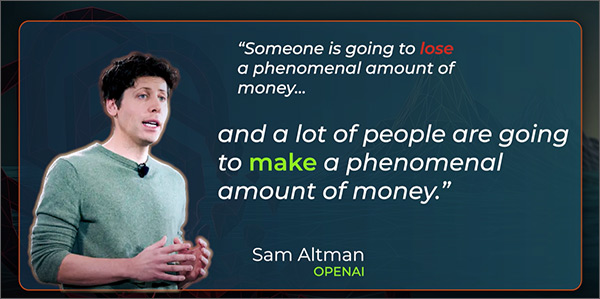
“Someone is going to lose a phenomenal amount of money … And a lot of people are going to make a phenomenal amount of money.”
To make sure you’re on the right side of this divide, click here.

Nilus Mattive
P.S. Look, if you wait for OpenAI to go public before you act … you’ll be too late.
Altman is expected to drop this bombshell on Dec. 18 …
Weeks before a potential IPO.
So please, don’t hesitate.
Watch this video to find out how you can protect yourself.
OpenAI Needs Gulf Sovereign Money to Write This Check

There is a version of this story that reads as triumph: OpenAI is negotiating up to a $30 billion investment that would bring its valuation to about $1.25 trillion, positioning it as the most valuable private company on record. That version is not wrong. It is just incomplete.
The more instructive question is who is actually willing to sign this check, and why the list is so short.
Investors from the United Arab Emirates and Coatue are reported to be leading the financing, which is being positioned as a bridge ahead of a potential IPO. That is two sources of capital: a Gulf sovereign bloc with geopolitical motivations alongside a compute supply agreement, and one crossover fund. For a company being priced above Apple’s market capitalization at its March 2026 peak, the room is nearly empty.
OpenAI is also reported to be negotiating a separate commercial deal that would secure more computing capacity from the UAE. Read that carefully. The UAE is not simply writing a financial check; it is buying a seat at the infrastructure table. The UAE has emerged as an important source of capital for American AI companies seeking to finance their infrastructure ambitions. That is a structural shift, not a one-off. Gulf sovereign capital is filling a gap that Western institutional money has left open, and it is extracting terms beyond equity in exchange.
Earlier in October, OpenAI was reported to be presenting a roughly $1.4 trillion valuation to prospective backers, including BlackRock and UAE fund MGX. Those conversations did not produce a deal at that level, and subsequent reporting put discussions closer to about $1.25 trillion. A similar Bloomberg report earlier said the lab was working on raising $30 billion at about $1.4 trillion; terms are still being negotiated and could ultimately change. The direction of travel over several weeks has been downward, not upward.
Disciplined investors ask what the narrowing of a company’s backer base actually reveals. Microsoft anchored the earliest rounds and holds a substantial stake and an exclusive cloud partnership. Nvidia’s exposure runs through compute dependency rather than equity. SoftBank has been involved in discussions. The accelerated fundraising is designed to lock in commitments before rival Anthropic’s anticipated mid-November IPO window, to avoid direct financial comparisons once public filings are released. That urgency is telling. A business that commands its own timeline does not sprint to close before a competitor’s disclosure date.
The competitor OpenAI is racing to beat before disclosure day tells a different financial story. Anthropic’s first operating profit on $10.9 billion of revenue resets the benchmark investors will use to judge OpenAI’s own unit economics.
OpenAI reported revenue growth in recent quarters, but the gap between income and the capital required for frontier model training remains wide. Each generation of large language models demands more compute and more data.
OpenAI has told investors it expects total compute spending of roughly $600 billion through 2030. That figure is the core tension inside any valuation model: a business with extraordinary revenue growth and extraordinary capital consumption in equal measure.
Capital consumption at that scale is not purely a financing question — it is also a product-reliability question. A canceled model release over alignment failures shows how behavior delays, unlike compute delays, cannot be solved by spending more on infrastructure.
The funding discussions follow OpenAI’s confidential IPO filing with the SEC in June. CFO Sarah Friar told employees in an internal meeting that the company aims to be public in 2027. CEO Sam Altman expressed caution the following month, saying it would be ill-advised to go public in 2026 and pointing to market conditions and safety-related work. The CFO says 2027; the CEO hedges. That split, however mild it appears in public, is worth noting before the company reaches a public market where millions of shareholders replace a handful of sovereign backers.
The world’s greatest investors have long understood that the quality of your capital base reflects the quality of your business. OpenAI may yet prove to be one of the defining businesses of this century. But a company that needs Gulf sovereign motivation and a commercial compute deal to fill a funding round at a self-selected valuation is not yet the kind of business that attracts patient, return-focused capital from everywhere. That gap, between the price being asked and the conviction of those willing to pay it, is the real number worth watching ahead of any 2027 listing.