



Dear Friend,
Quick question.
Want the one stock Elon can’t build without?
I’ll hand it to you today. Free.
It’s not Tesla. It’s not SpaceX.
Every Tesla. Every Starlink dish. Every AI satellite.
Each one runs on a chip Elon doesn’t own. He licenses it. From this company.
And he wants 1,000,000 satellites in orbit.
Every one pays this company a royalty.
Dylan says get in before December 8th.
After that, the easy money’s gone.
Yes, send me the free pick here >>
The Buck Stops Here,
Kelly Maguire
Behind the Markets
P.S. No catch. It’s a public stock you can buy today. The window closes December 8th.
Data Center Permits Are Running Out. Here Is Who Benefits.
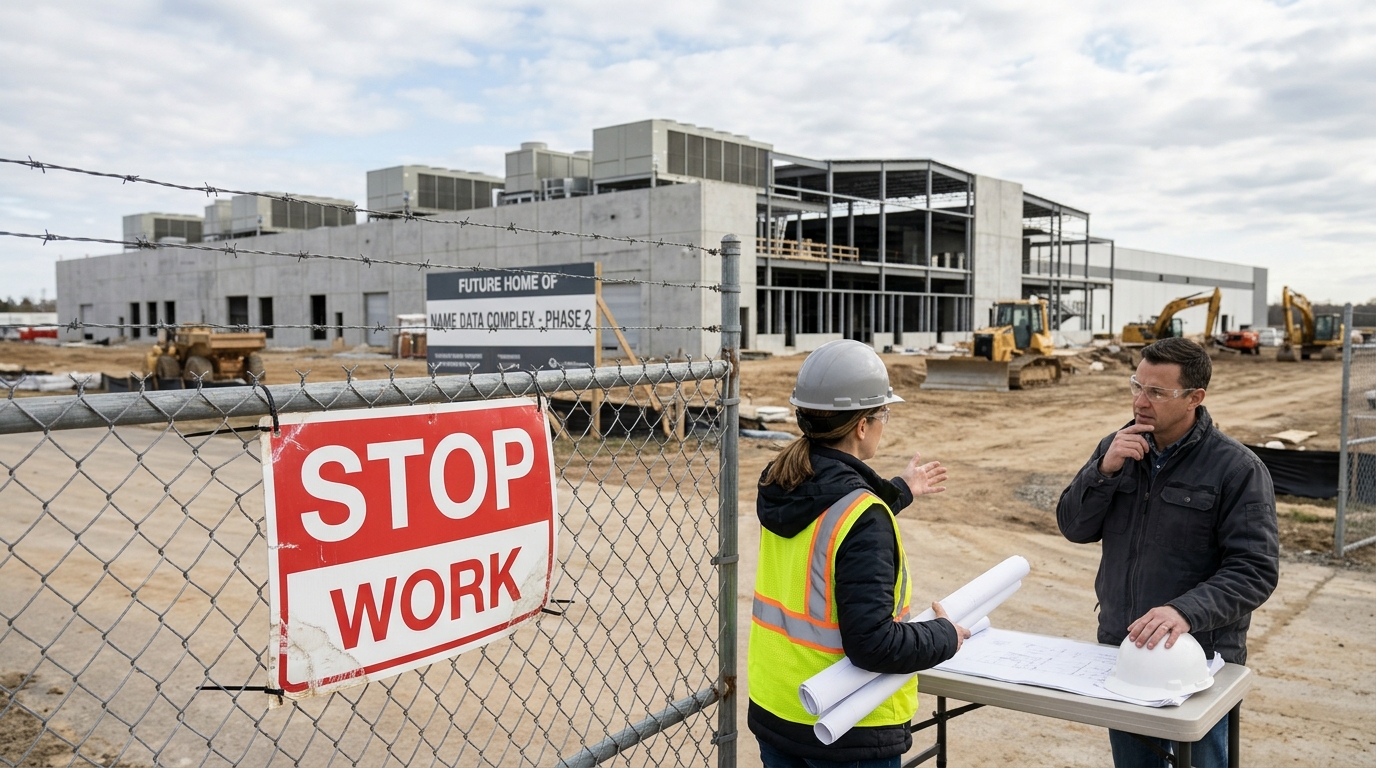
The AI buildout has always had one assumed bottleneck: chips. The bottleneck that is quietly emerging is a building permit.
Cleanview, a market intelligence firm, said that roughly 40% of planned US data-center capacity sits in states where newly elected governors have promised to stop or pause construction. That is not a forecast. New York Governor Hochul signed Executive Order 62 on July 14, 2026, launching what her office described as the nation’s first statewide moratorium on new hyperscale data centers while the state develops stronger standards. Texas Governor-elect Gina Hinojosa campaigned on a temporary moratorium on data-center approvals, and has said the current approach is over. On November 3, 40 of 41 local data-center ballot measures tracked by Ballotpedia across 10 states ran against expanded development, according to post-election tallies. The Indianapolis City-County Council’s Metropolitan and Economic Development Committee voted 11-2 to recommend rejecting approximately $113 million in tax incentives for a proposed $1.8 billion DC BLOX campus. The moratorium is not coming. It is already here, in pieces.
Scarcity is the oldest driver of pricing power. When a large share of planned supply is suddenly tangled in politics, the land, power, and permits that remain become considerably more valuable. The question for a long-term investor is not whether this political cycle ends (it will), but who holds the scarce assets in the jurisdictions that are still open while hyperscalers like Microsoft and Meta have no choice but to build.
Who Holds the Scarce Assets
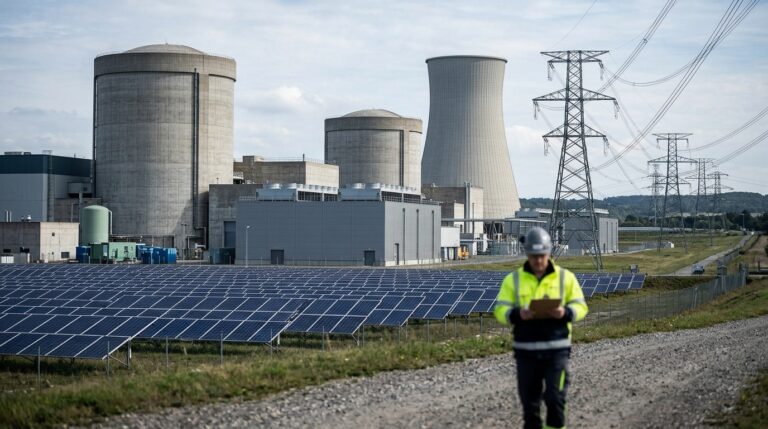
Constellation Energy (CEG), the biggest US nuclear operator, raised its 2026 adjusted operating earnings guidance to $12.50 to $12.80 per share and has said it has signed about 8,500 megawatts of long-term agreements year to date, including deals it has announced with Amazon and Google. Its model is structurally suited for restriction: nuclear plants cannot relocate, and their output is contracted in 10-to-20-year agreements that do not care which governor is in office. Restriction in Texas and New York does not shrink Constellation’s contracted fleet. It raises the price of whatever power is available in permitted zones. GE Vernova’s (GEV) third-quarter orders rose 96% organically to $29.3 billion, and the company said its Gas Power equipment backlog and slot reservation agreements grew to 122 gigawatts. Data centers were only one part of the demand the company cited for gas and grid equipment, so even a real slowdown would leave most of the order book in place.
Digital Realty Trust (DLR), one of the country’s largest data-center REITs, and Equinix (EQIX) both have meaningful exposure to U.S. expansion markets, but the exact risk depends on where their campuses, land banks, and power pathways sit. Both REITs benefit if completed campuses in restricted states appreciate in replacement cost, but new development pipelines need scrutiny by geography.
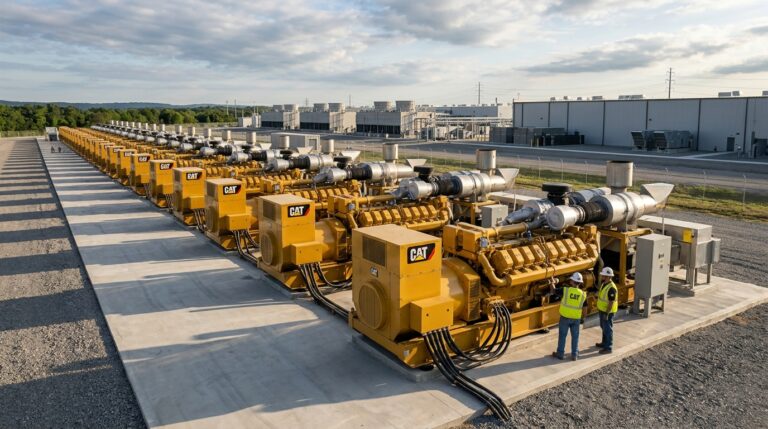
The equipment constraint runs deeper than permits. GE Vernova’s $9 billion acquisition of Trench Group targets the transformers and high-voltage components that data centers cannot get on time.
What Could Go Wrong
A moratorium is temporary by design, halting permits for a set period or until new rules arrive, as New York’s Executive Order 62 process plays out. A new Congress could pass federal permitting reform that overrides some state action. Constellation’s new deals suggest data-center buyers are still signing, raising the possibility that last week’s moratorium-driven selloff in power stocks was overdone. If restrictions lift faster than expected, the scarcity premium compresses quickly.
The capacity market is already pricing this scarcity. PJM’s auction cleared at the FERC-approved price cap while still falling short of the grid’s reliability requirement, a signal that the underlying power imbalance is structural, not temporary.
The more durable insight is simpler: when the ability to build is constrained and the demand to compute keeps growing, the companies that already hold the power and the permits collect the premium. Those assets were built over years. The companies that own them did not need a ballot measure to tell them they were scarce.