

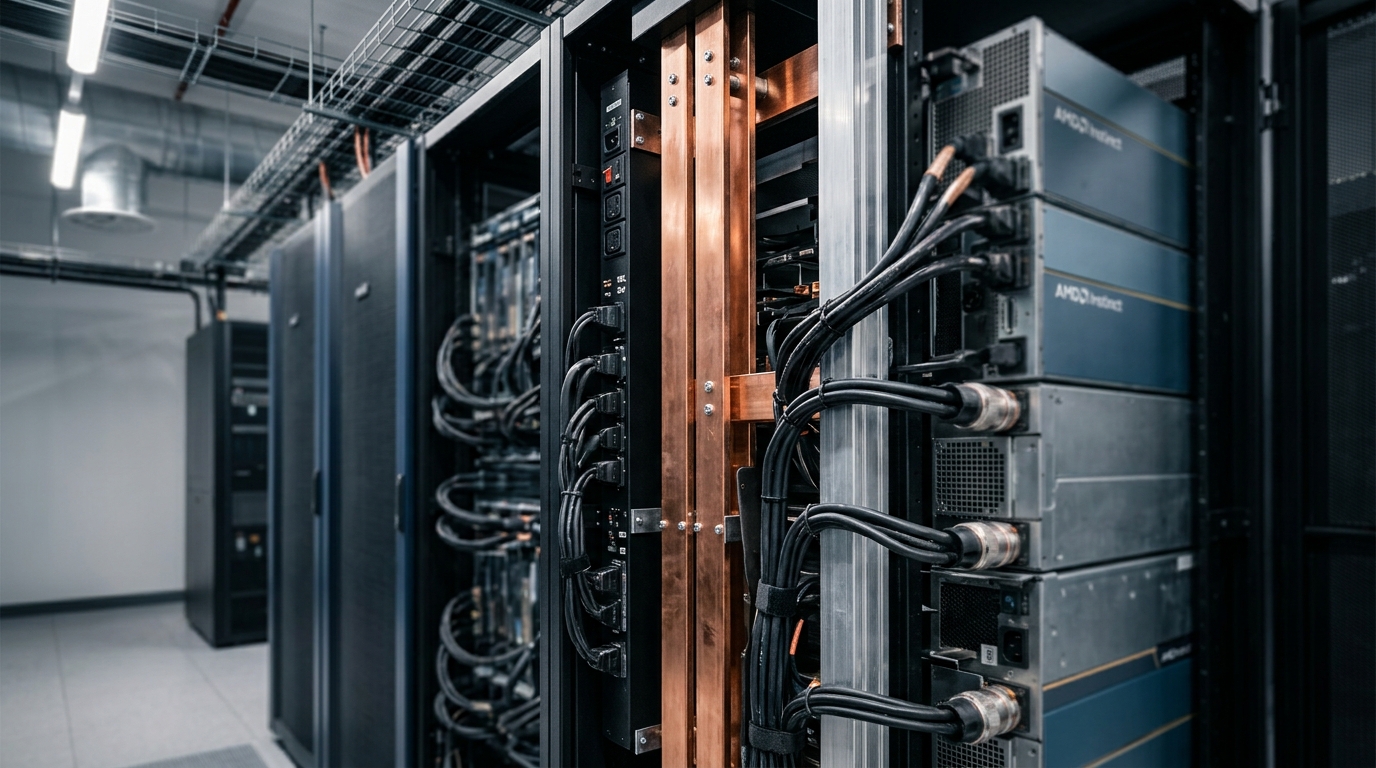
The loudest number AMD put in front of investors and operators at Advancing AI 2026 was 2.9 exaflops of FP4 compute per rack. The number that actually determines whether Helios is deployable is 245 kW.
Reports from the event and early briefings put a fully loaded Helios rack at roughly 225 to 245 kW of continuous draw. That is not a peak figure reached briefly during benchmarks. All of it is powered by a 50-volt liquid-cooled DC busbar at the back of the system, which under load can deliver between 225 and 245 kW continuously. The busbar is quietly the most consequential engineering choice AMD made here, because deep-learning workloads do not draw power smoothly.
Power loads in AI clusters are shifting from smooth and steady to dynamic and irregular, with spikes far above the nominal load, which makes power system design extremely challenging and inefficient. A rack pulling 245 kW at average utilization can demand considerably more during a training step transition, and those transients propagate up to the facility’s power distribution units fast enough to trip protection circuits or corrupt adjacent racks in a multi-rack cluster.
AMD’s Helios rack uses an Open Rack Wide chassis with 44 Open Units, holding 18 compute trays and six switch trays, with blind-mate quick-disconnect liquid cooling, redundant power supplies, and a 50V DC liquid-cooled busbar. The power shelf acts as a centralized hub, managing and distributing power across the rack via that vertical busbar, which means transient load spikes from a single GPU tray are absorbed at the shelf level rather than sent directly back to the facility circuit.
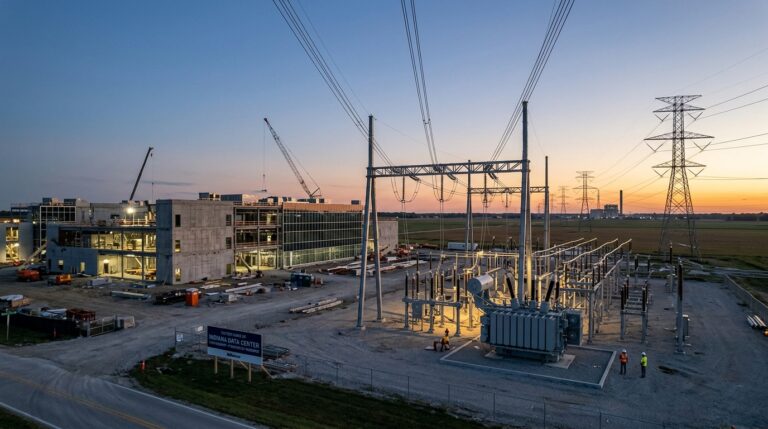
AMD and Schneider Electric have also published a jointly engineered reference design for deploying Helios in AI data centers around the Advancing AI 2026 launch window. The reference designs cover how Helios integrates with surrounding data center systems across four technical areas: facility power, facility cooling, IT space, and lifecycle software. That combination matters because the power module architecture inside a rack is only half the problem. The other half is what sits outside it.
Industry survey reporting in 2026 has put average rack density around 27 kW, up from about 16 kW in 2025, while only about one in five operators report being prepared to support the 50 to 70 kW racks now common in AI deployments. A 245 kW rack lands far beyond that threshold, and most colocation facilities were not built to handle it. AMD has separately reiterated a long-term goal of improving AI energy efficiency by 20x by 2030, and the company has pointed to mid-2026 progress on energy efficiency improvements tied to its Instinct roadmap and systems-level work, including Helios.
For traders, the angle is not the headline compute figure. It is the supply chain behind power modules rated for this class of load, the liquid cooling infrastructure qualified to roughly 385 liters per minute, and the handful of OEMs and ODMs that can actually build compliant Helios systems. AMD said Helios rackscale solutions were in production as of July 2026, but product availability and delivery dates still depend on the chosen OEM system. That dependency concentrates execution risk precisely where the power delivery specification is most demanding, and it is where the deployment ramp could stall before the compute benchmarks ever get tested in the field.