

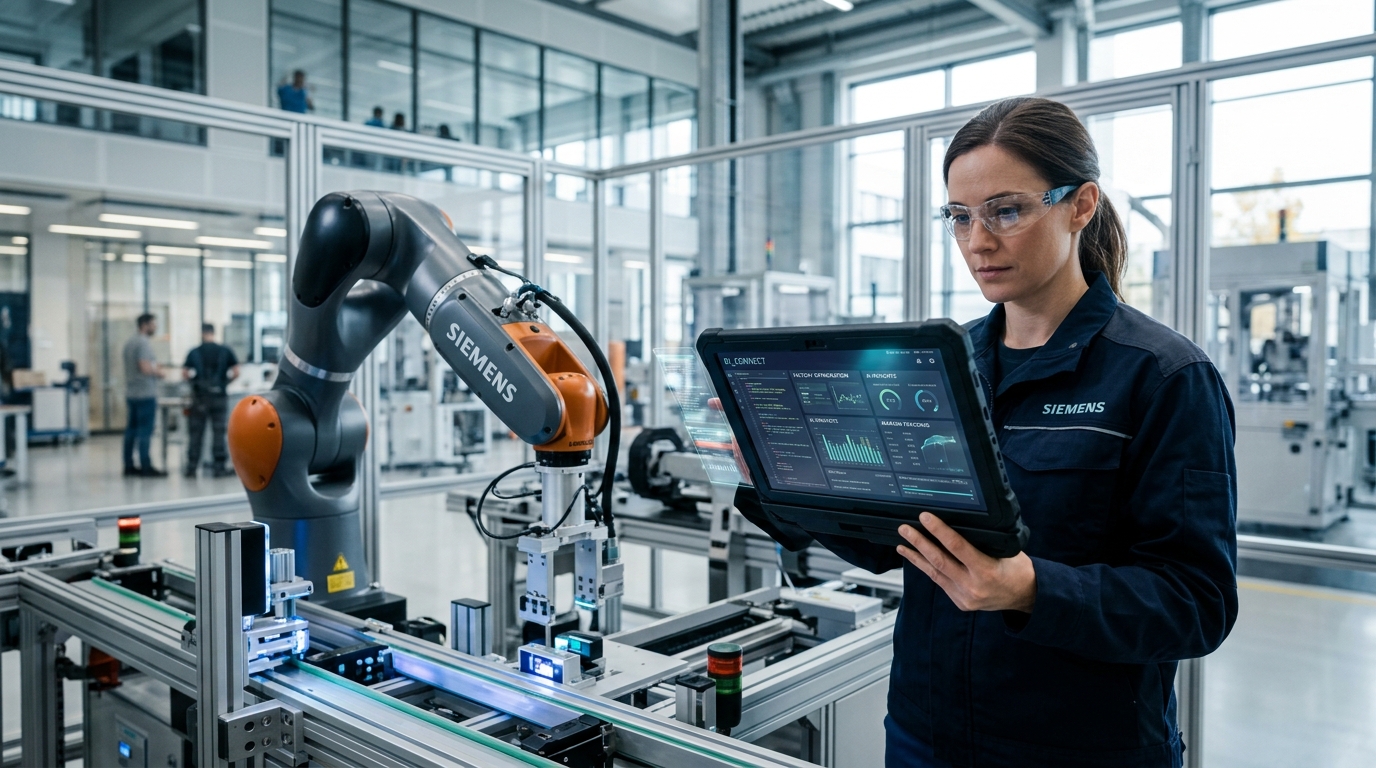
Before Monday’s open in Frankfurt, Siemens dropped one of the largest European industrial restructuring announcements of the quarter. CEO Roland Busch is launching a reorganisation of the 178-year-old firm to mesh its digital and real-world products, explicitly aimed at lifting profitability closer to the elevated returns reaped by technology companies. The structural piece is concrete: Siemens is combining its four automation businesses, Factory Automation, Motion Control, Process Automation, and Customer Services, into a single Automation organisation from October 1, 2026. That is not a rebrand. It is a direct assault on the internal silo problem that has kept Siemens’ margins below those of pure-software peers for years.
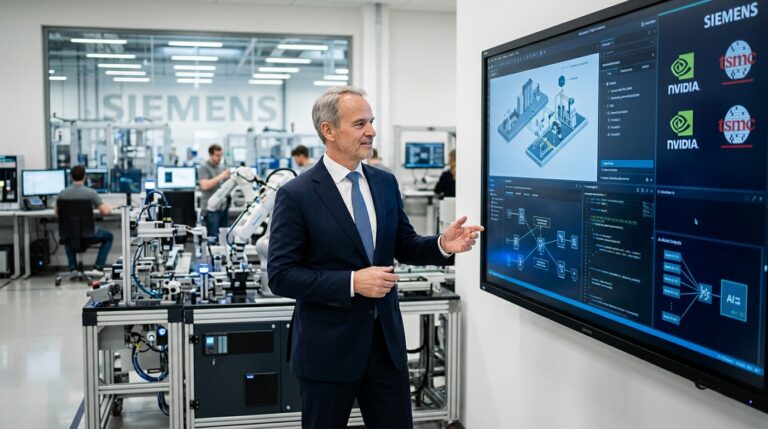
The AI infrastructure to support the ambition is already in place. Siemens and Nvidia expanded their partnership to build the Industrial AI Operating System, aimed at reinventing the entire end-to-end industrial value chain through AI, from design and engineering to manufacturing, production, operations, and supply chains. Earlier this year, Siemens said it would continue building on its long-standing relationship with TSMC to expand AI-powered automation and design enablement efforts across semiconductor design workflows, with Siemens adding Nvidia AI technology to enhance its EDA AI systems’ reasoning capabilities and efficiency. The Nvidia and TSMC partnerships are not background colour. They are the technical scaffolding for the margin thesis Busch is selling.
So what would have to show up in the accounts before this changes what SIEGY shares are worth? Three things.
First, recurring software revenue needs to grow faster than the industrial hardware segment. Siemens’ push into industrial AI has helped make it one of Germany’s most valuable listed corporations, but its margins still trail European competitors including Switzerland’s ABB and are dwarfed by high-margin industrial software businesses. Acquisitions are accelerating the software mix shift: the Dotmatics deal followed closely on the heels of Siemens’ roughly $10 billion acquisition of Altair Engineering, completed in March 2025, and Dotmatics was expected to generate more than $300 million in revenue with an adjusted EBITDA margin above 40 percent, immediately accretive to Siemens’ growth, EBITDA margins, and free cash flow. But accretion from bolt-ons is not the same as organic software scaling. Investors should watch software segment growth rates quarter by quarter, not just headline revenue.
Second, the industrial business margin needs to catch up to the software assets, not just be averaged down with them. S&P Global Ratings estimates Siemens’ adjusted EBITDA margins at about 18.0% to 19.0% in fiscal 2026 and fiscal 2027. For context, Rockwell Automation’s Software and Control segment posted an operating margin of 34.9% in its second quarter of fiscal 2026. The gap is the whole point of what Busch is attempting. The October 1 consolidation of the four automation units is designed to close it by removing duplication and putting AI tooling directly into the hardware sales cycle. If the combined Automation unit’s margins do not expand meaningfully by fiscal 2027, the reorganisation was overhead reduction dressed up as strategy.
Third, Busch wants manufacturing clients like Boeing and Volkswagen to bundle diverse needs through a single touchpoint, from connecting a plant to the grid to supplying the controls and the software used to design and operate them. That bundling is how software economics enter an industrial business: higher switching costs, longer contract durations, annuity-like cash flows. The metric to watch is annual recurring revenue. If ARR as a share of Digital Industries revenue is not disclosed or is not growing, the thesis remains an organisational chart, not a financial model.
The risk is valuation. Some analysts see Siemens’ current price as reflecting AI-driven optimism with normalization risk baked in. ABB and Schneider Electric are not standing still, and moat erosion from competitors like Schneider and Rockwell is a legitimate concern as rivals pursue the same software-attached-to-hardware strategy.
Busch has the partnerships, the acquisitions, and now the structure. The October accounts will show whether the factory floor is actually learning to price like software.