



Two numbers are squeezing corporate America from opposite ends right now. Brent crude traded near $107 a barrel on Thursday, trimming a surge that peaked above $108, amid shipping disruption risks in and around the Strait of Hormuz and renewed regional strikes. The University of Michigan’s consumer sentiment index fell to 47.8 in early September 2026, down for a second consecutive month and down 13.2% from a year earlier. The final September reading lands this morning at 10am ET.
Oil inflates the cost side. A collapsing consumer deflates the revenue side. The question every long-term investor should be asking right now is simple: which businesses sit between those two forces and still grow?
Thursday night gave us the first live answer.
What Costco’s Numbers Actually Mean
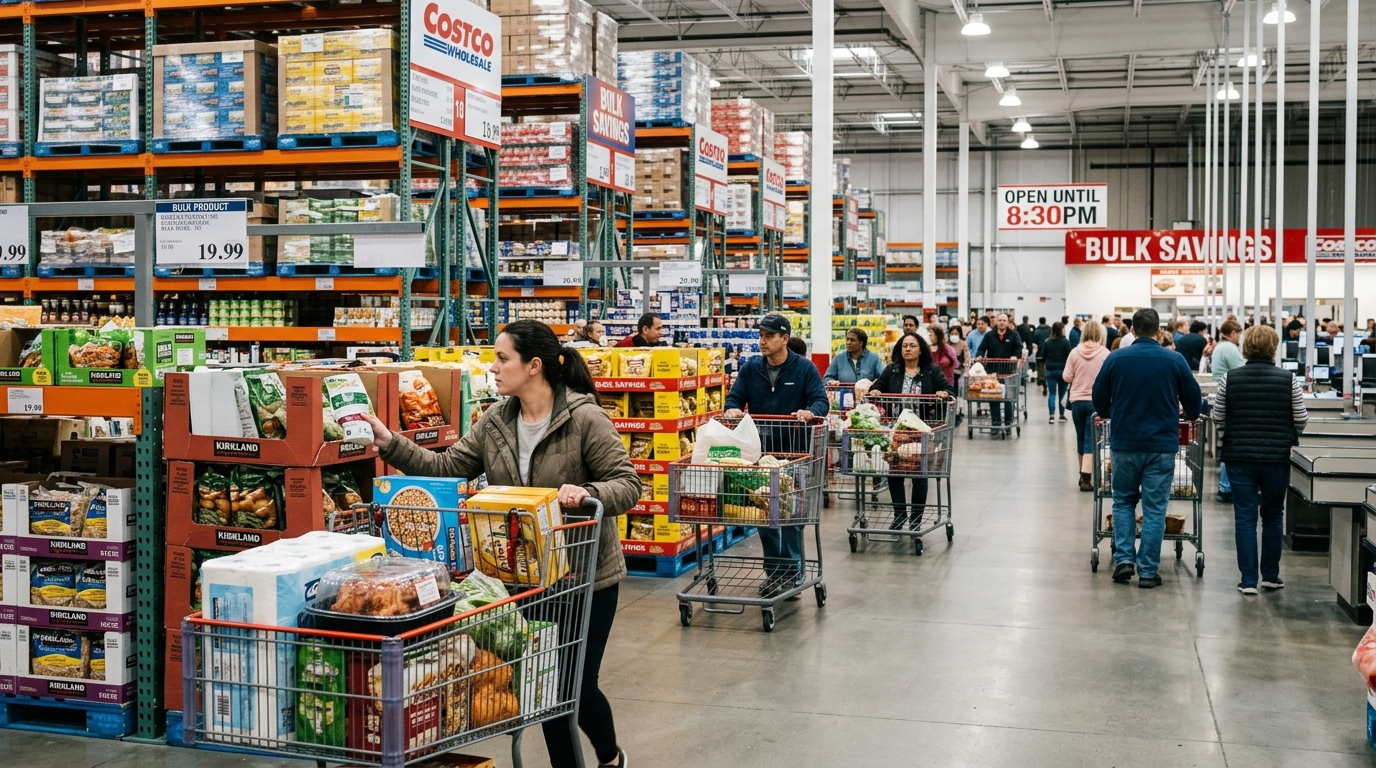
Costco closed fiscal 2026 with fourth-quarter net sales of $93.9 billion, up 11.2% year over year, as comparable sales rose 9.4% reported and 6.7% adjusted for gas inflation and foreign exchange. U.S. comparable sales rose 10.7%, or 7.2% after adjusting for gas and currency movements. The headline numbers are strong. What matters for investors studying pricing power is what sits beneath them.
Excluding gasoline inflation, gross margin actually expanded 20 basis points. Excluding tariff refunds and the related reinvestment in member value, core-on-core margins rose 18 basis points, with supply chain efficiencies driving improvement across categories. That is the real signal. A business absorbing $107 Brent, a rising LIFO charge, and persistent tariff noise, and still widening its underlying margin, is not lucky. It is structurally protected.
The LIFO charge increased significantly to $152 million in Q4 from $43 million last year, driven by higher memory costs and inflation in petroleum-based items. Costco ate that and kept growing. Membership fee income reached $1.849 billion, up 7.3%, as total cardholders grew to 150.4 million with a worldwide renewal rate of 89.8%. Renewal rates near 90% are not a metric, they are proof that the value proposition is intact under pressure.
The Darden Contrast
Darden’s quarter the same evening told a different story. Darden reported fiscal first-quarter net income of $233.4 million, or $2.04 per share, down from $257.8 million, or $2.19 per share, a year earlier, even as net sales rose 5.1% to $3.20 billion. Revenue grew; profit shrank. That is what happens when cost escalation outruns pricing latitude.
Same-restaurant sales rose 3.2% on a comparable calendar basis. Darden is executing. But outpacing peers while margins compress is not the same as having pricing power. It is managing the environment more gracefully than many competitors.
What Pricing Power Actually Looks Like in the Numbers
Costco’s architecture reveals why. The membership fee is structurally separate from merchandise margins, which means Costco has two levers: the annual fee it charges for access, and the pricing discipline it applies to goods. Costco’s value architecture, warehouse-scale unit pricing, a curated SKU count, and a membership gate that self-selects for committed shoppers, positions the company as a structural beneficiary of consumer belt-tightening rather than a casualty of it.
Year-ahead inflation expectations jumped to 4.6%, the highest since June, while five-year expectations edged up to 3.4% after holding at 3.3% for three consecutive months. When consumers expect sustained inflation, they migrate toward value. Costco captures that migration. Companies with undifferentiated products, heavy commodity input exposure, and weak customer loyalty do not.
Consumer sentiment sits 13.2% below where it was a year ago. That is not a cyclical dip. It is a structural reset in how households are allocating spending. Businesses whose volumes hold, or grow, through that reset are the ones worth owning for the next five years.
Costco’s fiscal 2026 results also underscored the point: operating income rose to $11.69 billion, giving the company meaningful flexibility heading into fiscal 2027. Free cash flow was not disclosed in the company’s fourth-quarter earnings release. Free cash flow expanding while oil trades above $100 is the operational definition of a business that passes costs on rather than absorbing them. That quality is rare. And at a 47.8 consumer sentiment reading, it may be the only quality that matters.