




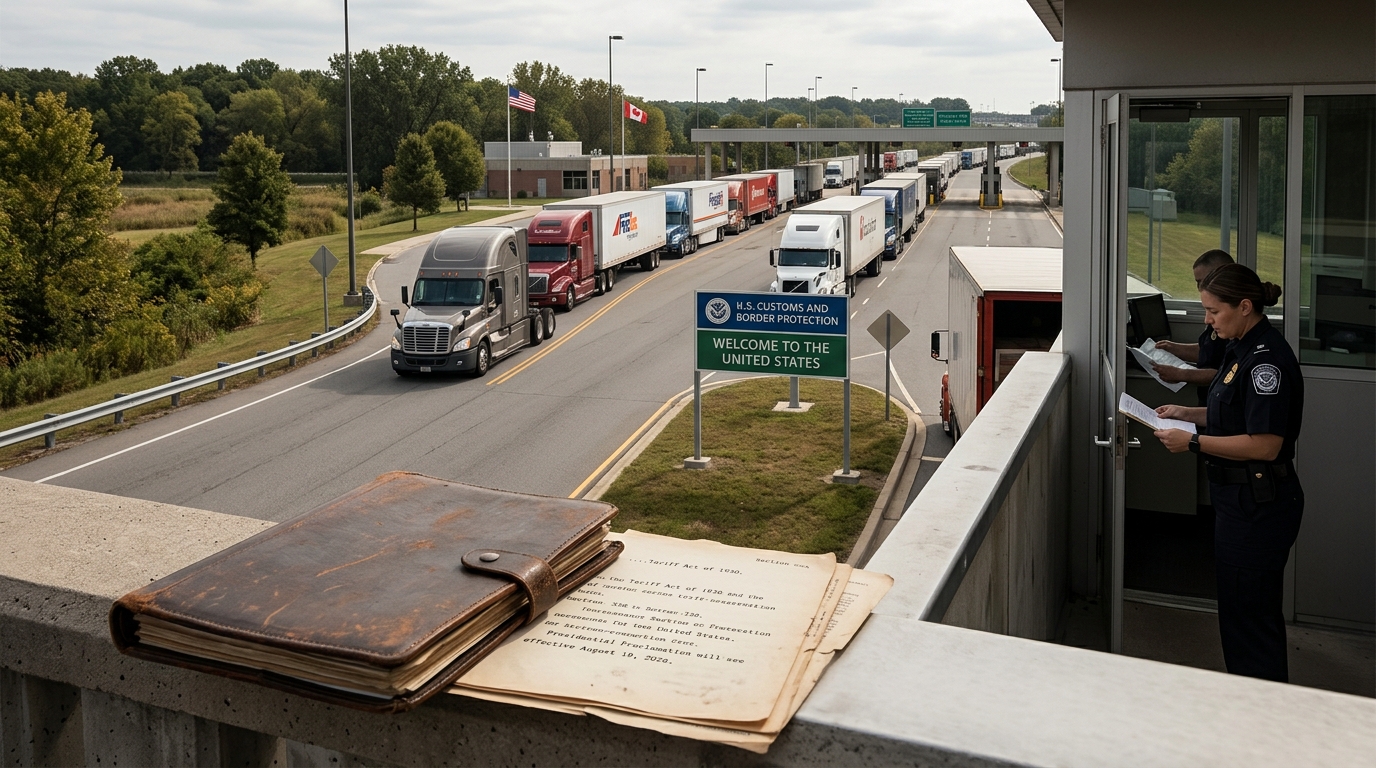
Here is the part most investors are not fully tracking yet. The tariffs landing on August 19 are not just another escalation in the U.S.-Canada trade fight. They come from a law that has sat dormant for roughly 95 years, never once used to actually impose duties on anyone.
That changes in 16 days.
On July 20, 2026, President Trump issued three proclamations imposing additional 50% tariffs on certain imports from Canada under Section 338 of the Tariff Act of 1930, marking the first time any U.S. president has invoked this authority. The law is part of the Tariff Act of 1930, often associated with the Smoot-Hawley Tariff Act. That name alone should trigger a reaction for anyone who took an economics class.
This move marks another shift in the administration’s tariff strategy following the Supreme Court’s February 20, 2026 decision holding that the International Emergency Economic Powers Act does not authorize the President to impose tariffs. The administration lost its most flexible tool in February, pivoted to Section 122 as a bridge, and now landed on something far more permanent. Unlike Section 122 of the Trade Act of 1974, which caps emergency import surcharges at 150 days absent congressional extension, Section 338 imposes no fixed expiration. These tariffs remain in effect unless and until the president issues a new proclamation modifying, suspending, or terminating them.
That indefinite shelf life is the detail most coverage glosses over.
Unlike Section 301 of the Trade Act of 1974, which requires a formal investigation by the United States Trade Representative, or Section 232 of the Trade Expansion Act of 1962, which requires a national security finding, Section 338 allows the President to act by proclamation without a prior investigation or hearing. No hearings. No formal investigation. Just a signature.
The three proclaimed sectors are well-known at this point: motor vehicles, alcoholic beverages, and dairy. The administration has specific grievances behind each. From April 2025 through March 2026, Canadian imports of U.S. motor vehicles decreased by approximately 22%, compared to the same period in 2024-2025. Comparing March 2025 through February 2026 to the same period in 2024-2025, Canadian imports of U.S. alcoholic beverages decreased by approximately 81%, from approximately $718 million to approximately $137 million, after provinces and territories halted the purchase, distribution, or retailing of U.S. alcoholic beverages.
But here is where the real compliance risk sits. Scroll down to Annex II of each proclamation and the list broadens fast: wine, hockey sticks, cement, plywood, furniture, fishing rods, seeds, clothing, wigs, swimming pools. The U.S. Trade Representative’s office has said the actions cover nearly $20 billion in imports from Canada, about 5.2% of the $383.0 billion in goods the U.S. imported from Canada in 2025. Most companies reviewed the headline categories and moved on. A lot of them have exposure they haven’t found yet.
That is a wide net. And USMCA compliance offers zero protection here. The White House fact sheet says these Section 338 tariffs apply to all covered goods regardless of whether a good qualifies under the United States-Mexico-Canada Agreement (USMCA).
The Bigger Legal Question
The administration did not choose Section 338 because it was the obvious tool. The White House and USTR have framed the move as an effort to find a durable legal basis for tariff action after the Supreme Court’s February 2026 IEEPA ruling.
Wide authority, but not necessarily unchallenged authority. Open legal questions could include how Section 338 interacts with later trade statutes and what role, if any, courts will require for the trade commission in practice. Litigation in the U.S. Court of International Trade is anticipated.
A legal challenge could test whether Canada’s policies meet the statute’s definition of unequal treatment, whether the selected products and 50% rate reasonably offset the claimed trade disadvantages, and whether the administration complied with any role Congress intended for the trade commission.
So the statute is real. The tariffs are real. And the legal durability is genuinely uncertain.
The Escalation Clause Nobody Is Discussing
Here is the part that matters most for investors in North American supply chains. If a country continues discriminating after the tariff is imposed, the president can escalate further and exclude articles of that country entirely. Unlike Section 122, Section 338 carries no statutory time limit.
Section 338 authorizes the president to escalate to an exclusion of articles of the foreign country if Canada maintains or increases its discrimination. An import exclusion. That is not a baseline expectation, but the fact that the statute permits it puts every Canadian counterpart, every cross-border manufacturer, and every USMCA-reliant supply chain in a different risk category than they were in six months ago.
That is the investment thesis embedded in this whole situation. Section 338 is not the end of a trade escalation. It may be a negotiating opening bid, with August 19 as the clock. Section 338 lets the President suspend or revoke the duties if the President deems the public interest requires it. Carney has signaled willingness to talk. Whether 16 days is enough to close a deal that has resisted resolution for over a year is a different question entirely.
Section 338’s precedent matters more than the tariffs themselves. A long-dormant statute now overrides a trade agreement’s core preference on a presidential finding alone. That is the real signal for investors. The administration has now demonstrated it will reach into the deepest corners of U.S. trade law, bypassing modern procedural guardrails, whenever a more recent tool gets blocked. Section 338 was the backup plan after IEEPA. What comes after Section 338 is a question worth asking before August 19 arrives.