


October 12, 2026
Bonus Content: 136,000 MW of Gas Turbines Are Leaving Power on the Table
Dear Friend,
The biggest energy deadline in American history is 12 days away.
And it just aimed its full firepower at ONE company.
See, on July 4th, the One Big Beautiful Bill Act killed the federal tax credits that powered alternative energy for years.
But here’s what almost nobody knows:
When the White House killed credits for solar, wind, EVs, and every other renewable energy source in America…
They left one untouched.
Not only that, they reclassified it alongside oil and nuclear…
And gave it eight years of credits.
Because in June 2025, a drilling crew working near the Grand Canyon…
Unearthed a well of clean energy producing almost 8 times the output of the largest oil well in Saudi Arabia…
Capable of powering civilization for two million years.
Right here on American soil.
Google signed a 15-year contract.
Bill Gates wrote a $100 million check.
And now the clock’s running.
On October 20th, Washington puts 83 parcels of federal land on the auction block.
Whoever wins them could lock up this energy for decades.
One company already owns the entire chain.
Once the gavel drops, this stops being a secret.
Get the Grand Canyon ticker before October 20th here >>
The Buck Stops Here,
Kelly Maguire
Behind the Markets
P.S. The auction opens October 20th. After that, everyone will know who’s behind this discovery.
136,000 MW of Gas Turbines Are Leaving Power on the Table
The most interesting power generation story of 2026 is not a new plant. It is the one already running.
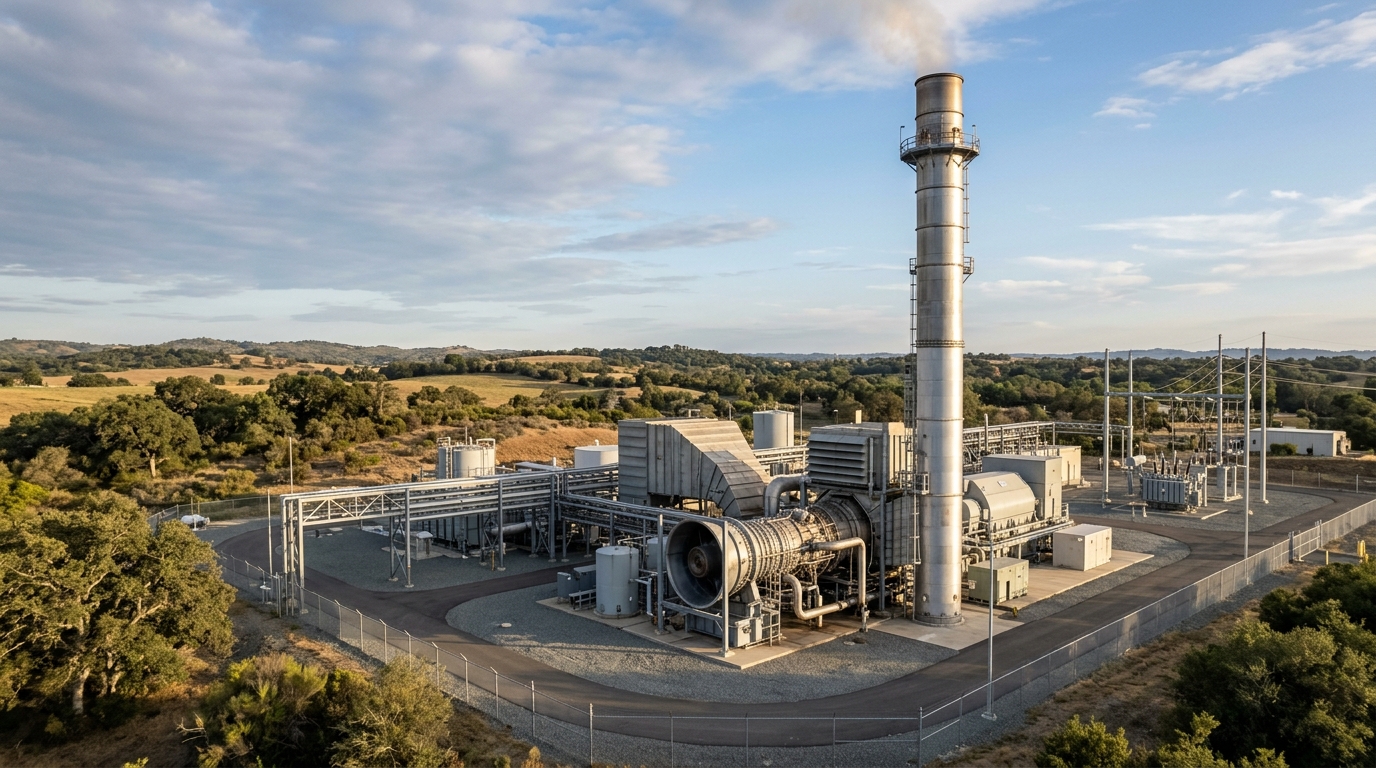
Total U.S. simple-cycle gas turbine operating capacity reached 136,074 MW as of May 31, 2026. The overwhelming majority of those assets were built to peaking duty, fired hard on the hottest summer afternoons and idled the rest of the year. They were never paired with a steam bottoming cycle because the economics did not justify it at small scale. That inefficiency is now a retrofit opportunity worth examining closely.
An sCO2 bottoming cycle can lift a simple-cycle gas turbine to combined-cycle performance, increasing nameplate output by 30% to 50%, depending on the gas turbine configuration. The working fluid is carbon dioxide held above 31°C and 73 atmospheres, the threshold where it behaves simultaneously like a liquid and a gas. At that state it carries more energy per unit volume than steam, which means the turbomachinery can be radically smaller and the plant far less complex to operate.
Echogen, using data from Orennia, has identified 127,498 MW, almost 95% of the existing U.S. simple-cycle fleet, as potentially eligible for an sCO2 bottoming cycle. Approximately 20% of that capacity comes from the Frame 7E fleet, with the LM6000 family contributing another 11%. Those are not exotic machines. They are the workhorses of the mid-merit grid.
The business logic has a second layer. Single-phase operation and lower thermal mass enable faster starts and steeper ramps than a comparable steam bottoming cycle, a directly relevant capability in grids with high renewable penetration. For a plant operator trying to bid into both capacity markets and ancillary services, that flexibility has real dollar value beyond the efficiency gain itself.
China moved first on commercialization. Chaotan One, described by Chinese state media and China National Nuclear Corporation-affiliated groups as the world’s first commercial supercritical CO2 power generation unit, entered commercial operation in Liupanshui in China’s Guizhou province on December 20, 2025. Public reports describe a 2×15-megawatt waste-heat project at the Shougang Shuicheng Iron and Steel plant, with 15 MW per unit. That is a steel plant, not a utility, but the proof of commercial operation at this scale matters.
In North America, the pipeline is moving. In late November 2024, Hanwha Power Systems and TC Energy signed a memorandum of understanding to develop an sCO2 waste heat recovery project, with Hanwha installing its system at a TC Energy compressor station in West Virginia. It is a modest starting point, but pipeline compressor stations and simple-cycle gas plants share the same physics: hot exhaust, no steam recovery, money left in the flue gas.
When using high-temperature heat sources, modern steam power plants are often around 40% efficient, while sCO2 cycles are frequently modeled above 50% depending on temperature, design, and heat rejection conditions. That gap is where the long-term investment story lives, not in any single plant, but in the scale of the retrofit market and the handful of companies positioned to serve it.
The risk is execution, not physics. Sealing sCO2 at high pressure, managing heat exchangers built to tighter tolerances than steam systems, and financing retrofit projects on aging assets are genuine engineering and capital challenges. But the addressable base, roughly 127,000 megawatts of infrastructure that could be eligible for an sCO2 bottoming cycle, is large enough that even a fraction of successful deployments represents a durable business. That is worth the attention of investors who think in decades, not quarters.