




Two technologies are being deployed across American hospitals right now to close a staffing gap that conventional hiring cannot fill. One is working. The other is generating protests in eight cities. The distinction matters enormously for investors trying to separate durable adoption from a compliance risk dressed up as a productivity story.
Start with the numbers behind the crisis. The Health Resources and Services Administration (HRSA) projects a nationwide registered nurse (RN) shortage of about 8% in 2026, and HRSA’s longer-range modeling shows RN shortfalls persisting into the next decade. More than 65% of hospitals report running at less than full capacity at some point because of staffing shortages. The financial pressure that creates is the opening both AI transcription vendors and algorithmic scheduling platforms are rushing to fill.
On the transcription side, the economics are compelling and largely uncontested. The Permanente Medical Group reported 15,791 hours of documentation time saved across 7,260 physicians in a single year using ambient AI scribes. At the high end of enterprise pricing, that works out to roughly a 78% to 86% cost reduction compared to a full-time human scribe. A JAMA study published on April 1, 2026 is more conservative: 1,809 AI-scribe users across five academic health systems were associated with about 16 fewer minutes of documentation time and about 13 fewer minutes in the electronic health record per eight hours of scheduled patient care. Modest per shift, meaningful at scale.
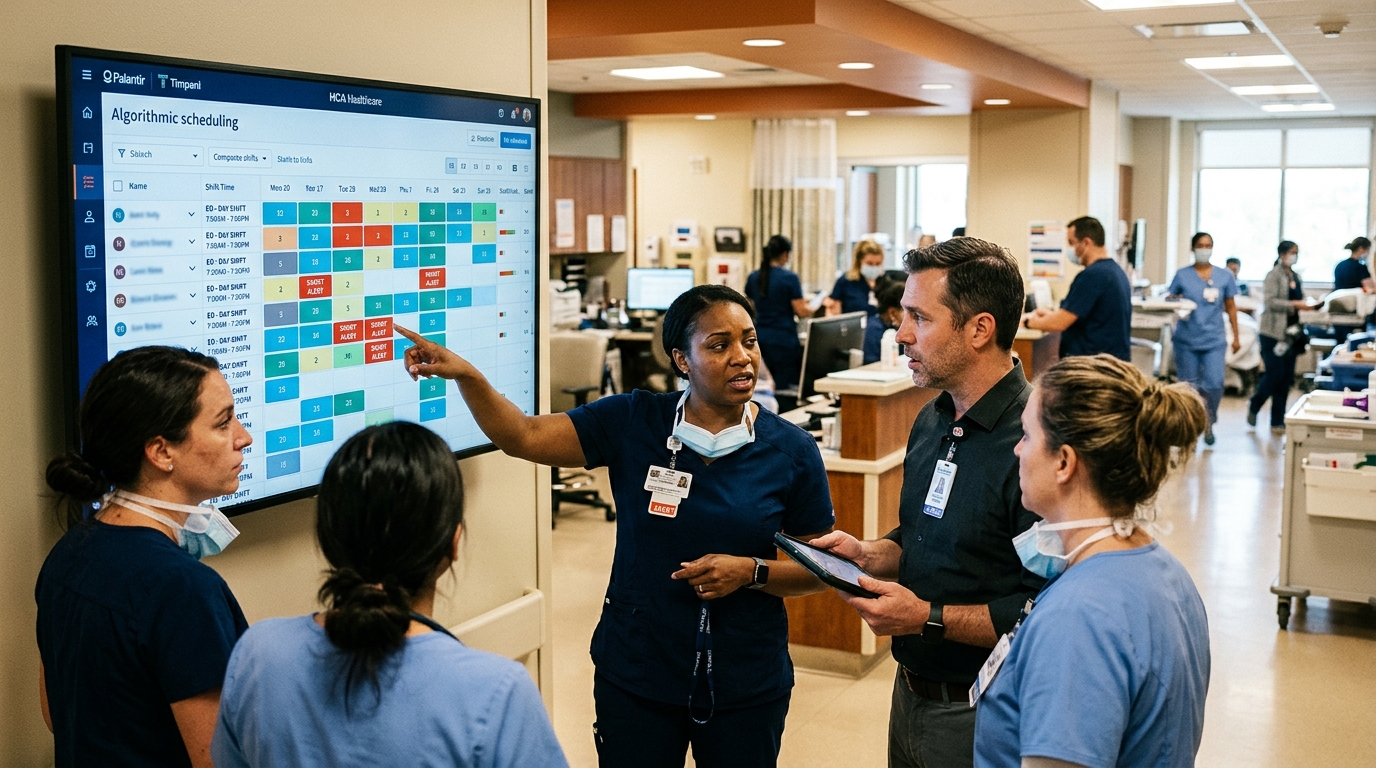
The scheduling story is where the fault line opens. Some HCA Healthcare nurses say Timpani, an AI-enabled scheduling tool built on Palantir software, ignores their shift preferences and leaves units short on experienced staff. HCA has rolled it out at roughly 130 of its locations since 2023. Management insists the tool delivers: HCA has said Timpani has cut the time managers spend on scheduling, reduced reliance on contract nurses, and improved retention.
Nurses tell a different story. They allege Timpani routinely schedules too few staff or fails to ensure a sufficient balance of experienced veterans, particularly on weekends and night shifts, and that the tool’s rigid adherence to baseline staffing ratios fails to account for patient acuity. National Nurses United escalated its campaign with demonstrations in eight U.S. cities on August 27, 2026; the union, which says it represents more than 225,000 registered nurses, described it as its largest coordinated national action against Palantir to date.
The second-order implication for investors is not about which side wins the public argument. It is about where the liability accumulates. In one National Nurses United survey, about two-thirds of nurses whose employers used AI-generated patient-acuity measurements said the computer-generated measurement did not correspond with their assessment, because the AI failed to account for patients’ psychosocial or emotional needs. If an adverse patient outcome traces back to an algorithm-built shift that placed one senior nurse against four novices, the legal exposure lands on the hospital, not the software vendor. HCA has pushed back, saying nursing managers still hold final say over schedules. That disclaimer is also the liability boundary HCA is drawing.
Ambient transcription and autonomous scheduling are not the same product solving the same problem. One returns time to clinicians. The other substitutes machine logic for clinical judgment about who stands next to a patient at 3 a.m. Investors pricing both as equivalent “healthcare AI” adoption stories are mispricing the risk embedded in the second.