


October 29, 2026
Caterpillar has become a gatekeeper of the data-center energy build
Caterpillar released its third-quarter 2026 results at 5:30 a.m. CDT this morning, and the stock climbed on what TipRanks described as a strong beat on both earnings and revenue. Consensus had the quarter at roughly $7.04 per share on about $20.7 billion in revenue, implying 42% earnings growth year over year from the $4.95 reported in the same quarter of 2025. Whether the company cleared that bar by a little or a lot matters less than the structural question the results keep answering: what exactly is Caterpillar becoming?
The Energy Stock Trump Once Called “A Big Mistake” to Mess With
When a U.S. ally tried to tax ONE American energy company…
Trump didn’t hesitate to issue a direct warning.
Now this same company is generating over $3 billion in operating income…
And partnering with the hottest AI stock on Wall Street.
Out of 23,281 publicly traded stocks, this is the ONLY one that meets all the “unicorn” criteria.
Not a machinery company that occasionally sells generators. A power infrastructure company that also makes bulldozers.
How a $72 Billion Backlog Gets Built
Last quarter, Caterpillar passed $20 billion in quarterly revenue for the first time, with sales reaching $20.543 billion, up 24% year over year. Management raised its 2026 sales-growth outlook to mid- to high-teens, and backlog rose $9 billion sequentially to $72 billion, with about 59% of it expected to ship within 12 months. That conversion rate has held steady for three consecutive quarters, which CFO Kyle Epley has described as evidence that the demand for power equipment is structural rather than a temporary surge.
In Power & Energy, power generation sales grew 72% in the second quarter from a year earlier, with management tying that growth to very strong demand for large generator sets and turbines used in data centers. Power & Energy grew 17% to $8.238 billion in Q2, with segment profit up 30%. But it was not the largest part of Caterpillar by sales in the quarter: Construction Industries was slightly larger at $8.346 billion. The broader point still stands that Power & Energy is now roughly the same size as Construction Industries, and the company’s identity has shifted in a way the market is still working through.
Write this date down, circle it on your calendar, whatever you need to do.
Dec. 18.
That’s when our research indicates OpenAI will release a confidential document.
When they do, likely around 4 p.m. just before the market closes …
It could kickstart a $40 trillion chasm.
Many investors will likely be caught off guard.
To make sure that’s not you, click here to find out all the crucial details.
The Moat Nobody Talks About
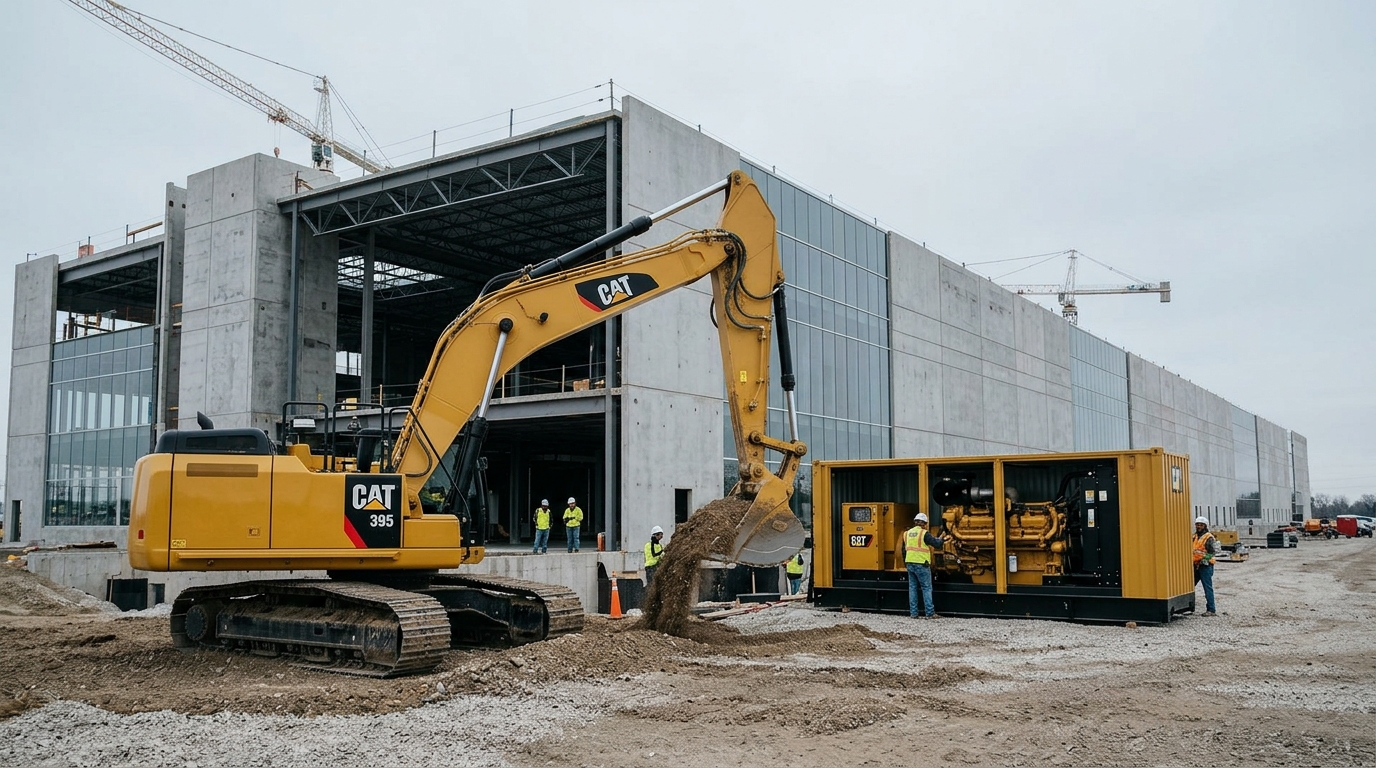
Caterpillar’s large reciprocating engines and gas turbines can power a data center on site, serving as backup when the grid fails or as primary power for facilities that cannot wait for a grid connection. The hyperscalers building at scale need both. For those engines, management said lead times are stretching toward the back half of 2028 and into 2029. That is not a hot product cycle. That is a multi-year order book that competitors cannot easily replicate, given that CEO Joe Creed has set out plans to nearly triple capacity at the company’s large engine plants, the facilities that build the generator sets data-center operators are queuing up for.
Caterpillar is not the only industrial reshaping itself around data-center power demand. GE Vernova booked $2.4 billion in electrification orders for data centers in a single quarter, more than all of the prior full year combined.
Caterpillar is resuming production of its 10-megawatt gas engine, with management planning to bring about 1.5 gigawatts of capacity back online. Shipments of that restarted engine are expected to begin in the fourth quarter of 2026. On-time delivery there will be one of the more telling signals on the call this morning.
The Tariff Drag Is Real, but Manageable
The honest version of this thesis includes the cost side. Excluding expected emergency tariff recoveries from the second quarter, Caterpillar now expects 2026 tariff costs of around $2.2 billion. That cost is close to 3% of the $74.7 billion of revenue Caterpillar booked over the past twelve months, and about $600 million of that bill lands in the third quarter of 2026. Q2’s adjusted operating margin of 21.9% was partly flattered by $392 million of one-time federal tariff recoveries that management explicitly said will not repeat in the second half. The main test heading into today was whether operating margins can remain near 19% after excluding those temporary recoveries, while tariffs and cyclical construction demand pressure results.
5 Stocks Built for a Strong Finish to 2026
Higher interest rates, a reshuffled Washington and a market that wants proof of AI profits will all test stocks before the year is out. These 5 companies have the earnings to handle it. Download our free report for the catalysts, recent results and analyst price targets behind each one.
Management expects the year-over-year drag to fade in the second half of 2026 as it laps the earlier increases. That is a comparison getting easier, not a cost going away. Investors should keep that distinction in mind when evaluating any margin improvement the company reports today.
What Could Go Wrong
Bernstein analyst Chad Dillard notes that orders scheduled beyond 12 months now account for nearly 40% of backlog, versus roughly 20% historically, and that construction of data centers using behind-the-meter power has remained around 15 gigawatts since May, raising questions about future bookings. A backlog built on a few large hyperscaler commitments is less durable than one spread across many buyers, and management has not broken down how much of the backlog comes from large awards versus broad demand, so it is not yet possible to determine whether a few big buyers or many smaller ones are driving it.
The long-term verdict comes down to one question: do data-center operators keep ordering beyond the next two years? On the Q2 call, management answered that no one is slowing down, and that customers are asking for more units if Caterpillar can make them. That is demand-constrained only by supply. For a company already running at record backlogs, that is an unusual and enviable problem to have.