

For more than a decade, Google’s Tensor Processing Units were the company’s private edge. Built to keep Google from depending entirely on Nvidia, they powered everything from Search to YouTube recommendations and never appeared on a price list. That era ended quietly in Q2 2026, when Alphabet began recognizing revenue from TPU system sales for the first time. Tuesday’s announcement from Las Vegas accelerated the logic considerably.
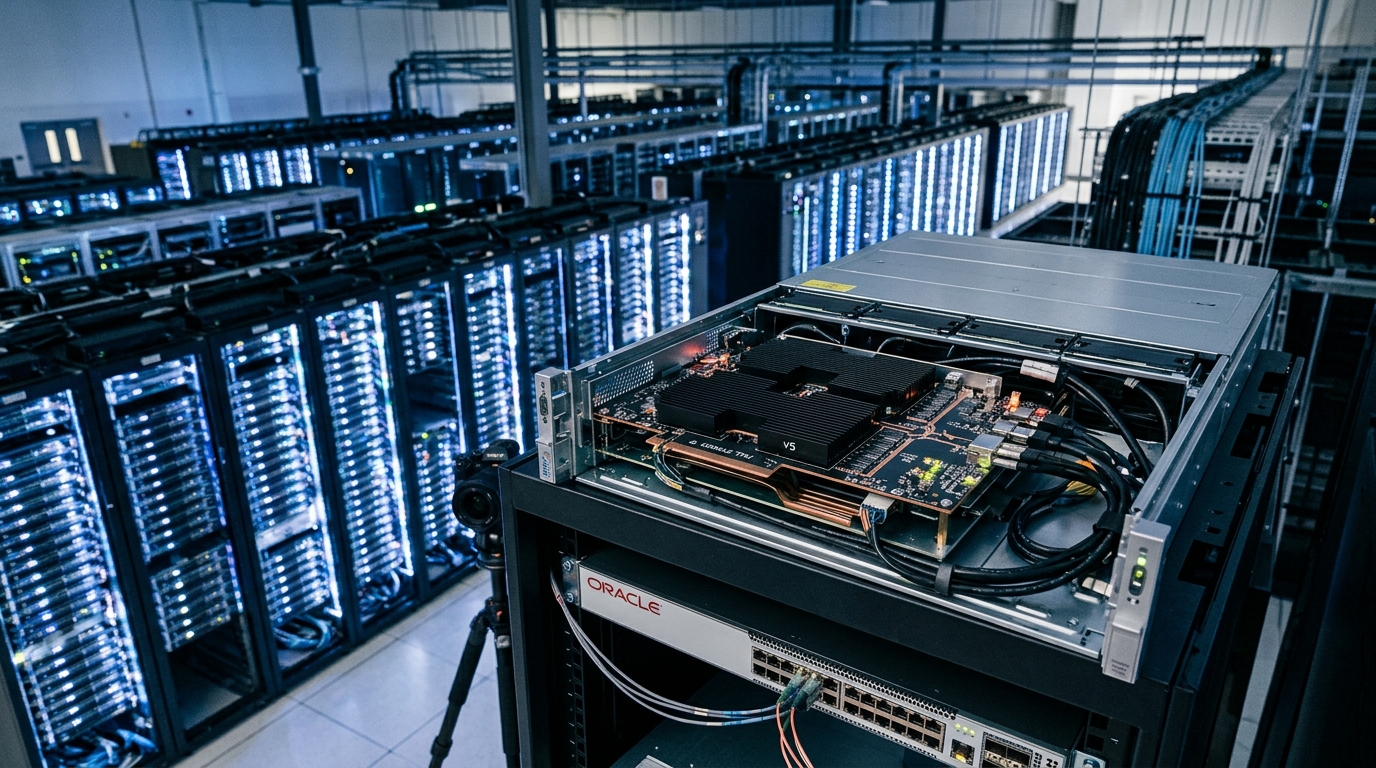
Oracle Cloud Infrastructure will be the first hyperscale cloud platform outside Google to offer Google TPUs, with the service expected to launch in calendar year 2027 and ramp over a multi-year period. Oracle handles the physical infrastructure, providing the power, cooling, and data center networking needed to deploy the systems within OCI. Google supplies the silicon. The arrangement is structurally significant: a chip that could only be consumed through Google’s own cloud now reaches customers via a competing platform.
Google’s eighth-generation TPU includes two architectures, TPU 8t for training and TPU 8i for inference, with TPU 8t delivering nearly three times the compute performance per pod over the previous generation. A low-diameter interconnect design reduces the number of hops data must traverse, and Google says TPU 8i can deliver up to 80% better performance per dollar for low-latency serving versus the prior generation. These are not surplus chips being liquidated. They are leading hardware, now available on someone else’s infrastructure.
The scale of the opportunity being priced into analyst models is striking. Evercore ISI has projected $75 billion in 2027 and $113 billion in 2028 in external sales of Google’s TPUs. Another widely circulated sell-side forecast pegs third-party TPU sales at roughly $20 billion in 2026, rising to about $67 billion in 2027, and then accelerating sharply by 2028. Estimates vary widely, and the business is still in its first commercial year, but the direction is consistent across desks.
Merchant TPU sales shift the capital expenditure burden away from Google to its third-party customers. Alphabet’s 2026 capex guidance is $195 billion to $205 billion, so any incremental revenue that does not require Google to build the data center first is unusually valuable. Oracle absorbs the physical build cost. Google collects the chip revenue. That is an enviable arrangement when you are running one of the largest capital programs in corporate history.
At the same conference, Nvidia and Oracle announced plans to expand OCI Superclusters with Nvidia Vera Rubin NVL72 systems to multi-gigawatt scale, citing growing customer demand for AI training, inference, and agentic applications. Nvidia has put the Vera Rubin platform’s revenue opportunity at about $40 billion per gigawatt, which frames OCI’s multi-gigawatt ambition as a considerable prize for NVDA shareholders as well.
Oracle’s willingness to absorb that infrastructure cost is easier to understand in the context of its own capital commitments. Oracle’s $90-to-$95 billion FY2027 capex plan and $638 billion RPO backlog show how aggressively OCI is betting on AI infrastructure partnerships.
The honest risk is allocation. When pressed on whether TPU external sales would grow into a full merchant-silicon business, CEO Sundar Pichai declined to commit, saying the company would scale based on demand and its own allocation requirements for frontier model development, as well as serving its consumer and enterprise businesses. Selling to Oracle does not change that priority ordering. If Alphabet faces a supply crunch, internal needs come first, and OCI customers wait.
But the strategic inflection is real. A chip built to eliminate a vendor dependency has become the dependency other clouds sell. Over a decade, that transition compounds in ways that are difficult to model today and likely being underpriced in GOOGL’s current valuation.