

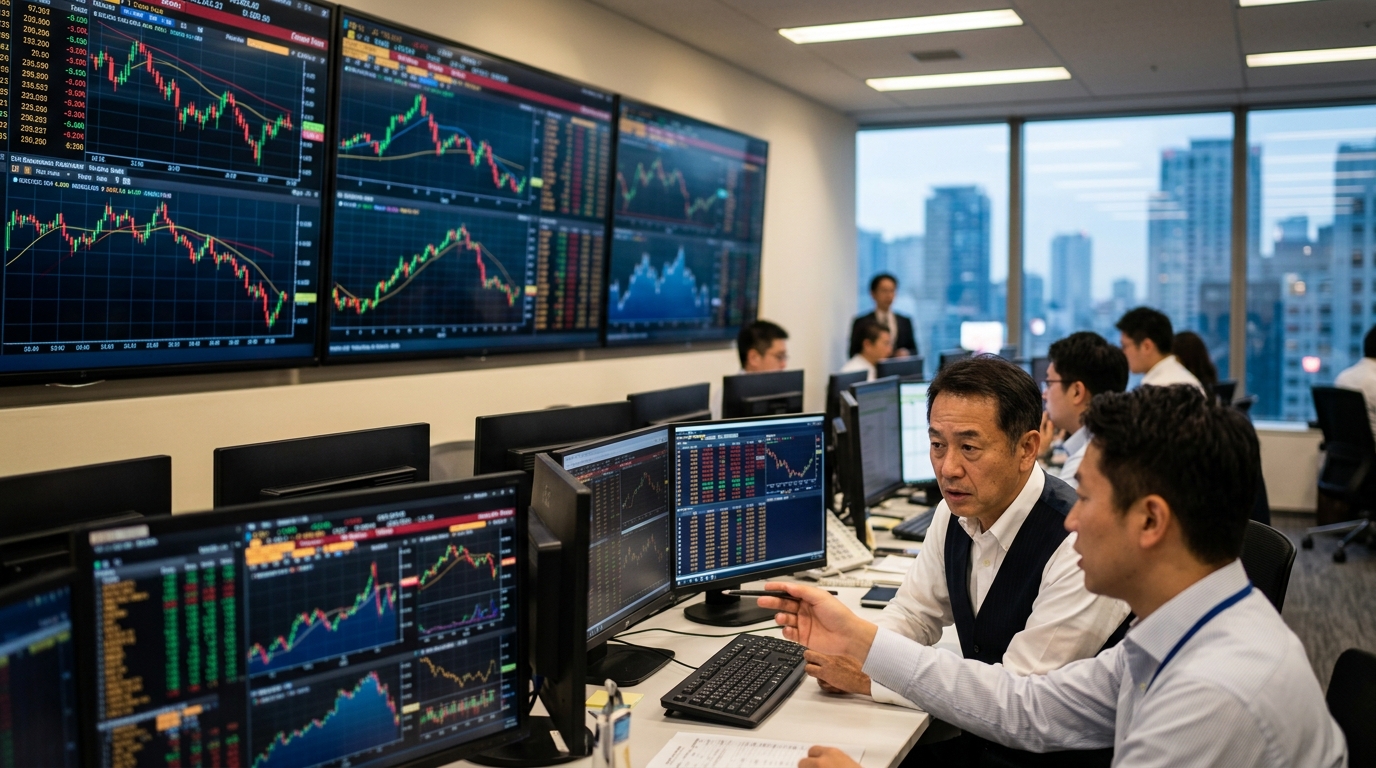
Thursday’s Asian session produced two very different market events wearing the same headline. Seoul’s KOSPI closed down 7.57% at 5,554.22 while Tokyo’s Nikkei 225 fell 4.9% to 64,425.95. Both look bad. But the detail that matters most appeared inside Tokyo, not between the two cities.
The Nikkei fell 4.9%, while the broader Topix lost far less. A gap that wide between a price-weighted index and a market-cap-weighted one is not statistical noise. The Nikkei is price-weighted, meaning companies with higher share prices mechanically sway it more than lower-priced stocks. The Topix, weighted by market value, is a better snapshot of how Japan’s listed companies are doing overall. When those two diverge by roughly a couple of percentage points on a single day, the market is telling you the selling is concentrated, not broad. Japan’s auto makers, banks, and consumer names were not the target. AI hardware was.
What Actually Moved
Selling in Tokyo was concentrated among AI-linked stocks. Advantest fell about 14%, and Tokyo Electron dropped about 7%. SoftBank Group fell about 9%, and Kioxia dropped roughly 11% to 13%, depending on the quote. In Seoul the carnage was less discriminating, because Samsung Electronics and SK Hynix together account for a far larger slice of the KOSPI than any single AI name does of the Topix. SK Hynix sank 11.06% to 1.26 million won, while Samsung Electronics plunged 9.48% to 210,000 won. During the session the index fell more than 9% to an intraday low of 5,450.81, briefly slipping below the 5,500 mark, before paring some losses toward the close.
The sharp decline triggered a sell-side sidecar at 9:07 a.m., temporarily suspending sell orders in index futures-linked program trading. A circuit breaker followed at 12:38 p.m., halting trading across the market for 20 minutes. It was the first time since July 29 that both the KOSPI and KOSDAQ had activated circuit breakers on the same day.
Why It Happened
Two triggers arrived together on Wednesday in New York. CoreWeave shares fell about 16% as yields on its 2031 and 2032 bonds rose close to 15%. The timing mattered: the selloff came on the same day a hotter U.S. inflation reading pushed traders toward a December Fed rate hike, and higher rates for longer raise the cost of refinancing for heavily indebted AI builders. Separately, Gartner said more than $3.5 trillion of AI infrastructure spending could be exposed to impairment by the end of 2030 if investment continues at the current pace.
The combination reframed the AI trade from a revenue question to a credit question. As Seo Sang-young at Mirae Asset Securities put it, “The market is reacting sensitively to whether capital raising will be sustainable and whether massive infrastructure investment will lead to real income, rather than revenue growth itself in AI services.”
What the Market May Be Missing
Foreign investors were heavy sellers again, and the speed matters more than the headline level. A vacuum in steady demand is one reason these moves can gap lower quickly once outflows hit. Market commentary in Seoul has pointed to the fading boost from the large buyback programs at Samsung and SK Hynix, which had been a steady source of demand that does not care much about day-to-day prices. Without that floor, even moderate foreign outflows can pull prices lower fast, which is precisely when circuit breakers kick in.
TSMC’s record earnings were out during the Asia session, but they failed to support the market. That is a signal worth noting: strong foundry results could not arrest a selloff driven by credit fear rather than demand doubt.
Risks and Counterpoints
Wedbush analyst Dan Ives categorized investor panic surrounding CoreWeave as “way overdone” and expects upcoming hyperscaler earnings to reinforce the trajectory of AI infrastructure spending rather than challenge it. Lorraine Tan at Morningstar argued that the problem for heavily technology-weighted markets such as Korea and Taiwan is that any risk to perceived AI spending growth may lead to slower demand growth for chips and equipment. Both views can be right: hyperscalers may keep spending while the financing structure around neocloud providers comes under sustained pressure.
What to Watch Next
The Topix-Nikkei gap will be the first indicator to watch in coming sessions. If the Topix begins to close toward the Nikkei’s loss level, selling is broadening beyond AI names into Japan’s economy at large. If the gap holds, the trade remains surgical. In Seoul, the direction of foreign flows matters more than index levels right now. The KOSPI has fallen for seven consecutive trading days, declining by a cumulative total of about 21% over the period. A reversal in foreign positioning, not a bounce in Samsung’s share price, would be the credible sign that the worst of this leg is over. Beyond Asia, all eyes fall on upcoming hyperscaler earnings from Alphabet, Amazon, and Meta, whose capital expenditure guidance will either validate or puncture the AI spending story that the credit market is currently questioning.