

![Dec 8th – Become 1 of 1,806,000 New “Musk Millionaires” [How To Guide]](https://www.stockmoguls.com/wp-content/uploads/2026/10/4ded152d-a6f3-477b-bbee-fc796f4ea4c7-300x167.jpg)

Why This Stock Now
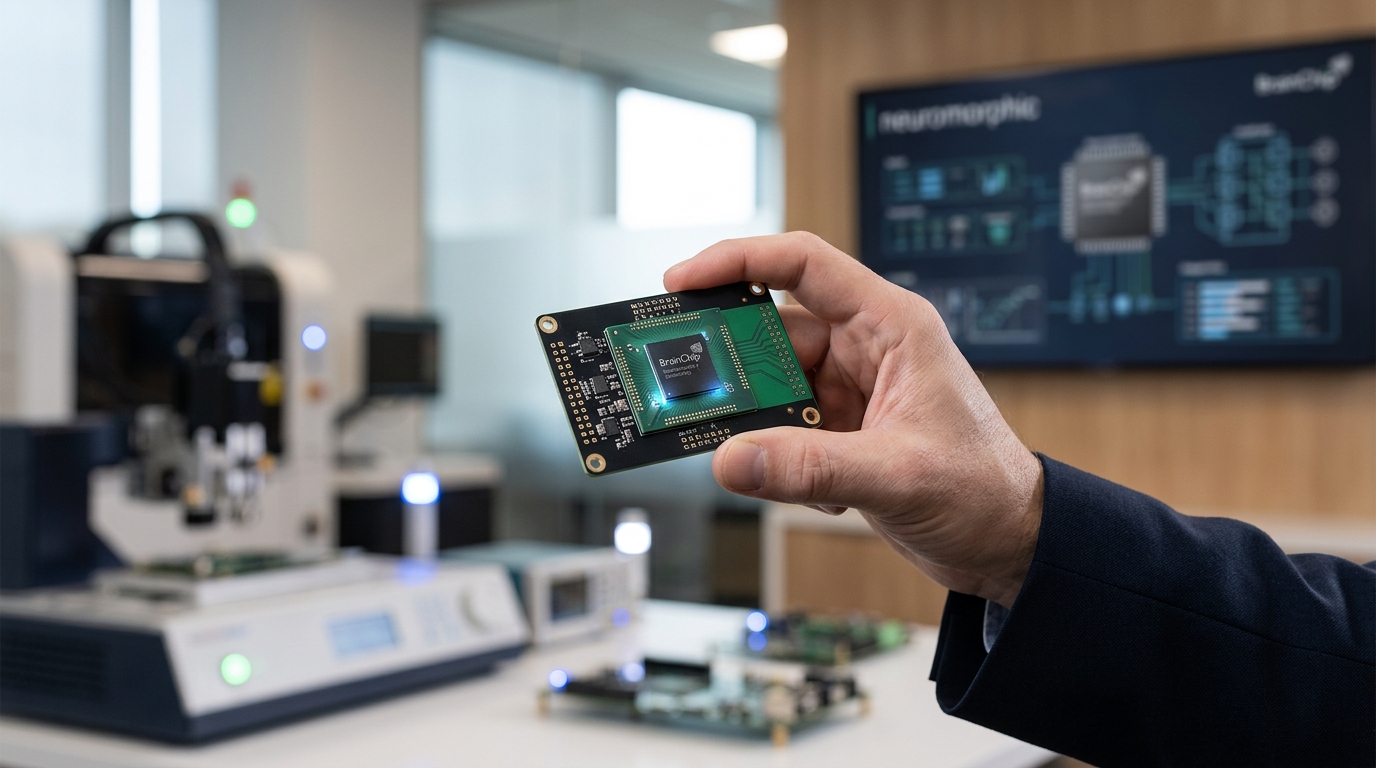
For years, neuromorphic computing was described as the next big thing. In 2026, BrainChip began shipping production silicon and rolling out commercial platforms with named partners. That shift changes the investment calculus, and one company sits at the center of where some of the first dollars are landing.
The Business
BrainChip Holdings (OTCQX: BRCHF; ASX: BRN) is a publicly traded company focused on commercial neuromorphic processors and related IP. Its Akida chip family processes sensory data using spiking neural networks, firing only when something changes in the environment, just as biological neurons do. That architecture is not a gimmick. It is designed to cut power and data movement, which can make it practical for devices running on batteries: wearables, autonomous drones, and other edge endpoints.
The energy math can be stark, but the original figures in this draft are not supported. Intel has publicly discussed Loihi systems and Loihi 2 research platforms, but the specific claim that a “Loihi 3” part was released in Q1 2026 with “8 million neurons on 4nm” and “1.2 watts at peak load” could not be verified in reliable primary sources. Likewise, the statement that “Akida runs SNN inference at 0.5 watts” is too specific to leave standing without a published benchmark or product spec. BrainChip’s own materials emphasize milliwatt-range operation and avoiding wasteful always-on processing, and the company has described typical AKD1500 module-level draws in the hundreds of milliwatts in marketing materials, but power depends heavily on workload and system design.
Why Wall Street Is Paying Attention
The evidence that commercial engagement is arriving is more concrete than “lab only,” but it needs to be described precisely. In March 2026, BrainChip announced the AkidaTag reference platform at Embedded World in Nuremberg. In June 2026, BrainChip announced commercial availability and initial production shipments of its AKD1500 reference chips. BrainChip also promoted CES 2026 demonstrations including a Deep Perception visual computing pipeline using AKD1000 for drones and mobile devices. And in August 2026, BrainChip and Neuromorphyx announced BrainBoard1500, an AKD1500-based embedded developer board platform designed, manufactured, and sold by Neuromorphyx.
The broader ecosystem is validating the category. In June 2026, Prophesee announced Mantara, which it described as an integrated event-based system for drone detection and tracking, alongside a €20 million financing round. Where a conventional camera must capture and analyze full frames, event-based sensors transmit changes, which can reduce latency and data throughput in motion-heavy scenes. Meanwhile, Qualcomm has a China-published patent application describing low-power always-on face detection, tracking, and recognition using event-based vision sensors. That is suggestive of ongoing interest in event-based sensing for always-on endpoint use cases, but a patent filing by itself does not confirm near-term commercialization in mass-market smartphones.
What’s Driving the Opportunity
The market-sizing line in the original draft is too specific to treat as a fact. Some third-party market reports project edge deployment as the dominant share of neuromorphic chip demand in 2026, but the “approximately 68%” figure depends on the specific paid report and methodology. More defensibly: the category’s most obvious early fits are edge endpoints where power, latency, and privacy constraints make always-on sensing valuable.
BrainChip’s positioning is specific. The AKD1500 has been in customer evaluation, and BrainChip has emphasized a model that combines chip and module offerings with licensing of its IP. In principle, licensing and royalties can scale without BrainChip manufacturing every unit, which can keep capital requirements more manageable if design wins accumulate.
What Could Go Wrong
BrainChip remains early. Reference platforms and developer boards are not the same thing as sustained, high-volume shipments. Major players and well-funded research efforts continue to explore competing approaches. Tooling and developer workflow maturity versus mainstream GPU ecosystems can slow adoption, especially for teams that are already standardized on CUDA-centric stacks. The stock trades primarily on the Australian Securities Exchange, with U.S. access through OTCQX tickers BRCHF and the Level I ADR BCHPY, which can mean thinner liquidity than a major U.S. exchange listing.
The Bottom Line
The core question for any early-stage hardware company is whether its market transition is real or perpetually five years away. Prophesee’s Mantara launch and financing in June 2026, Qualcomm’s event-sensor patent publication in March 2026, and BrainChip’s AKD1500 production-shipment announcement in June 2026 all point toward more real-world activity around event-based, low-power visual sensing. BrainChip is small and carries real risk. It is also one of the few U.S.-accessible public equities that offers direct exposure to a company positioning neuromorphic, event-based processing for edge deployment.



![Dec 8th – Become 1 of 1,806,000 New “Musk Millionaires” [How To Guide]](https://www.stockmoguls.com/wp-content/uploads/2026/10/4ded152d-a6f3-477b-bbee-fc796f4ea4c7-768x429.jpg)