



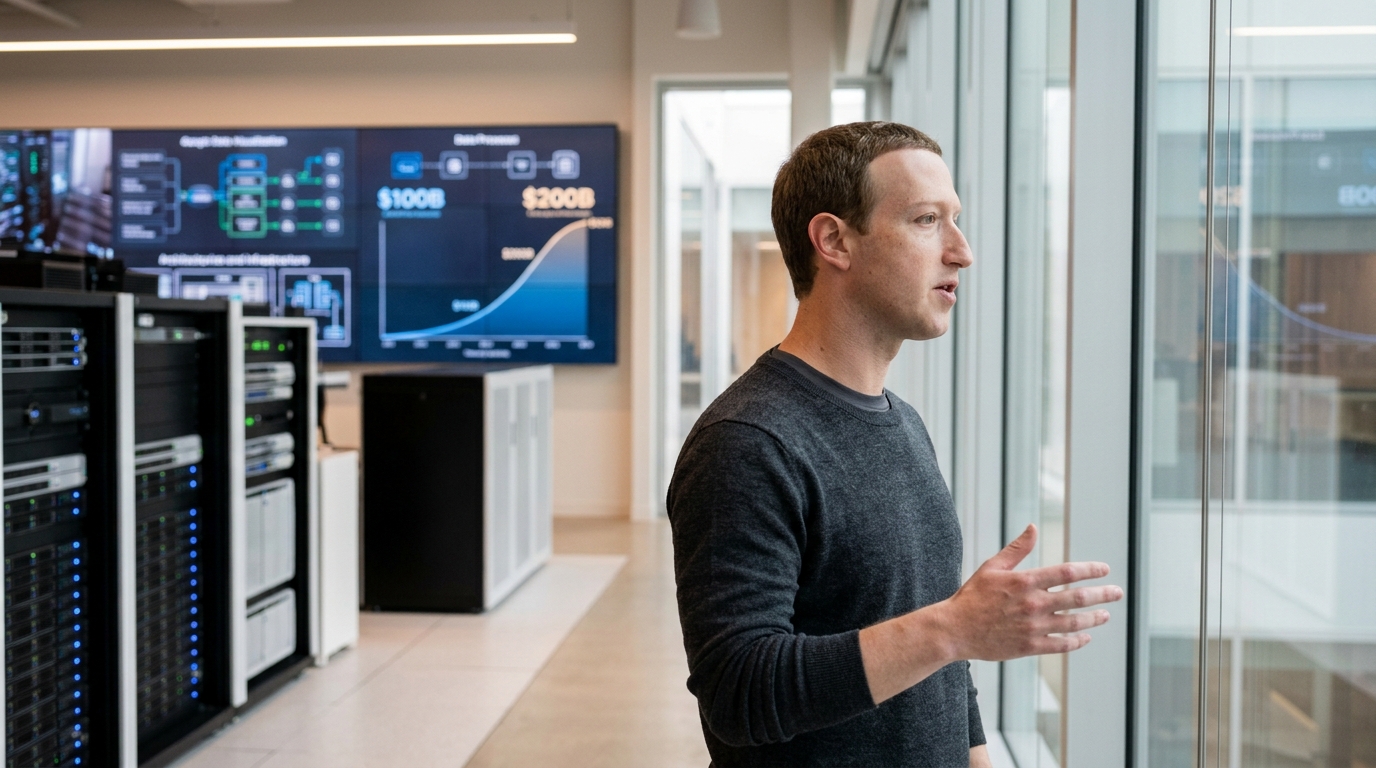
Mark Zuckerberg admitted something last week that most CEOs would never say on a podcast. He said Meta committed to spending up to $200 billion on AI infrastructure before anyone at the company knew whether the technology would succeed. He said it plainly, almost casually: “We’re going to write this check for, like, I don’t know, like $100 billion, $200 billion” before asking his chief AI officer whether he was sure it would work. The honest answer, at the time, was no.
That candor deserves serious analytical attention, because what Zuckerberg described is not a growth investment in the conventional sense. It is a founder betting the financial character of the company on a technology that had not yet proved itself commercially. The only investors history rewards for that kind of move are those who turn out to be right.
The Numbers on the Table
Meta’s narrowed 2026 capex guidance stands at $130–145 billion, up from $72.22 billion actually spent in 2025, which was itself roughly double the $39.23 billion spent in 2024. That compounding acceleration is the point. After the second quarter, quarterly capex had jumped to $31.1 billion, consuming roughly 98% of operating cash flow. Free cash flow fell about 91% year over year in that quarter. For a business that once generated some of the most envied margins in corporate America, that is a striking transformation.
Meta is not the only hyperscaler reshaping its balance sheet around physical infrastructure. Alphabet has committed to long-duration nuclear power deals and Nordic data center sites to lock in the physical layer AI runs on.
Meta is not alone in the spending arms race. Amazon, Alphabet, Meta, and Microsoft are collectively planning enormous capital spending in 2026 aimed largely at data centers, GPUs, custom silicon, and power. But Meta’s position within that group is structurally different. Amazon and Microsoft earn cloud revenue that partially offsets their buildout. Meta’s income is advertising. Every dollar of capex must be justified by what advertising, subscriptions, or transaction fees eventually produce.
The Monetization Argument
The answer Zuckerberg is offering is Muse. The Muse app, built around the new Muse Wonder model, requires users to pay for subscriptions at $20 or $100 per month to access its most capable features. That adoption speed matters, but download counts are not revenue. The harder test is whether those users convert and stay.
Meta is also exploring transaction fees as a monetization pathway, given that Muse currently assists users in reducing costs, creating a framework for charging on the value it delivers. It is a sensible model if scale is achieved. But it is still a model, not a result, and the October 21 earnings call is where analysts will press for early conversion data. Analysts currently expect $63.32 billion in Q3 revenue and earnings per share of $6.28.
The subscription conversion question is not unique to Meta. Anthropic’s first operating profit on $10.9 billion in revenue shows what the monetization curve looks like when an AI product reaches scale.
What Could Go Wrong
The IMF chose the same day Zuckerberg’s podcast aired to name an AI investment correction as a systemic risk. A steep drop in AI investment prompted by disappointment in productivity gains or profitability could cut global GDP by 1.1% by 2028, including a 1.8% fall in US output, the Fund warned.
That is the precise risk sitting inside Meta’s balance sheet. Zuckerberg’s own hedge is that even if Meta’s specific AI consumer products fail, broader AI success means other companies will pay to use Meta’s computing capacity. That is a reasonable fallback, but it is not the thesis investors are paying for at a market capitalization above $1.9 trillion.
The Mogul Verdict
Great capital allocators make asymmetric bets: downside they can survive, upside that transforms the business. Meta’s advertising engine, which generated $59.36 billion in Q2 advertising revenue alone, gives Zuckerberg a cash foundation that almost any other CEO would envy. The infrastructure he is building, including a five-gigawatt cluster in Louisiana and a one-gigawatt-scale facility in Ohio, is real and difficult to replicate quickly.
The question a disciplined long-term investor must answer is not whether the AI opportunity is real. It almost certainly is. The question is whether Meta’s path to earning back $130–200 billion in a compressed timeframe runs through a subscription product with no established revenue history. Muse’s early traction is genuinely encouraging. But the check has already been written. Now the receipts have to follow.