


September 19, 2026
A €13B bet on Finland, a nuclear plant deal through 2050, and a new voice model for enterprises: judge whether vertical control is Alphabet’s durable edge.
The question most investors ask about Alphabet is whether Google Search survives the AI era. The more interesting question is whether Alphabet has quietly positioned itself to own the physical layer that every AI model, including rivals’, will eventually need to run on.
The Supreme Court Protected Your Location. What About Your Financial Data?
In June, the Supreme Court ruled that acquiring an individual’s cell-phone location data constitutes a Fourth Amendment search. But your financial activity on most public blockchains can still be visible. One overlooked altcoin was designed around financial privacy – and our team believes it deserves attention as crypto momentum builds.
Discover our next “Freedom Coin” and get the complete $3 research report today.
What Finland Actually Is
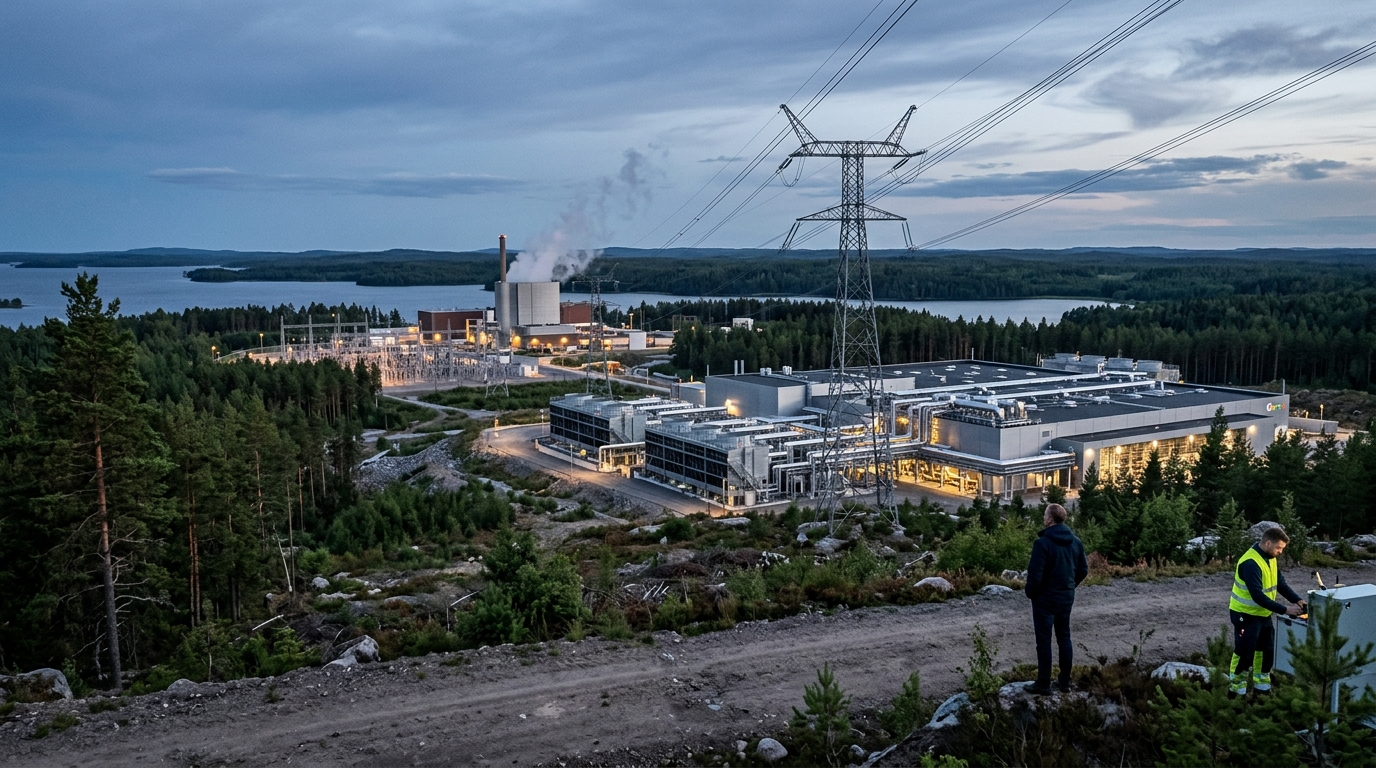
Alphabet’s Google will invest at least €13 billion ($15.1 billion) in artificial intelligence infrastructure in Finland over the next two years, and Fortum says Google has signed a 22-year nuclear power purchase agreement tied to the Loviisa nuclear power plant. The deal is not a real estate story. Finland’s cold climate requires little mechanical cooling, and heat generated by servers can be captured to warm homes. Meanwhile, 96% of electricity production in the country is already CO₂-neutral, led by nuclear and renewables.
That engineering reality translates directly to operating costs. The buildout pairs long-duration power supply with Nordic sites where average air temperatures cut cooling load for most of the year, and cooling routinely runs as a large recurring share of data center operating cost, so ambient cold removes a recurring expense outright.
The energy contract is the most structurally important piece. Fortum says the 22-year power purchase agreement provides the long-term revenue certainty needed to support a lifetime extension and power upgrade program for the Loviisa nuclear power plant, with contracted volumes running through 2050. Google is not merely buying electrons. A data center company’s demand for AI compute is now directly tied to the economics of sustaining and upgrading a nation’s nuclear baseload asset.
The Model on Top of the Infrastructure
Infrastructure is the cost side. Gemini is how Alphabet turns that cost into revenue.
Musk’s Hidden AI Play Could Be the Next Big Thing
While tech giants dominate headlines…
Elon Musk is quietly building a formidable AI enterprise.
This under-the-radar stock offers a unique entry point into his latest venture.
Don’t miss out on this potential game-changer.
Google announced Gemini 3.8 Live and Gemini 3.8 Live Extended Thinking on September 15, 2026, a pair of live dialogue models rolling out through the Gemini API and Google AI Studio, as well as into Search Live and Gemini Live. The company positions Gemini 3.8 Live for scale and cost efficiency, combining conversational intelligence with fluid dialogue and visual grounding, while Gemini 3.8 Live Extended Thinking is built for high-complexity tasks that call for increased intelligence and multi-step reasoning.
Google said the models are rolling out to enterprises in private preview in Gemini Enterprise, with broader enterprise availability coming later. Getting production deployments in healthcare and financial services before competitors lock in contracts is not trivial. Enterprise AI adoption follows switching costs, and Gemini built on Google Cloud is exactly the kind of sticky arrangement that compounds over time.
Alphabet executives have said nearly 90% of the Fortune 100 are using Gemini Enterprise. The models benefit from the same infrastructure Alphabet is now bolting down in Finland.
The Financial Case and the Risk
Google Cloud revenue climbed 82% to $24.8 billion in Q2 2026, driven by demand for AI infrastructure and AI solutions, with Cloud operating income reaching $8.8 billion, up from $2.8 billion in the same period a year earlier. The Cloud backlog tells the longer story: Alphabet reported $513.9 billion of remaining performance obligations related to Google Cloud as of June 30, 2026.
A growing piece of that backlog is tied to Alphabet’s proprietary Tensor Processing Units. In April 2026, CEO Sundar Pichai said Alphabet would begin delivering TPUs to a select group of customers for installation in their own data centers, aiming first at AI labs, capital markets firms, and high performance computing users. Oppenheimer has said external TPU sales could represent roughly $170 billion in cumulative incremental revenue through 2028 that is not in Street estimates.
5 Little-Known Stocks Behind Today’s Defense Tech Shift
Behind the headlines, a major transformation is underway.
Modern warfare is being driven by AI, autonomous systems, and next generation technology. A handful of lesser known companies are helping power this shift.
This report uncovers five stocks quietly playing a critical role in the future of defense.
The risk is real and worth stating plainly. Alphabet reported free cash flow of roughly negative $5.9 billion in Q2 2026, and long-term debt stood at about $98.2 billion as of June 30, 2026. Capital commitments of this scale require the revenue conversion to arrive on schedule. If enterprise AI adoption stalls or a competing model cuts deeply into Cloud wins, the Finland infrastructure becomes a fixed cost burden rather than a moat.
On the stock, Evercore ISI analyst Mark Mahaney raised his price target to $450 from $420 and reiterated an Outperform rating in mid-September 2026. Tigress Financial raised its price target to $485 from $415 and kept a Strong Buy rating.
The Long-Term Verdict
The mogul’s edge in AI infrastructure is not the model. It is the land under the data center, the power running through the facility, and the silicon processing the requests. Alphabet is assembling all three in Finland while simultaneously pushing Gemini into enterprise workflows that generate recurring, high-margin revenue.
Instead of treating electricity as an external utility purchased after computing facilities are designed, major technology companies increasingly have incentives to participate in securing and shaping the energy supply itself. Alphabet is not following that trend. It is setting the pace. Whether $15 billion in Finland proves to be a generational infrastructure advantage or a monument to peak-cycle enthusiasm depends almost entirely on how fast enterprise AI adoption converts that backlog into reported earnings. The architecture of the bet is sound. The execution risk is large. Long-term investors should watch Cloud margins over the next four quarters more closely than any benchmark score Gemini publishes.