


New to Trading Options? Try THIS
An Easy Options Strategy For Beginners:
Get the Strategy + the “Battle-Tested” ticker today – FREE

✓ How the 11-Hour Options Strategy works – explained in plain English, from A to Z…
✓ The three things you need to start trading options today.
✓ Why this single-focused window has so much more potential than grinding through charts all day (and lets you actively trade while still LIVING your life).
✓ See a simple 3-question filter you can use to help protect yourself before ever placing a trade.
✓ And the exact “rinse and repeat” ticker used nearly 900 times with a 95.3% win rate, just to get you started.
Send me my Free Copy of the 11-Hour Options For Beginners Guide – NOW
To your trading success,
Dave Aquino
Base Camp Trading
TSMC Is Building a Second America. What That Is Worth.
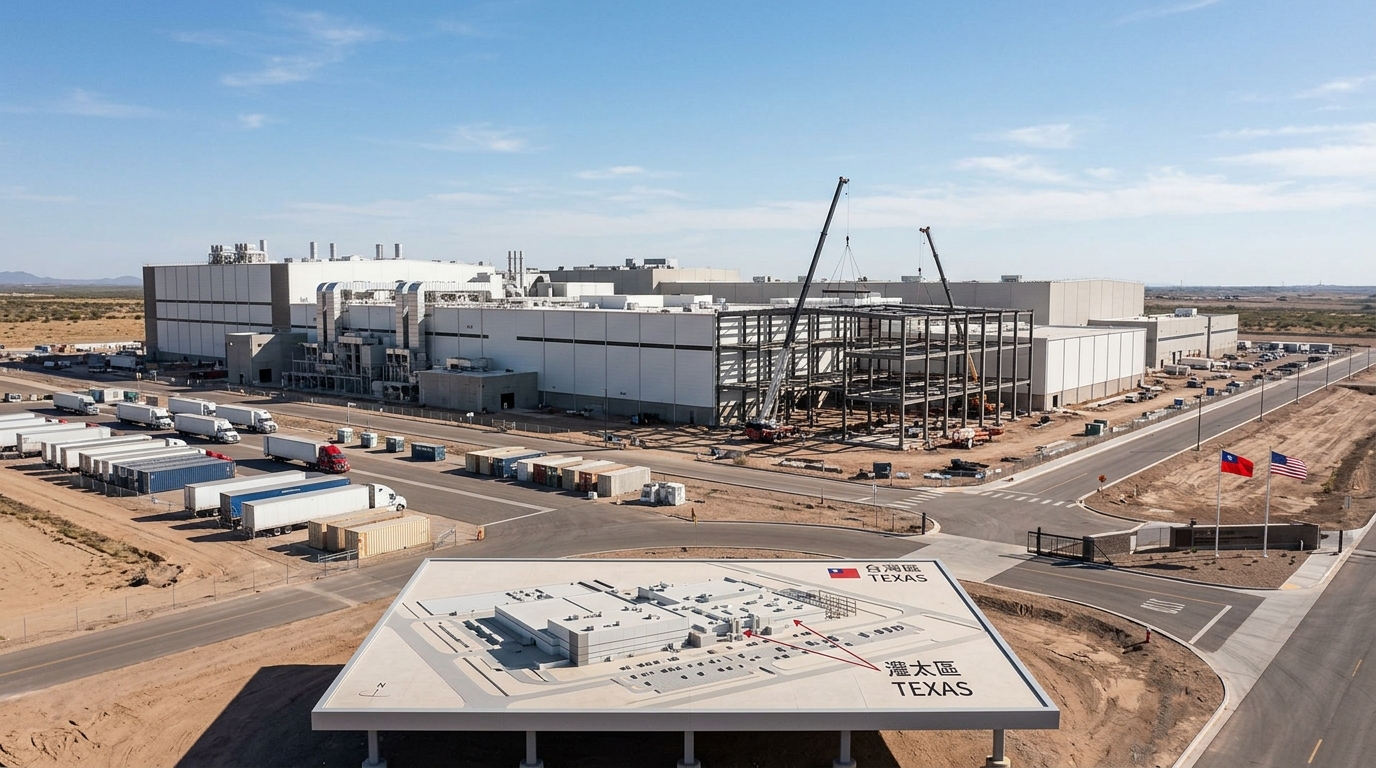
There is a moment when a company stops expanding and starts relocating the center of gravity of an entire industry. TSMC may be approaching that moment.
Taiwan Semiconductor Manufacturing is weighing a new campus in Texas, a move that would add tens of billions of dollars to an already extraordinary U.S. footprint. The go-to chipmaker for Nvidia and Apple is looking at further overseas facilities to handle unrelenting AI hardware demand, and the envisioned Texas investment would involve multiple fabs on top of the $265 billion TSMC says it has expanded its Arizona plans to.
Each fab in the Texas campus would cost at least $20 billion. The broader scope under discussion mirrors what TSMC has publicly described for Arizona: six wafer fabs, two advanced packaging facilities, and a research and development center. If Texas ever matched anything close to that, it would not look like a single project. It would look like a second U.S. anchor for advanced chipmaking.
The business logic behind this is not complicated. In 2025, North America accounted for about 75% of TSMC net revenue by region, a reminder of where the center of demand already sits. Key clients include Nvidia, Apple, and AMD, all of which lean heavily on TSMC to manufacture their most advanced designs. Management has repeatedly described demand as strong across leading-edge nodes and advanced packaging, with advanced packaging in particular widely viewed across the industry as a key constraint for AI systems. Building more capacity in America is not a diplomatic gesture; it is an operational necessity.
The financial quality of the business underneath this expansion is what disciplined long-term investors should study. TSMC reported Q2 2026 revenue of $40.2 billion with a gross margin of 67.7%, and it raised its full-year 2026 revenue growth target to slightly above 40% while lifting its 2026 capital expenditure budget to $60–$64 billion. In the first quarter of 2026, TSMC held a 73% share of the global pure-foundry market, according to Counterpoint Research. A business generating those margins while simultaneously commanding that share is not easily disrupted. Samsung operates in Texas already, but has not closed the process-technology gap with TSMC at the leading edge.
The long-term case rests on geography as a moat. Texas is attractive partly due to existing chipmaking infrastructure and a deep industrial base. Arizona, meanwhile, has faced well-documented execution challenges, including higher costs and labor constraints typical of greenfield leading-edge builds. Two complementary campuses across two states, connected to the same customer base, is a supply-chain resilience argument that Nvidia and Apple will happily pay a premium to support.
The risks are real. The potential Texas investment is contingent on U.S. lawmakers extending the CHIPS-era Advanced Manufacturing Investment Credit for new projects, which under current law expires for qualified property whose construction begins after 2026. The credit rate is 35% for facilities placed in service in 2026 and later (and 25% for those placed in service before 2026). For a project where a single fab could cost $20 billion or more, a 35% credit is not a rounding error. Whether Congress extends the credit could determine whether Texas becomes a construction site or remains a slide in a strategy deck.
The board has not approved the plan, and no final site decision has been publicly announced.
The next concrete checkpoint is TSMC’s earnings call on October 15, 2026, when the company reports third-quarter results and typically updates its global manufacturing footprint.
A decade from now, the question will not be whether TSMC dominated advanced chipmaking. It already does. The question will be whether it managed to anchor that dominance in a geography that removed geopolitical and concentration risk for its biggest customers. A Texas campus, if built, helps answer that question decisively. That kind of durable, customer-embedded competitive position is precisely what the best long-term investors have always been willing to pay for, and rarely get the chance to buy while it is still being constructed.