



Six days. That’s how long until the largest earnings event of the quarter lands.
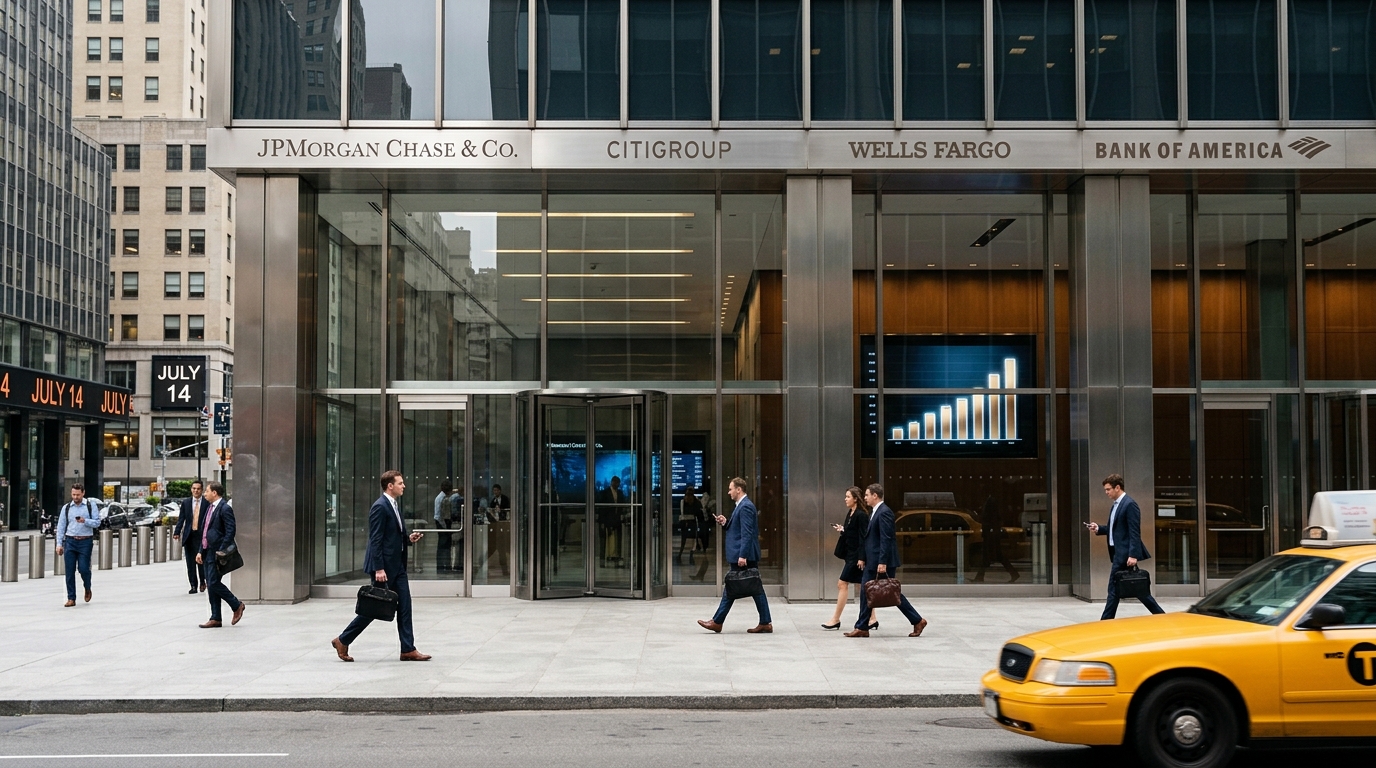
JPMorgan, Citigroup, and Wells Fargo report on July 14. Bank of America also reports July 14, and Morgan Stanley follows on July 15. This is not just a sector event. The Finance sector is the second-largest earnings contributor to the S&P 500, accounting for approximately 16.4% of the index’s expected forward 12-month earnings. What these banks say about loan demand, credit quality, and the macro environment will set the tone for the entire reporting season.
The numbers the market is walking in with are not modest. The broader market setup into earnings season is aggressive. FactSet data cited this week points to expected S&P 500 Q2 EPS growth of about 22.5% year-over-year. These are not easy comps to clear.
JPMorgan: Still the One
JPMorgan (JPM) is the fulcrum name. Analysts are forecasting Q2 EPS of approximately $5.44-$5.49 — up roughly 9.7% from the year-ago quarter. For full-year 2026, the consensus EPS estimate is $22.44, representing about 10.3% growth over fiscal 2025. The prediction market has JPM beating those estimates at roughly 96% implied probability, and the historical base rate backs it up: JPMorgan has beaten Wall Street EPS estimates in 14 of the last 16 quarters.
Management reiterated full-year 2026 guidance after Q1, with net interest income of approximately $103 billion, adjusted expense guidance around $105 billion, and a Card net charge-off rate of about 3.4%. Q1 results were genuinely strong — net income rose 13% to $16.5 billion, revenue increased to $49.8 billion (reported) / $50.54 billion (managed), and Markets revenue rose 20% year-over-year with Fixed Income Markets up 21%. The ROTCE came in at 23%.
Here’s the thing: JPMorgan guided its full-year NII slightly lower after Q1, from $104.5 billion to roughly $103 billion. That was enough to clip the stock earlier this year. The Q2 earnings call will determine whether that revision was conservative sandbagging or a genuine signal that rate-sensitivity pressures are building.
What’s interesting is the broader macro context heading into July 14. Q2 earnings season is beginning against a backdrop of May CPI at 4.2% year-over-year — the highest reading since April 2023 — a weak June jobs report (only 57,000 payrolls added), and continued uncertainty around tariffs. Fed Chair Kevin Warsh has said prices remain too high, and the July 28-29 FOMC meeting is already being watched closely. For banks, a higher-for-longer rate path protects net interest margins. But it also increases the risk of credit deterioration if consumer spending slows.
What Traders Are Actually Watching
Four variables dominate the Q2 bank earnings read:
- Net interest income trajectory: Did the yield curve’s loss of steepness in Q2 compress margins further, or did loan growth offset it? Loan growth began improving in 2025 and continued in Q1 2026. The Q2 trend matters for back-half NII guidance.
- Credit quality: Card net charge-off rates are the leading indicator. JPMorgan’s guidance of approximately 3.4% is the benchmark. Any deterioration — especially in consumer credit — lands across the entire sector.
- Trading revenues: Mid-quarter updates from several banks indicated trading revenue growth in the +10% to +15% range. If that momentum held into Q2, the trading desks will carry the quarter.
- Capital returns and M&A tone: M&A activity has been underwhelming this year, weighed down by geopolitical uncertainty. Any commentary suggesting deal pipelines are rebuilding would be a positive catalyst for investment banking fees in H2.
Wells Fargo is the one to watch carefully. Estimates for WFC have been trimmed while JPM, BAC, and Citigroup have seen modest upward revisions. Wells is still in the “prove it” phase of its turnaround, and any further NII guidance cut will reprice the stock immediately. The Dow Jones hit a record at the end of June — a sign of demand for stocks outside of the AI trade — and banks have been part of that rotation. Whether it holds after earnings depends heavily on what JPMorgan says about the second half.
The Options Framework
Options traders were pricing roughly a 3.87% implied move in JPM around the Q1 earnings event. For Q2, with more macro uncertainty and a higher bar, the expected move is likely in a similar range. At current price levels, that translates to meaningful dollar volatility per contract.
Bull case — for traders expecting confirmation of the constructive trend: A bull call spread in JPM using the July 18 expiration — buying the at-the-money call, selling a strike roughly 5% above current price — limits premium at risk while capturing the upside if the quarter confirms accelerating loan growth and resilient credit.
Bear case — for traders who believe NII guidance disappoints again: A defined-risk put spread, buying the July 18 put at current levels and selling a strike 5-7% lower, monetizes the downside scenario while capping maximum loss. The risk here is that JPMorgan has a demonstrated history of conservative guidance — a miss is historically rare and would require a sharp deterioration in credit losses or a major one-time charge.
Sector play — for traders wanting broad bank exposure: The Financial Select Sector SPDR ETF (XLF) has lagged the broader S&P 500 meaningfully this year. Options on XLF currently price a subdued expected move, which means the premium is relatively modest for the potential catalyst ahead. A defined-risk call spread on XLF through the July 18 expiration captures sector-wide upside if the four major banks collectively signal a constructive H2 outlook.
The Number That Matters Most
S&P 500 aggregate Q2 earnings are expected to rise about 22.5% — the fastest pace in years. That’s the number the rest of the season has to confirm. The banks, reporting first, either validate that picture or crack it. Their tone on loan demand, credit, and the consumer is the market’s first real data point on whether the H2 acceleration in the consensus is real.
Twelve financial institutions report in the next eight days. The conversation about what this earnings season actually means starts Monday morning.