

Dear Reader,
Every two years, you can vote out every member of the House.
On November 3, Americans voted. Two days later, the Dow dropped more than 1,800 points in a single session.
Elections can move markets for a day.
But the most powerful people over your money… never face a single vote.
The Federal Reserve’s governors are appointed to 14-year terms. And according to the Fed itself, they can’t be removed for their policy views.
That’s not an accident. It was DESIGNED that way.
Six men drew up the plan in secret on Jekyll Island in 1910… and didn’t admit the meeting happened until the 1930s.
Since the Federal Reserve Act was signed in December 1913, the dollar has lost 97.0% of its buying power, per the government’s own CPI data.
You can’t vote that out.
But you can stop keeping everything inside it.
I show you the back door in a free presentation.
To your wealth,
Tan Gera, CFA
Decentralized Masters
P.S. On November 5, the market gave back its entire post-election rally, and then some, in one session. Elections come and go. The Fed stays. Watch the free presentation and see the way out →
Goldman Says 52 GW Is Coming. Moratoriums in Aurora and Michigan Show Who Actually Controls the Grid.
The constraint on artificial intelligence has quietly shifted. It is not Nvidia’s production schedule. It is not data center construction timelines. It is the grid itself, and Goldman Sachs published a figure this week that makes that case with unusual clarity.
In a November 24 research note, Goldman estimated that 52 gigawatts of additional data center power capacity could enter service in 2028 alone, Reuters reported Tuesday. To put that in proportion: Goldman expects the average power capacity of a single US data center building to reach 49 megawatts in 2028, up from 31 this year and 16 in 2020, Reuters reported. The buildings are not just multiplying. They are getting dramatically hungrier.
The bank reported that US data center capacity and electricity demand have increased nearly 30% so far in 2026, representing more than one-third of the country’s overall electricity demand growth, Reuters reported. The projected growth in 2028 far exceeds the assumptions underpinning Goldman’s existing natural gas outlook, and the analysts said the new estimates reinforced their bullish view on US natural gas prices through 2030, Reuters reported.
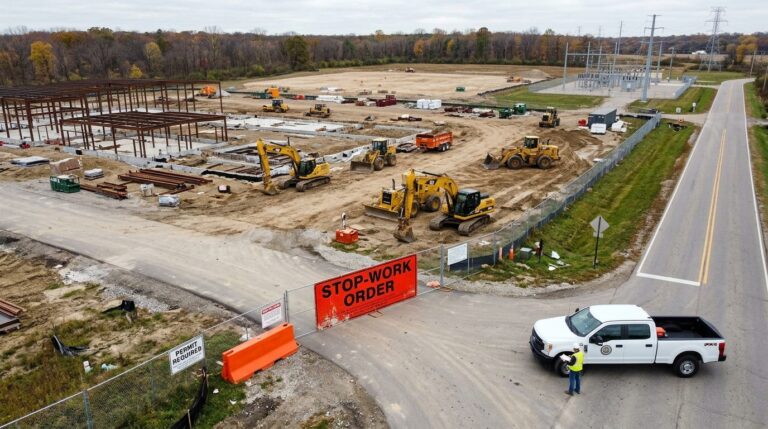
The same week Goldman published those numbers, two communities decided they had seen enough. The Aurora City Council in Colorado unanimously approved a partial moratorium on new data centers on November 23, 2026, following months of community opposition and earlier unsuccessful attempts to pause development. In Michigan, Wayne County put a temporary stop to construction on Google’s data center site in Van Buren Township, and the county issued a stop-work order to Panattoni Development Co., the company developing the 1-gigawatt campus for Google.
These are not isolated events. They are a signal about where power over the build-out actually sits: with the entities that already control generation and electrical infrastructure, not with the hyperscalers racing to build.
The Generators Locking In Contracts Now
Constellation Energy operates the largest nuclear fleet in the US at about 32 gigawatts of largely carbon-free, dispatchable baseload power, and it signed a 20-year power purchase agreement with Microsoft to restart Three Mile Island Unit 1, creating a template that every other hyperscaler has since tried to replicate. CEG has said it has a 10-gigawatt-plus PPA pipeline for data center customers.
Vistra signed a major power purchase agreement with Meta Platforms for about 2,600 megawatts of energy and capacity from its PJM nuclear plants. Bilateral contracting allows asset owners to capture scarcity value before that scarcity appears in public power curves. Vistra is the closest public read-through because it combines a large ERCOT generation position with retail load, commercial capabilities, and experience managing integrated power exposure.
NRG Energy receives less attention than Constellation and Vistra, but is also expanding power capacity to meet AI data center demand. Its generation fleet is about 25 gigawatts, and it cannot offer hyperscalers the 24/7 carbon-free baseload that drives premium PPA pricing, but it commands a large retail customer base and is pivoting toward data center power models. At scale, that is a different kind of positioning.
The Equipment Company With a 15-Year Pipeline
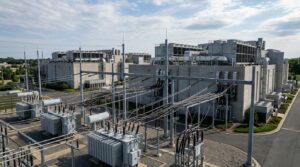
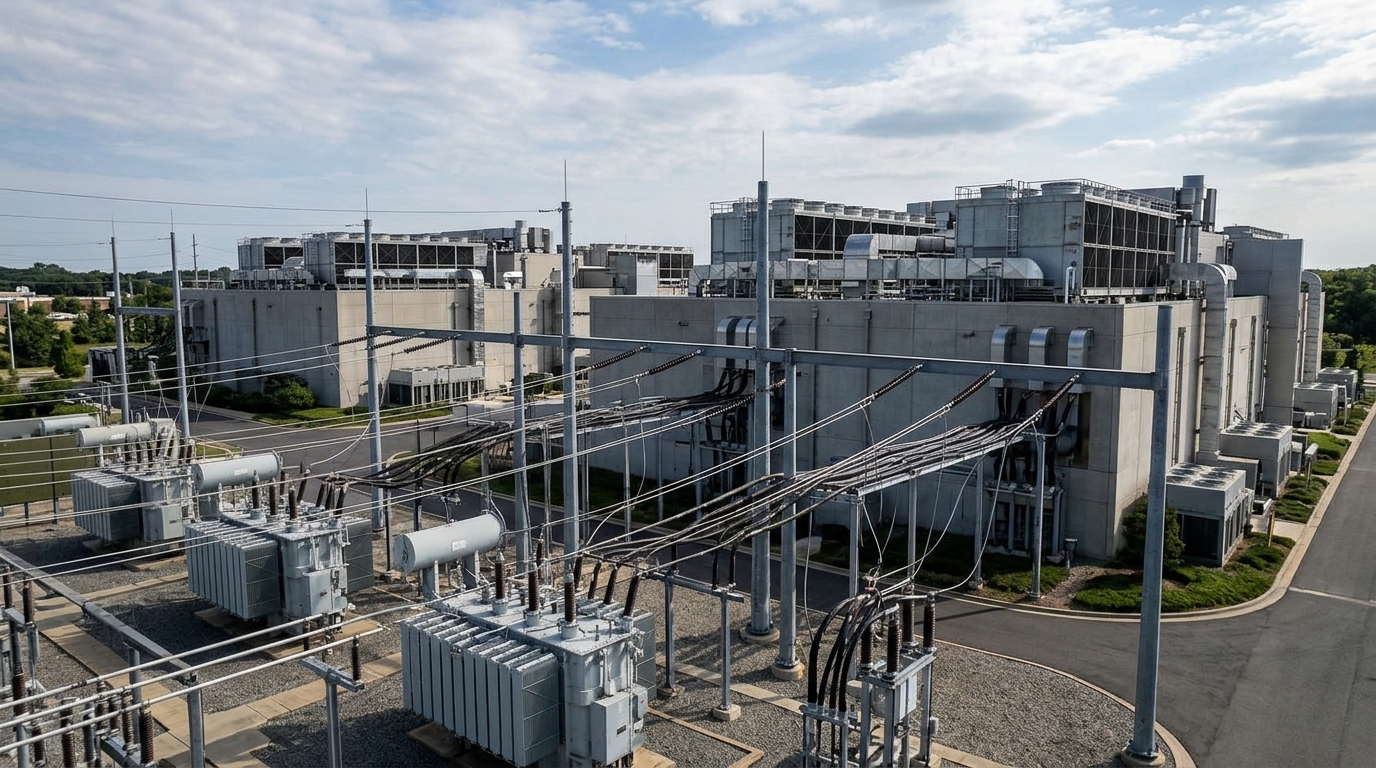
Among the beneficiaries of the Goldman forecast, Eaton may carry the most durable economics. Power transformers are now a rare commodity, and major manufacturers including Eaton have backlogs stretching multiple years. Eaton has said its total US data center backlog stood at 307 gigawatts as of its second-quarter update, equivalent to 15 years of backlog at 2025 build rates.
In the second quarter, Eaton’s sales reached a record $8.5 billion, a 21% jump from the prior year, and management said data center revenue was up roughly 65%. Total backlog at September 30, 2026 had grown to approximately $26.2 billion. Goldman’s forecast of 52 gigawatts in 2028 does not threaten that position. It extends it.
What Could Go Wrong
Announced data center projects do not necessarily translate into immediate energy consumption. Goldman’s earlier research estimated that only 50% to 60% of capacity scheduled for completion over the following one to two years would become operational on time. The actual pace of implementation still depends on power supply capacity, grid upgrades, and the sustainability of capital spending by major cloud providers and AI companies.
Community backlash is accelerating too. Aurora is not an outlier. The moratoriums tracker shows pauses spreading across Colorado, Illinois, Utah, and Michigan. Each one raises permitting friction, delays interconnection, and concentrates power demand in jurisdictions still willing to absorb it. Goldman notes that Virginia and Texas alone are projected to account for 36% of all new US data center power capacity in 2028, which means geographic concentration risk is real.
The permit friction is now forcing hyperscalers to change their public posture on cost allocation. Microsoft’s commitment to pay its own way on grid costs is a direct response to the political backlash spreading across states and localities.
The investment question is not whether 52 gigawatts arrives on schedule. Goldman itself does not guarantee it will. The question is which companies profit whether the build runs hot or cold: the generators with locked-in contracts, and the equipment makers whose backlog extends further than any single project can disrupt. That is where this story lives.