



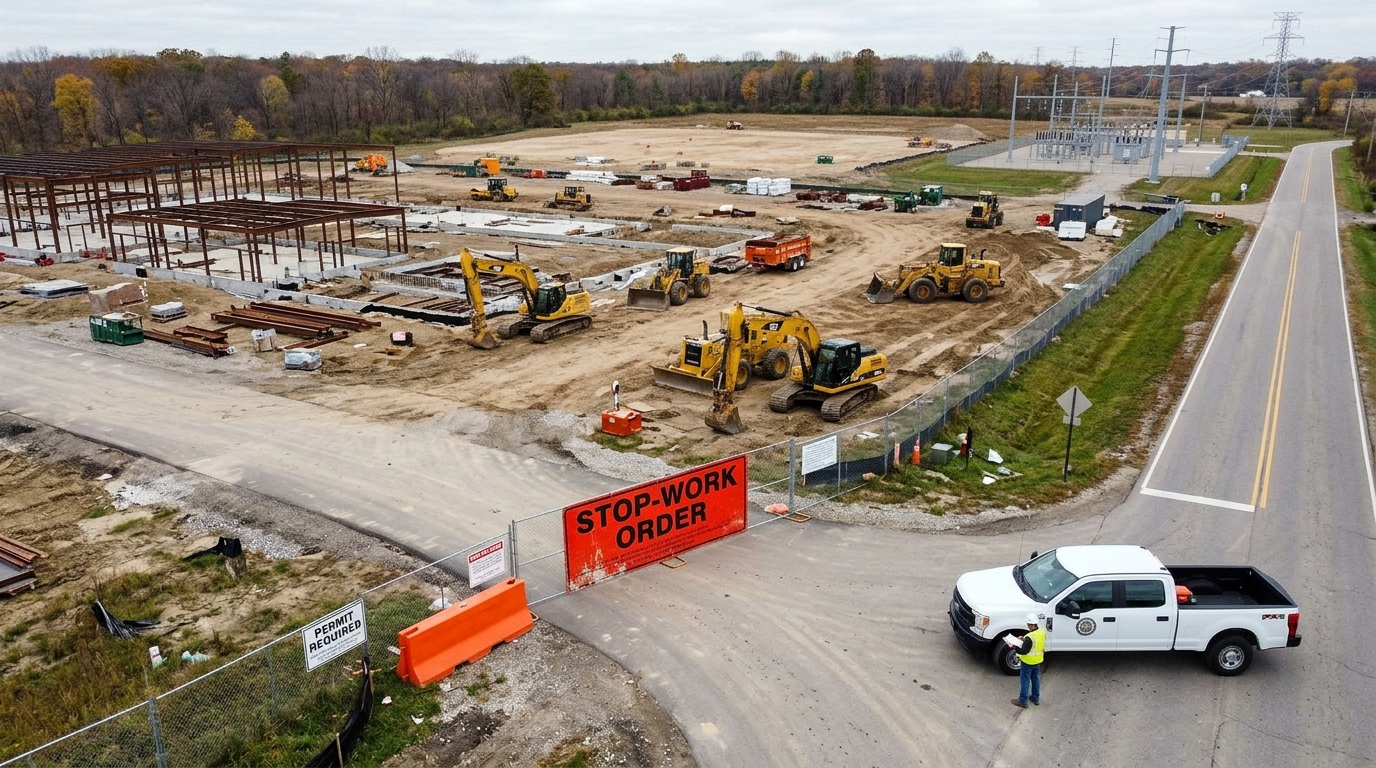
Google’s Project Cannoli is a 1-gigawatt data center planned for about 282 acres in Van Buren Township, Michigan. It cleared township planning, secured a roughly $125 million local tax break, and had construction crews on-site. Then, on November 20, Wayne County issued a stop-work order after concluding developer Panattoni had done unpermitted work in county rights-of-way and work that violated the county’s stormwater controls. Work stopped. A county spokesperson confirmed construction had halted as of November 24, with no timeline for resumption.
Three days earlier, Aurora, Colorado unanimously passed a one-year moratorium on new data centers in defined areas of the city. The Aurora City Council passed the moratorium in a unanimous vote after earlier attempts at a moratorium had not advanced. Vantage Data Centers, which had planned the Trident project near the Windler and Green Valley Ranch neighborhoods, said it is reviewing alternative sites in response to community concerns. The proposed Trident campus has been described by local opponents as a roughly 500-megawatt project on about 108 acres.
These are not isolated events. Reporting this year has pointed to a growing pattern: local pushback forcing delays, withdrawals, or redesigns of large projects. One widely cited count has put the number of U.S. jurisdictions adopting data-center moratoriums at more than 500. Aurora also joins a broader set of Colorado Front Range communities that have debated or adopted tighter rules around data center siting and impacts.
The investment implication cuts against the obvious read. When Google loses a permit battle and Vantage loses a site, the story is not that AI infrastructure spending is slowing. The demand for artificial intelligence infrastructure and cloud computing remains intact, and when local regulations restrict new construction, the existing, fully energized supply becomes substantially more valuable.
That is a direct benefit for the companies that already own it. Data center REITs have returned about 36% year to date, making them one of the best-performing property sectors on the Nareit board outside hotels. Two of the largest publicly traded data center REITs are Equinix and Digital Realty Trust. Existing facilities can be advantaged when new rules slow new builds, forcing major technology companies facing construction delays to lease from established operators at higher rates.
The scarcity premium extends beyond the real estate itself. Electrical switchgear lead times of 52 to 80 weeks mean that even approved projects face years of delay before a single server goes live.
On the utility side, the constraint is equally pronounced. Dominion Energy, Virginia’s primary electric utility, reported 54.9 gigawatts of data center capacity in various stages of contracting as of its third-quarter 2026 disclosures, a 13% increase from the end of 2025. Dominion’s service territory in Northern Virginia is the world’s largest concentration of data center infrastructure. When Michigan’s attorney general challenged the Michigan Public Service Commission’s approval of DTE’s Google data center contracts over potential ratepayer cost-shifting, and when county engineers stopped the same project over a county permit issue, it underscored that replicating what already exists in Loudoun County is harder than it looks.
The capacity crunch is not limited to permitting offices. PJM’s capacity market has cleared at the price ceiling two consecutive years as data center load growth outpaces available supply.
The mogul’s question here is not which hyperscaler builds the most gigawatts. That race will continue regardless of local resistance. The question is who collects rent on the capacity that already exists and cannot easily be replicated. New data center zoning restrictions and rising construction costs are boosting pricing power for established operators Equinix and Digital Realty, which both reported record third-quarter bookings, while voters favored limits on data center development in 40 of 41 local ballot measures across 10 states.
A county drainage ordinance just made that pricing power stronger. Every moratorium that holds is, in effect, a moat.