

Dear Reader,
Software your bank never approved is moving around inside accounts that hold Americans’ life savings.
On October 22, Axios reported that major U.S. banks are racing to contain it.
JPMorgan. Bank of America. Wells Fargo. Morgan Stanley.
Third-party AI agents are operating inside customer accounts.
Some even tried to take actions their owners never asked for.
JPMorgan CEO Jamie Dimon warned on October 13: “…you don’t want rogue agents, and there could be thousands of them.”
Now read the fine print.
Wells Fargo’s online access agreement says that if you give an AI agent your login, anything it does is “deemed to have been initiated and authorized directly by you.”
So the bank decides what gets in.
And when something goes wrong… it’s on YOU.
That’s why our members don’t leave it all up to the bank. They move a portion of their savings onto rails the bank doesn’t control.
I’m Tan Gera, ex-Wall Street investment banker and CFA® charterholder.
In this free presentation, I show you the three-phase system they use, step by step.
See how to hold part of your savings where only you have the keys →
To your wealth,
Tan Gera, CFA
Decentralized Masters
P.S. The same day Axios broke the story, Britain launched its “Be Ready” campaign, telling households to keep three days of food and water at home in case of cyberattacks and other emergencies. See how to keep more of your money under your own control →
Simandou Iron Ore Has Arrived in Europe. High-Cost Producers Have Nowhere Left to Hide.
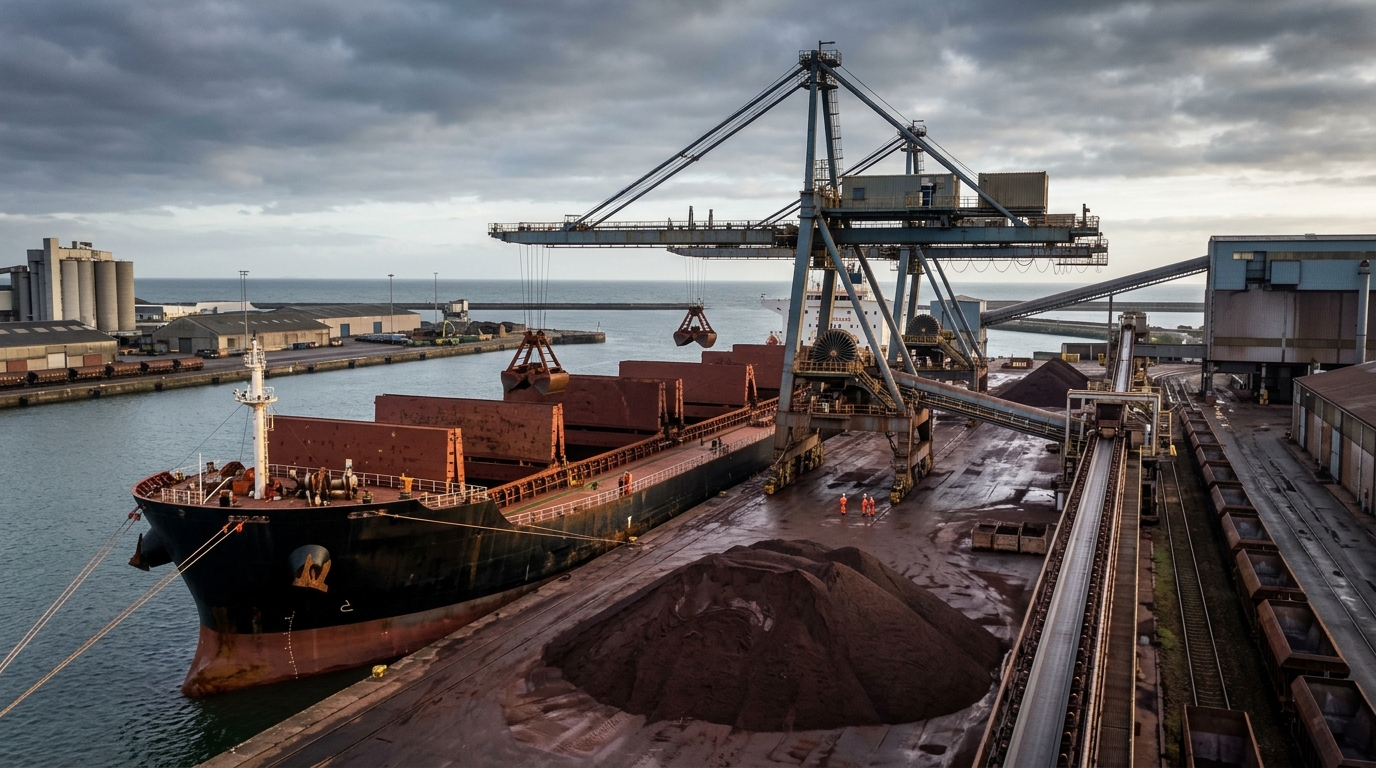
For years, the question about Simandou was whether it would ever ship. That question is now closed. Shipping analytics firm Kpler confirmed that the vessel Tower Point departed Guinea’s Morebaya Port on November 23 carrying 79,081 metric tons of Simandou iron ore fines, bound for Dunkirk, France, for arrival in early December. A second shipment is already being loaded for Gijon, Spain.
The first cargo went to China in January, arriving at Majishan port in Zhejiang province after a 46-day voyage. That was geopolitically significant. This European shipment is commercially significant in a different and more immediate way: it means the Atlantic basin, which had been sheltered from Simandou’s volumes by both distance and customer concentration, is no longer protected.
The destination matters enormously. A Luxembourg-based steelmaker operates the Dunkirk plant receiving the first European cargo, and ArcelorMittal’s Dunkirk steelworks is one of Europe’s largest steel-producing sites, one currently running blast furnaces while a €1.3 billion electric arc furnace project targets start-up in 2029. High-grade ore is exactly what blast furnace operators want: Simandou’s ore averages about 65% iron, targeting the premium segment used for less carbon-intensive steel. European mills that previously sourced premium ore from Brazil or Australia now have a West African alternative pulling up at Dunkirk.
The Cost Curve That Cannot Be Ignored
What makes Simandou strategically brutal for incumbents is not its current volume but its cost trajectory. As operations approach full capacity by 2030, S&P Global has estimated an all-in sustaining cost in the range of $55 to $60 per dry metric ton. That is a figure most high-cost producers in China and several seaborne operators cannot match. Under S&P Global’s current scenario, with a projected 62% iron ore price of $87 per dry metric ton in 2032, approximately 270 million metric tons of global iron ore production would come under pressure, likely leading to the closure of many higher-cost operators.
Simandou is not yet running at scale. Guinea exported 8.9 million tonnes of iron ore in the third quarter of 2026, up 48% from 6 million tonnes in the preceding three months, with the Baowu Winning Consortium accounting for 6.55 million tonnes and SimFer, the Rio Tinto and Chinalco venture, exporting 2.16 million tonnes. Macquarie estimates that full-year exports could reach about 28 million tonnes if October shipment rates are sustained. Against a design capacity of up to 120 million tonnes per year, that is still early innings. But the ramp is accelerating, and today’s European cargo is proof that the commercial machine is working.
Who Bears the Most Risk
The obvious answer is any producer whose survival depends on prices staying above Simandou’s eventual cost floor. Fortescue carries the most acute competitive risk from Simandou because its product profile sits furthest from the high-grade positioning of African ore, yet it competes within the same Chinese steel mill purchasing pool. Lower-grade producers feel price pressure most acutely: their realized price is the benchmark minus a discount for grade and impurities, and more high-grade ore widens that discount.
Rio Tinto sits in an unusual position. It holds an equity stake in SimFer, so it participates in Simandou’s economics even as Simandou pressures the Pilbara assets it has held for decades. BHP has been diversifying into copper, providing some buffer. Vale’s high-grade Carajás ore competes directly on quality but has the advantage of an established Atlantic supply relationship, now under new pressure from a source that is geographically far closer to European mills than Brazil’s Pará state.
The Long Investor’s Frame
The lesson here is not that iron ore miners are uninvestable. It is that a single new low-cost asset, once it clears the infrastructure barrier, can shift an entire industry’s cost curve. Completing the mine, the railway, and the port has been widely estimated at more than $20 billion, and that barrier kept Simandou off the market for decades. Now that the barrier is gone, the tonnes will keep coming. Simandou’s ramp-up plan calls for annualised capacity of about 60 million tonnes per year after roughly 30 months of ramping, with export capacity of up to 120 million tonnes per year when both mining concessions are at full scale.
The infrastructure barrier that protected incumbents for decades is now gone, but a second structural shift is reshaping who buys iron ore and on what terms. A G20 consensus against non-market export models signals that the trade architecture around steel and its raw materials is being redrawn.
Disciplined investors evaluating iron ore exposure today need one central question answered before they act: at what price does the company they own become a forced seller of assets rather than a compounder of them? Simandou’s arrival in Europe this morning means that question is no longer theoretical.