



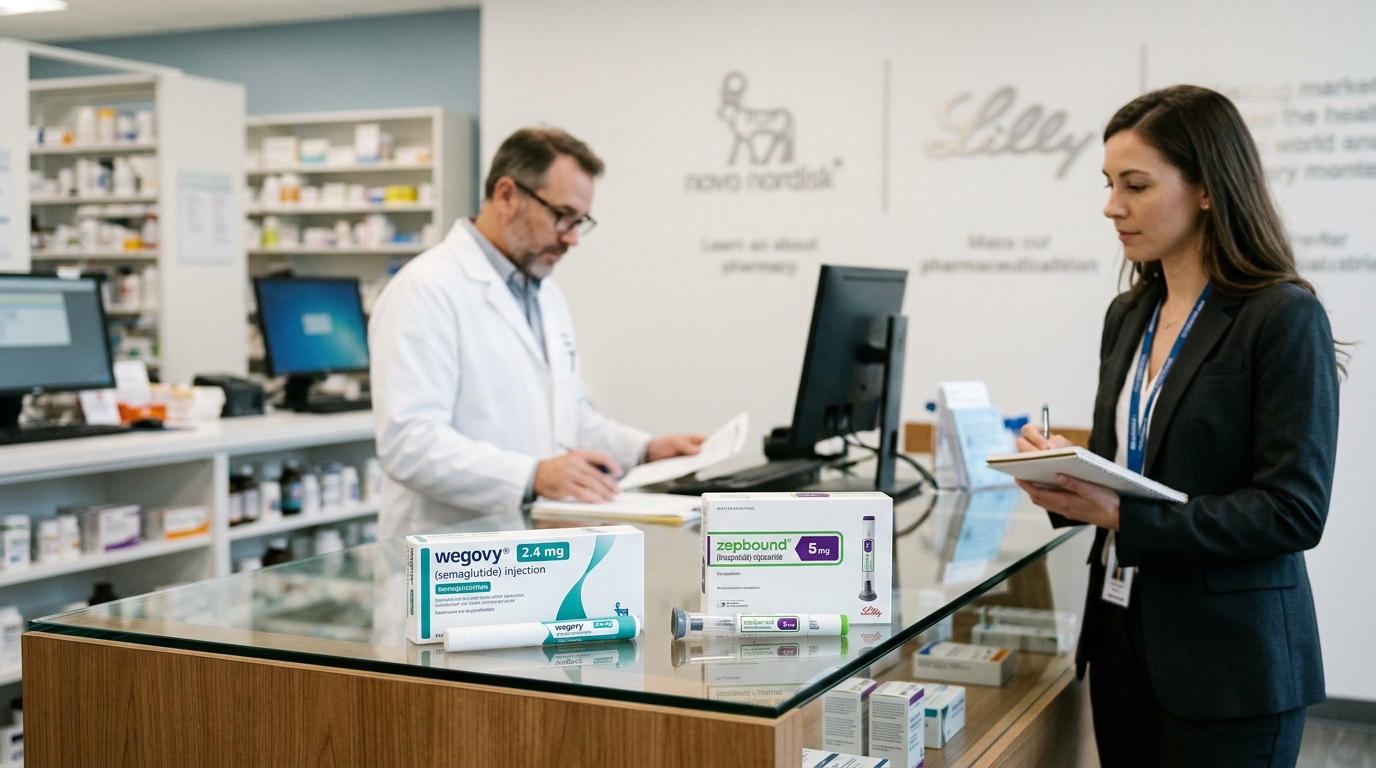
There are two ways to read Novo Nordisk’s decision to slash Wegovy’s list price by 50% effective January 1, 2027. The optimistic version: a calculated move to crush access barriers, expand the insured patient pool, and keep semaglutide dominant for another decade. The realistic version: a company that once led the fastest-growing drug market in history is now competing on price because it is losing on efficacy.
On November 4, Novo’s Q3 report will be the first quarter where investors can begin to measure the damage. Analysts expect Novo to post earnings of $0.73 per share on revenue of $11.11 billion, against $1.02 per share on $11.79 billion in the same quarter a year ago. That is a 28% drop in earnings per share, and the year is not over. Full-year guidance calls for adjusted sales growth of minus 6% to 0% at constant exchange rates.
The competitive picture underneath those numbers is harder to look at. Novo once dominated the market with Wegovy, but Lilly caught up with Zepbound and now has the lead in U.S. prescriptions and momentum. Just last week, Novo lost a bid in a U.S. court to temporarily block Eli Lilly from using advertisements claiming its drugs are more powerful, with District Judge Zahid Quraishi denying Novo’s request for a preliminary injunction while Novo proceeds with its lawsuit. The judge found Novo’s case for an injunction “less than persuasive” because it failed to show irreparable harm.
The clinical record is equally uncomfortable. In a head-to-head Phase 3 trial, Zepbound provided a 47% greater relative weight loss compared to Wegovy, with patients losing an average of 20.2% of body weight versus 13.7% at 72 weeks. Novo responded by launching Wegovy HD, a higher-dose injectable approved in March and launched in April. It narrowed the gap somewhat, but an indirect treatment comparison showed Zepbound still provided greater weight reduction than Wegovy HD, with patients on 15 mg Zepbound losing an average of 4.5% more body weight at 72 weeks.
Meanwhile, Lilly is accelerating away. Eli Lilly reported third-quarter earnings that beat estimates and raised its full-year sales outlook, as demand for Zepbound and Mounjaro surged again, Reuters reported on October 29, 2026. Revenue guidance rose to $91 billion to $92 billion from $85 billion to $87 billion, after quarterly sales climbed 39% to $24.4 billion. Mounjaro revenue rose 65% to $10.7 billion, and Zepbound revenue rose 49% to $5.35 billion. That is Lilly’s third guidance increase this year.
What the Price Cut Actually Does
Novo’s announcement sets a new list price of $675 per month across Wegovy, Ozempic, and Rybelsus, effective January 1, 2027, representing reductions of approximately 50% for Wegovy and 35% for Ozempic from current list prices. The company frames it as an access move. The change aims to reduce access barriers for patients whose out-of-pocket costs are tied to list price.
But Novo is expected to offset the lower list price by reducing rebates, meaning payers may see less benefit than the headline number suggests. Novo has also cited U.S. pressures including intensifying competition and shifting coverage decisions in public programs. Claims about a most-favored-nation drug pricing agreement tied to President Trump were removed here because they could not be substantiated from primary documentation at the time of review.
The Mogul Question
A long-term investor evaluating Novo today must weigh one thing above all else: is semaglutide a durable franchise, or a transitional drug that Lilly’s tirzepatide has already eclipsed? Novo still holds formidable assets. The Wegovy pill launched to record demand. The pipeline includes amycretin, which showed no weight-loss plateau over 36 weeks in patients with type 2 diabetes, suggesting its efficacy could strengthen with longer follow-up. A specific Citi projection of a 9% compound annual earnings growth rate between 2027 and 2030 was removed because it could not be verified from a citable primary source at the time of review.
The bull case requires believing that lower prices expand the market faster than they compress margins, and that amycretin or another next-generation compound re-establishes clinical parity. The bear case is simpler: in 2026, Lilly has repeatedly raised guidance, while Novo has been forced into a defensive posture on pricing. That split screen does not describe two companies fighting on equal terms. It describes a market leader and a company adjusting to being second.
Novo’s numbers will not resolve the question. But they will clarify how much ground Novo has already given up, and whether the franchise can hold while it waits for its next drug to arrive.