


October 15, 2026
Bonus Content: Abbott’s Factory Floor Makes the Case for Flywheel UPS
Record revenue. Producing gold and silver assets. The biggest transaction in company history.
And shares still largely undiscovered below $1.
That’s the setup right now at one little-known gold-silver royalty firm entering a critical new growth phase.
Unlike the typical mining company… it doesn’t have to build or operate a single mine.
Instead, it puts its capital to work in carefully selected mining projects in exchange for a share of the gold and silver produced:
- Exposure to multiple producing mines without operating them
- Exploration upside and mine-life growth funded by mine operators
- Diversification across multiple metals and jurisdictions
- Growing cash flow to be deployed into new royalties and streams
- Powerful leverage to rising gold and silver prices
Put capital to work… generate cash flow… reinvest… rinse and repeat.
And right now, that compounding machine is shifting into a much higher gear.
The company has just inked the largest transaction in its history – a new gold streaming deal on an established producing gold mine.
Even more intriguing, behind the company is a longstanding strategic relationship with a major mining-focused investment firm, providing direct access to a steady pipeline of deals across the global mining landscape.
That’s a serious advantage for a company flying just below Wall Street’s radar.
And the smart money knows it.
One of the sector’s best-known financiers has already put his own money behind the firm – and joins the CEO in our exclusive in-depth interview.
We’ve put together a FREE online report revealing the full story – including:
- The royalty and streaming advantage
- Producing assets already generating cash flow
- Largest transaction in company history
- The secret weapon driving the deal flow
- Our exclusive in-depth interview with the CEO and special guest
Shares are still below $1. The opportunity to get in early is right now.
Abbott’s Factory Floor Makes the Case for Flywheel UPS
Abbott Laboratories reports Q3 2026 results on October 21, 2026. Analysts’ consensus is about $1.42 in adjusted EPS on roughly $13.0 billion in revenue, and most pre-earnings commentary centers on FreeStyle Libre growth, Exact Sciences integration, and pricing in continuous glucose monitoring. That is the right conversation for a trader. It misses the one that matters for a long-term capital allocator.
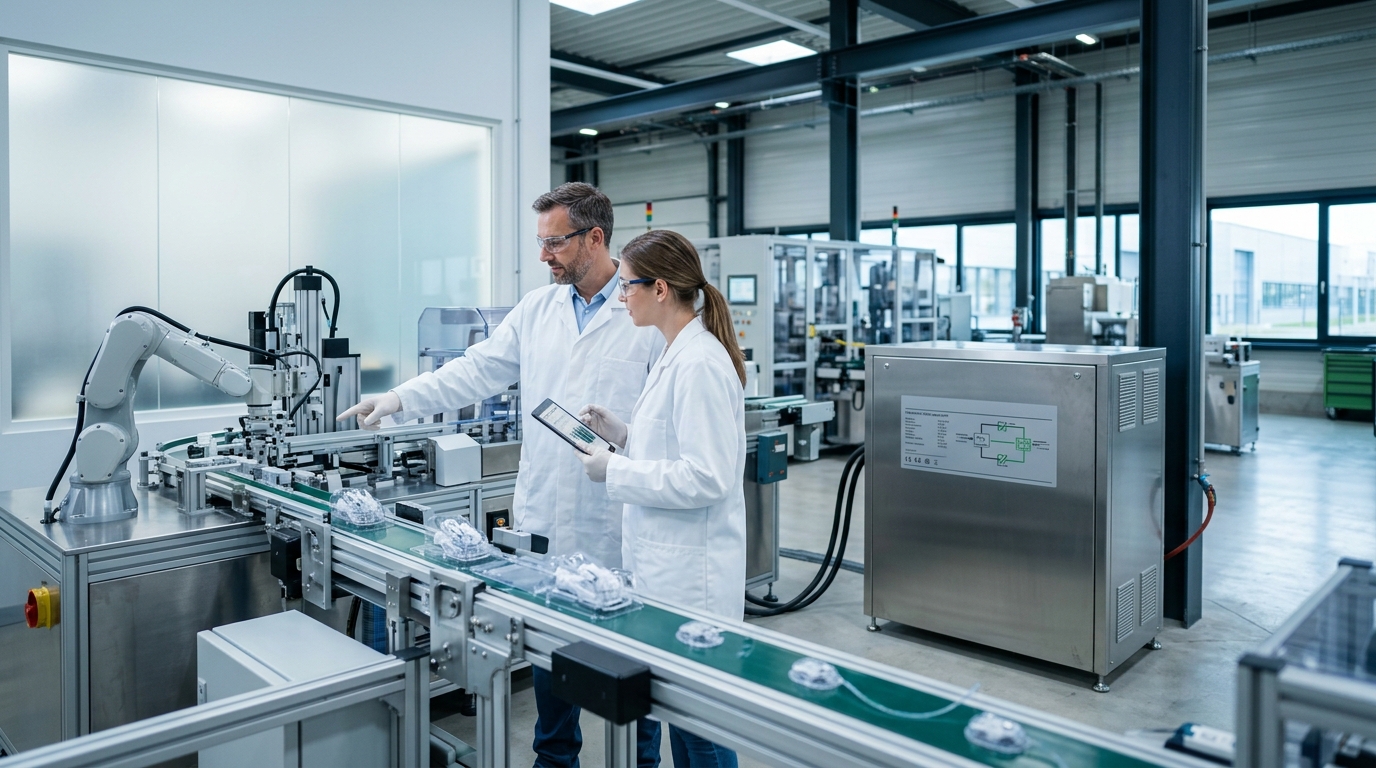
Abbott operates 89 manufacturing facilities globally and sells products in more than 160 countries. Its factories produce cardiovascular devices, blood-screening diagnostics, and sensors accurate to about 1.1 mmol/L in head-to-head reference testing. Precision at that level is not just a chemistry problem. It is a power problem. A single voltage spike during fabrication of a FreeStyle Libre 3 sensor does not simply pause production. It can destroy an in-progress batch, trigger a quality investigation and documentation burden, and compress the margin on every unit that came before it.
This is where kinetic energy storage enters: not as a green energy story, but as a hard-nosed operational requirement.
Flywheel-based uninterruptible power systems store energy in a spinning rotor and discharge it fast enough to cover short-duration events, on the order of milliseconds. Unlike chemical batteries, they can cycle repeatedly without the same wear mechanisms that drive frequent battery replacements, can be designed for multi-decade service lives, and avoid the on-site chemical and thermal risks that come with large battery strings inside or adjacent to controlled manufacturing space. For medical device manufacturers, the value proposition is specific: protect batch integrity, satisfy continuity expectations, and reduce the most failure-prone component in conventional UPS architectures. Industry surveys and vendor analyses consistently flag batteries as the most common point of failure in UPS-backed power systems.
Abbott’s 2025 disclosures repeatedly frame resilience and continuity as operational priorities, including in supply chain risk management. The company reported $2.2 billion in capital expenditures in 2025 for upgrading and expanding manufacturing and research and development facilities and equipment. It also highlighted large, multi-year manufacturing investments as part of its broader push to keep supply close to key markets. Power resilience is not a footnote in that plan; it is a prerequisite.
The flywheel energy storage market sits at roughly $580.8 million in 2026 per Grand View Research, growing to about $1.15 billion by 2033 at a compound rate around 10.3%. The UPS segment accounts for a meaningful share of current flywheel demand, and pharmaceutical and regulated cleanroom environments rank among the highest-value use cases, where a production loss can exceed $1 million per hour.
The investor question is not whether Abbott buys flywheel systems. It is what Abbott’s manufacturing model reveals about where kinetic storage earns durable value. Businesses that need flywheel-grade protection share a common profile: regulated processes, batch sensitivity, and replacement costs that dwarf the capital outlay of the storage system itself. Semiconductor fabs, medtech manufacturers, and bioprocessing facilities are the customers turning a niche technology into a structural market.
Semiconductor fabs sit at the top of that list for a reason. Equipment makers serving sub-2nm nodes face the same batch-loss economics that make flywheel-grade power protection a capital necessity rather than a preference.
Abbott exemplifies the business quality that long-term investors seek. The company increased its dividend for the 54th consecutive year when it announced its 2026 payout. It reaffirmed guidance for 6.5% to 7.5% comparable sales growth in 2026, and is steadily shifting toward higher-margin medical devices and diagnostics. Its moat is the combination of regulatory clearances, manufacturing scale, and installed diagnostic platforms that competitors cannot replicate quickly.
Kinetic energy storage is earlier-stage and more fragmented. But Abbott’s floor shows exactly what the technology must deliver to earn its place: zero compromise, no maintenance surprises, performance that outlasts the products it protects. That brief is narrow. It is also enduring.