


Most investors have never heard of nLIGHT. By the close today, that’s harder to say.
LASR shares surged more than 28% on July 9 after the Pentagon announced it had selected the Camas, Washington-based laser manufacturer for a Joint Laser Weapon System (JLWS) contract — with an initial award value of $44 million and a total program ceiling of up to $627 million, inclusive of follow-on development, integration, and potential production options.
Here’s the thing. This is not a research grant. It is not a study contract.
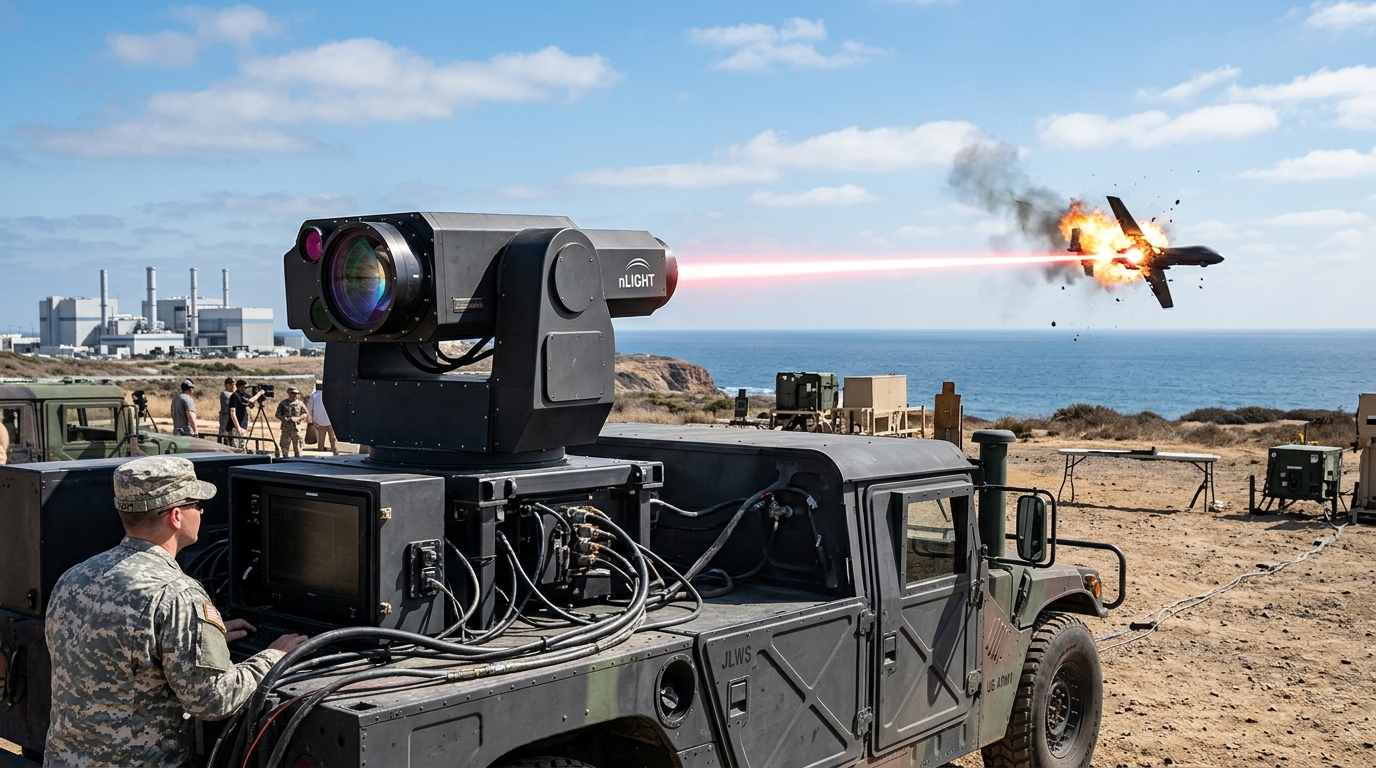
The JLWS initiative, overseen by the Office of the Under Secretary of War for Research and Engineering, is intended to move directed-energy systems from experimental demonstrations into platforms that can be produced, fielded, and sustained at scale. That distinction matters enormously for anyone trying to understand whether this move is justified — or just another defense hype trade.
Why the Move Is More Than One Contract
The context here is critical. The contract comes after the Trump administration requested a $1.5 trillion defense budget from Congress, and the cost of the Iran War had already risen to $29 billion. Active conflict accelerates procurement timelines in ways that peacetime budgets rarely capture. The Pentagon is not shopping. It is buying.
The Pentagon’s fiscal year 2027 budget request contains $452 million in proposed R&D spending for the development, integration, and assessment of directed energy weapons in support of Golden Dome alone — more than triple the $142 million enacted under the One Big Beautiful Bill Act. That tripling in a single budget cycle is not an incremental shift. It is a strategic reorientation.
And nLIGHT is now formally embedded in that reorientation. The U.S. Army and U.S. Navy together have laid out plans to spend $675.93 million over the next five years on a containerized 150–300 kW Joint Laser Weapon System as part of the military’s broader Golden Dome architecture. The JLWS awarded today is the first contract under that umbrella.
Slight tangent, but it matters: the economics of laser weapons versus traditional kinetic systems are genuinely different. Defense officials have long cited the benefits of directed energy systems — their high-speed engagement, low cost-per-shot, and deep magazines. The US Navy spent nearly a billion dollars on munitions countering drones during Red Sea patrols in 2024. A laser system does not run out of bullets as long as it has power. That math is what is driving the urgency behind these awards.
The Business Behind the Pop
What separates nLIGHT from other defense plays caught up in a geopolitical trade is the operating data sitting underneath this stock.
nLIGHT posted Q1 2026 revenue of $80.2 million, up 55% year over year, and swung to $0.6 million net income. Aerospace and defense led growth, supported by higher unit sales of directed energy laser products and progress on development contracts. That swing from loss to profit matters because it tells you the fixed-cost leverage is starting to work.
Aerospace and defense revenue in Q1 reached $55.1 million, with record A&D product revenue of $33.1 million — up 98% year over year. Nearly doubling the highest-margin segment in a single year is not noise. That is a business in active acceleration.
Gross margin reached 33.1%, with product gross margin at a record 44.6%, as high-value defense sales accelerate operating leverage.
The company is not starting from zero on this contract, either. nLIGHT is building on earlier work, including a 300-kilowatt system delivered through the High Energy Laser Scaling Initiative and a 50-kilowatt system supplied under the Army’s Directed Energy Maneuver-Short Range Air Defense program. The Pentagon does not hand $627 million ceiling contracts to companies that have never delivered. It hands them to companies that have.
Sector Breakdown — Who Else Is in This Trade
The Defense Department awarded other transaction agreements to nLIGHT Defense and Lockheed Martin Aculight for directed energy weapons as the military seeks new tools for countering adversary drone swarms and cruise missiles. Lockheed gets a piece of the pie but is a $110 billion company. The $44 million initial award moves nLIGHT far more.
The broader sector picture is also constructive. The global directed energy weapons market is projected to reach $35.32 billion by 2034, growing at a CAGR of 15.11% during the forecast period. High-energy laser platforms lead the market with a 61.45% share in 2025. That is exactly where nLIGHT operates.
Other names to watch in the directed energy ecosystem include RTX, Northrop Grumman, and L3Harris — all of which have active programs, all of which benefit from the same budget expansion. But none of them had a single-day catalyst today the way nLIGHT did.
AeroVironment is worth monitoring separately. The company delivered JLTV-mounted laser systems to the Army in December 2025 and competes in some of the same counter-UAS applications. If the Golden Dome budget continues expanding, AVAV could be the next name this trade rotates into.
What the Technical Picture Looks Like
nLIGHT stock rose approximately 30% to $76.03, and is up 306% in the past 12 months. A move like that on a single catalyst day is going to attract attention — and it already has. Volume on LASR today is running significantly above average. Options activity has also picked up, consistent with the pattern seen after the Q1 earnings beat in May.
The 52-week range is extreme — from lows below $20 to today’s highs near $76. That kind of range implies significant institutional rotation in and out of the name. Post-announcement, the stock needs to hold above the $70 level on a closing basis to suggest the move is being confirmed rather than faded.
Key levels to watch: $70 as near-term support, $80 as the next analyst target cluster (Needham raised its price target to $80, maintaining a Buy rating, and Stifel raised its target to $85). Resistance above $80 is thin, given the stock has rarely traded at these levels historically.
The RSI and momentum indicators were showing oversold conditions heading into today, which is what made the contract announcement so effective as a catalyst — it landed on a technically stretched base with institutional buyers who had been waiting for confirmation.
Scenario Modeling
Bull Case: The JLWS program advances on schedule toward the Golden Dome demonstration planned for summer 2028. nLIGHT captures 65–70% of the $627 million ceiling value, consistent with the Pentagon’s current allocation structure. A&D revenue run rate exceeds $300 million annually by 2027. The stock re-rates toward analyst targets in the $85–$100 range as the revenue visibility improves. This requires successful prototype delivery and no major program delays.
Base Case: nLIGHT executes on the initial $44 million award, progresses into follow-on development phases, and maintains Q2 guidance of $75–$81 million in revenue. The stock consolidates in the $65–$80 range post-catalyst as the market waits for Q2 results to confirm the momentum. Gross margins hold above 30%. The directed energy theme continues to attract institutional interest but the stock’s premium valuation moderates near-term multiple expansion.
Bear Case: The Pentagon’s transition from prototype to production — historically a failure point for directed energy programs — stalls. Despite their promise, the Pentagon has historically struggled to transition directed energy platforms from research and development to larger-scale production and fielding. If program timelines slip or the industrial segment continues declining faster than expected, the stock’s 13x price-to-sales multiple becomes difficult to defend. A reversal below $65 would signal the move is being unwound rather than institutionally held.
Active Trader Strategy Framework
A 28% single-day move on a defense contract changes the risk math meaningfully. The position risk for traders who chased the open is very different from those who owned the stock going in. That asymmetry deserves recognition.
For active traders, the tactical question is whether this is a momentum continuation trade or a catalyst that pulls forward demand. nLIGHT has seen its stock surge 213% over the past year as defense spending on directed energy systems accelerates. Multi-hundred-percent moves do not always reverse cleanly — sometimes the new contract unlocks a higher structural floor as institutional ownership expands.
Watch the post-announcement volume pattern over the next three to five sessions. High volume on green days following a catalyst suggests accumulation. High volume on red days suggests profit-taking from earlier holders who used the announcement as an exit. The distinction will tell you more than the price action alone.
Risk management consideration: the stock’s beta is elevated, and with the US-Iran conflict still active, any geopolitical de-escalation could reduce the urgency premium embedded in defense names generally. Position sizing should reflect that macro overlay.
The next data point that matters is Q2 earnings — likely mid-to-late August — when investors will see whether the A&D revenue trajectory held through the second quarter and whether the JLWS contract begins contributing to backlog guidance. That number, not today’s contract announcement, will determine whether the stock is priced correctly at $75.
The Bigger Picture
What nLIGHT’s move today actually represents is the market beginning to price something it has been skeptical about for years: that directed energy weapons are graduating from science projects into fielded military hardware. The difference between a demonstration program and a production contract is everything for a company this size.
Pentagon officials are working to advance directed energy weapons from experimental prototypes to combat-ready, deployable defense systems — and nLIGHT has been selected as a key participant in this transformation. That framing is deliberate. The Pentagon does not use language like that for programs it is not serious about.
Whether the stock holds the move or fades it, the message embedded in today’s contract is harder to fade: the Pentagon just wrote a check, named a winner, and pointed toward a budget line that is tripling. That is not a theory. That already happened.
For informational and educational purposes only. Not investment advice. Trading involves risk, including loss of principal.