

$29.4 billion. That is what SK Hynix filed to raise through a Nasdaq ADR listing today, targeting a July 10 debut. If it prices at the top of its range, it would be the largest American depositary receipt offering in history — larger than Saudi Aramco’s record 2019 IPO by some measures.
Let that sit for a second.
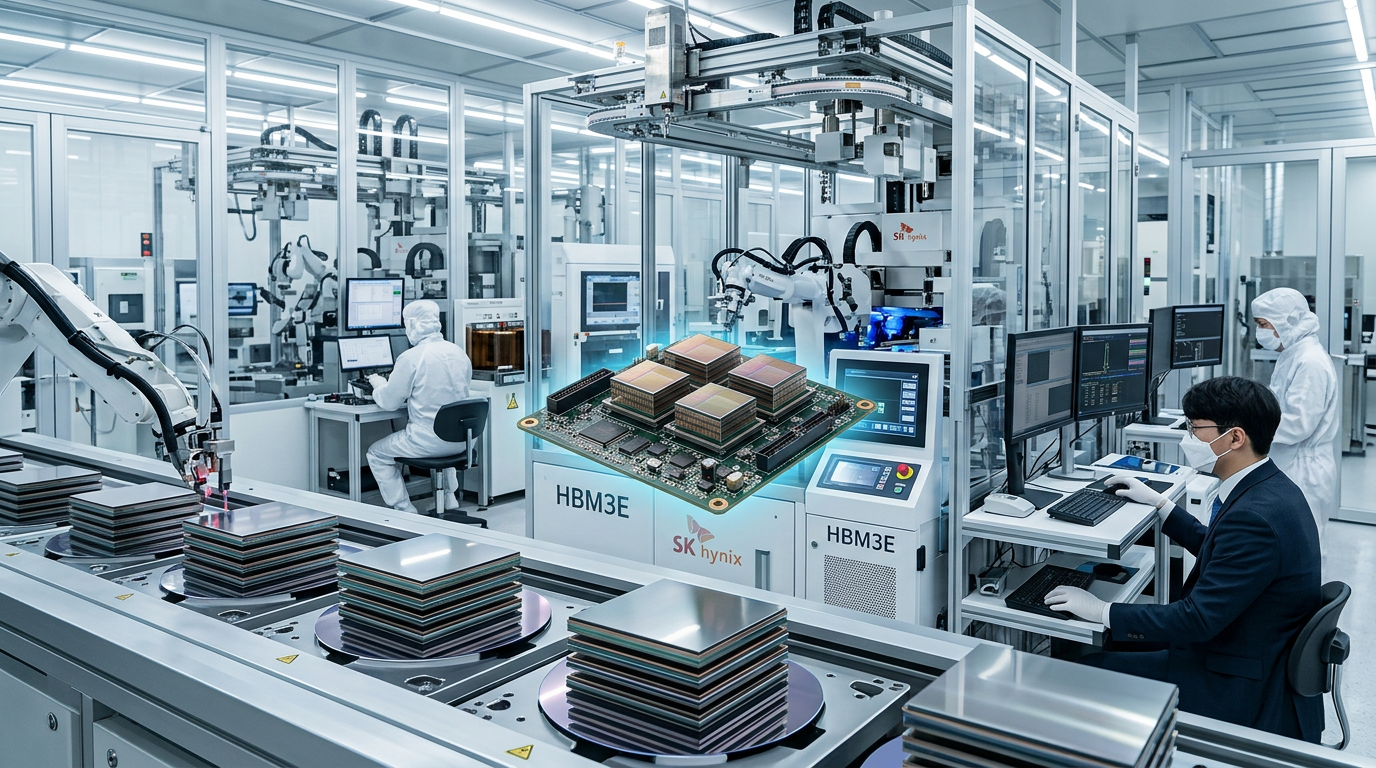
SK Hynix filed a securities registration statement with the U.S. SEC on Wednesday to raise up to 45.45 trillion won through an ADR listing on the Nasdaq Global Select Market scheduled for July 10. The offering covers 17.79 million newly issued common shares, and the company said every dollar goes directly toward factories and equipment — not executive payouts, not acquisitions. Specifically: a new chip fab in the Yongin cluster, an advanced packaging plant in Cheongju, and EUV lithography equipment.
Here is what is interesting about that. None of those facilities will produce memory in time to ease the shortage that is already running hot. The company is raising money for demand that does not fully exist yet on paper, but which SK Hynix and its customers are certain is coming.
Why This Company. Why Now.
SK Hynix controls roughly 60% of the global high-bandwidth memory market, according to Counterpoint Research. Every major AI accelerator — Nvidia’s Blackwell, Vera Rubin, AMD’s MI-series — runs on HBM. There is no substitute. SK Hynix does not just supply Nvidia. It is a co-development partner, with industry estimates placing the company at roughly 60 to 70 percent of HBM4 volume allocated to Nvidia’s Vera Rubin platform.
In Q1 2026, SK Hynix posted revenue of 52.58 trillion won, up 198% year-over-year, with an operating margin of 72% — higher than Nvidia’s. That is not a typo. A memory company posting higher operating margins than the most celebrated AI chip designer on the planet.
The stock has reflected it. Shares have surged roughly 230 to 240% this year, pushing SK Hynix past $1 trillion in market cap — and, just recently, past Samsung Electronics to become South Korea’s most valuable listed company. That last part matters more than most Western investors realize. Samsung had held that title continuously since around 2000.
The Trade Wall Street Hasn’t Fully Priced
For years, U.S. investors who wanted exposure to the AI memory supercycle had exactly one major option: Micron. That changes on July 10.
When SK Hynix ADRs start trading on Nasdaq, U.S. institutional funds that have mandates restricting foreign-listed equity exposure suddenly get direct access. Pension funds, index ETFs, and large active managers who have been forced to express this thesis through Micron proxies will be able to own the actual market leader outright — in dollars, during U.S. trading hours.
One analyst at Meritz Securities said it plainly: “Once the receipts start trading, funds that hold Micron will move in right away.”
That is not a small flow. Micron has surged over 700% in the past year partly because it was the only major U.S.-listed name competing at the highest levels of the AI memory market. SK Hynix’s arrival reshapes that dynamic.
The Part Everyone Is Skipping
The supply shortage is the real story. HBM capacity for 2026 is sold out. Shortages are forecast into 2027. The three major memory manufacturers — SK Hynix, Samsung, and Micron — have essentially fully booked their capacity for this year, and wafer fabs take four to five years to build. There is almost nothing that can add meaningful supply in the near term.
Bank of America has called 2026 a “supercycle similar to the boom of the 1990s,” forecasting global DRAM revenue to surge 51% and HBM market size to reach $54.6 billion this year alone.
SK Hynix itself has said publicly that DRAM, NAND, and HBM are completely sold out. They literally cannot satisfy all customer orders.
The proceeds from this listing are funding capacity that comes online in 2027 and beyond — which means the company is raising capital to meet a shortage it is already telling customers it cannot fix this year.
The Risk That Is Real
Memory is historically one of the most cyclical industries in semiconductors. That is not up for debate. The question is whether HBM breaks the cycle or just delays it.
Samsung is catching up. Reports indicate Samsung passed final quality tests for HBM4 from Nvidia and AMD, with full-scale supply potentially beginning in the second half of 2026. If Samsung achieves mass production on schedule, SK Hynix’s share of Nvidia’s HBM orders could compress from its current dominant position toward something closer to 50%. That would pressure margins and almost certainly reprice the stock — at least temporarily.
The dilution math also matters. The offering covers 17.79 million newly issued shares. At these price levels, that is real dilution. Investors buying ADRs on July 10 need to understand they are buying into a company that just issued new stock near all-time highs.
What to Watch
- Micron’s earnings report tonight (June 24) — the first real data point on AI memory demand heading into SK Hynix’s listing
- Samsung’s HBM4 qualification progress — the single biggest competitive threat to SK Hynix’s market share
- ADR pricing mechanics ahead of July 10 — ten ADRs represent one common share, with final per-ADR pricing set through bookbuilding shortly before debut
- Institutional positioning shifts in MU, SMH, and SOXX as fund managers recalibrate memory exposure
The bottom line is this: SK Hynix filing to raise $29 billion is not a routine capital markets event. It is a statement about where AI infrastructure money is going for the next several years. The company is printing 72% operating margins in a shortage it cannot fix fast enough, and it is asking U.S. investors to fund the expansion. Whether you own it directly or not, this listing changes the competitive landscape for every memory-adjacent position in your portfolio.
For informational purposes only.