

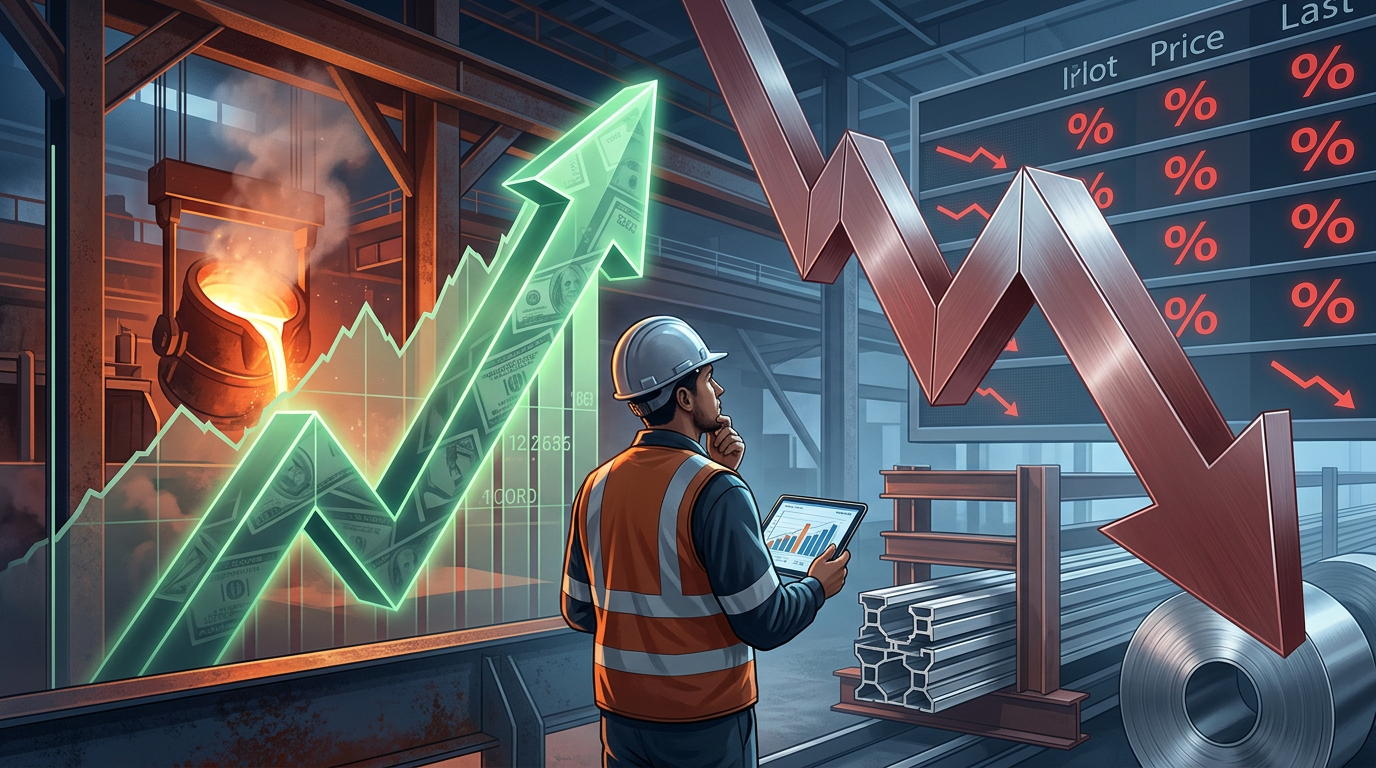
The stock is down. The business isn’t.
Steel Dynamics (STLD) just provided Q2 2026 earnings guidance of $3.51 to $3.55 per diluted share on June 17. That compares to $2.78 in Q1 and $2.01 in the same quarter last year. Year-over-year, earnings are up roughly 75%. The share price, after running over 100% in the past year, has pulled back more than 11% in the last week alone.
This is a pattern worth understanding.
Why the business has fundamentally changed
Most investors still think of STLD as a commodity steel play — cyclical, rate-sensitive, exposed to construction demand and scrap prices. That framing made sense three years ago. It’s increasingly incomplete today.
The Q1 2026 results showed record steel shipments and expanding margins. Net sales hit $5.2 billion. Net income was $403 million. Demand remained strong across non-residential construction, energy, automotive, and industrial end markets — all segments that are either structurally growing or tariff-protected from foreign competition.
Here’s the part worth focusing on: Steel Dynamics is not just a steel company anymore. It is actively ramping a flat-rolled aluminum business that management has described as a counter-cyclical earnings diversifier spanning beverage cans, packaging, automotive, and construction applications. The aluminum plant is expected to add over $650 million in EBITDA as it reaches full capacity — a number that represents a meaningful addition to the company’s through-cycle earnings power.
The aluminum flat-rolled business is ramping into a persistent domestic supply deficit, enhanced by high tariffs on aluminum imports. As domestic customers increasingly can’t source from overseas, Steel Dynamics is positioned to capture that volume at margins that could exceed its legacy steel operations.
The tariff story that most investors are underestimating
Steel tariffs of 50% create a protective barrier that didn’t exist in prior cycles. Analysts highlighting firm tariff levels see meaningful pricing power and margin resilience for domestic producers versus global competitors. U.S. mills are actively taking market share from imports as domestic capacity increases.
Slightly fragmented thought here, but it’s relevant: the aluminum expansion is benefiting from the same tariff dynamic. High import tariffs on aluminum are forcing domestic customers to source locally. Steel Dynamics built the capacity to serve that demand at exactly the right time. The first of two planned CASH lines for finished automotive products became operational in Q1 2026. The second is expected to commission in Q3 2026.
That’s a business that is expanding its addressable market, diversifying its earnings, and doing both with a tariff wall protecting its margins.
The earnings trajectory is accelerating
Let’s run through the numbers as they stand. Q4 2025 earnings: $1.82 per share. Q1 2026: $2.78. Q2 2026 guidance: $3.51 to $3.55. That’s a near-doubling of earnings per share over two quarters. Analysts following the stock have raised their full-year 2026 EPS forecast to $14.68 — up 55% from prior estimates — after the Q1 results, and lifted the consensus price target to around $223. That followed a 15% target increase from analysts who had been forecasting revenues of $21.4 billion before the quarter. They’re now modeling $21.9 billion for the full year.
The dividend has been raised 6% for 2026. Cash reserves sat at $769.9 million heading into Q2. The company is simultaneously buying back shares, investing in growth capacity, and raising its payout. That’s not the capital allocation of a company managing decline.
The risks are real but known
The aluminum expansion is still ramping. Free cash flow will remain pressured until the new facilities reach full utilization. Reports suggest Trump is reviewing tariff levels on certain steel and aluminum imports — any easing of that protection would create near-term margin pressure. U.S. manufacturing activity, while improving, remains muted in some pockets. A global economic slowdown would weigh on steel demand regardless of tariff protection.
Those are real risks. They’re also already widely known and largely priced into the multiple. STLD trades at roughly 15.5x forward earnings — not cheap for a cyclical, but not expensive for a business with this earnings trajectory and the structural tailwinds behind it.
What the pullback actually is
The 11% drop this week followed a strong run and some valuation concerns after the stock crossed above analyst price targets. It was not driven by a fundamental deterioration in the business. Earnings guidance for Q2 came in ahead of prior-year results by over 75%. The aluminum ramp continues. The tariff wall holds.
The last time this stock pulled back to the $190 to $200 range, multiple analysts flagged it as an attractive entry. The same thesis applies now. The business grew into a higher earnings range. The pullback gave the valuation room to breathe. What happens next depends on whether the aluminum expansion delivers what management has outlined — and so far, execution has been ahead of schedule.
The market is treating this like a cyclical top. The earnings trajectory suggests something different.