

Nvidia reported a beat last night. The company posted Q3 fiscal 2027 earnings of $2.68 per share, well above the $2.48 consensus, on revenue of $115.8 billion. By every traditional measure, it was a strong quarter. And yet the question hanging over the stock today is not about margins or data center demand. It is about who runs the company.
On November 12, Nvidia’s board announced that Jensen Huang resigned as President, CEO, and board member, effective immediately. CFO Colette Kress was named Interim CEO, a role she will hold alongside her CFO duties until a permanent successor is chosen. At the earnings call, board chair Harvey Jones confirmed that the board unanimously accepted Huang’s resignation and does not intend to reinstate him. The company Huang built over 33 years is now searching for his replacement with no clear timeline.
Why This Stock Now
That leadership vacuum changes the competitive landscape faster than any product cycle could. Bloomberg Intelligence argues that uncertainty at Nvidia could push AI buyers toward Google’s lower-priced TPUs, and sees TPU sales ramping to about $50 billion in 2027. By 2028, the firm projects TPU sales will top $135 billion, including related software and hardware, up from an estimated $12 billion this year, and that figure excludes chips rented through Google Cloud.
That would be roughly a fourfold increase in two years. For context, Nvidia’s data center revenue rose nearly 8x from about $15.0 billion in fiscal 2023 to about $115.2 billion in fiscal 2025. Google’s projected trajectory is steeper, and it starts from a base the market is barely pricing in.
The Business
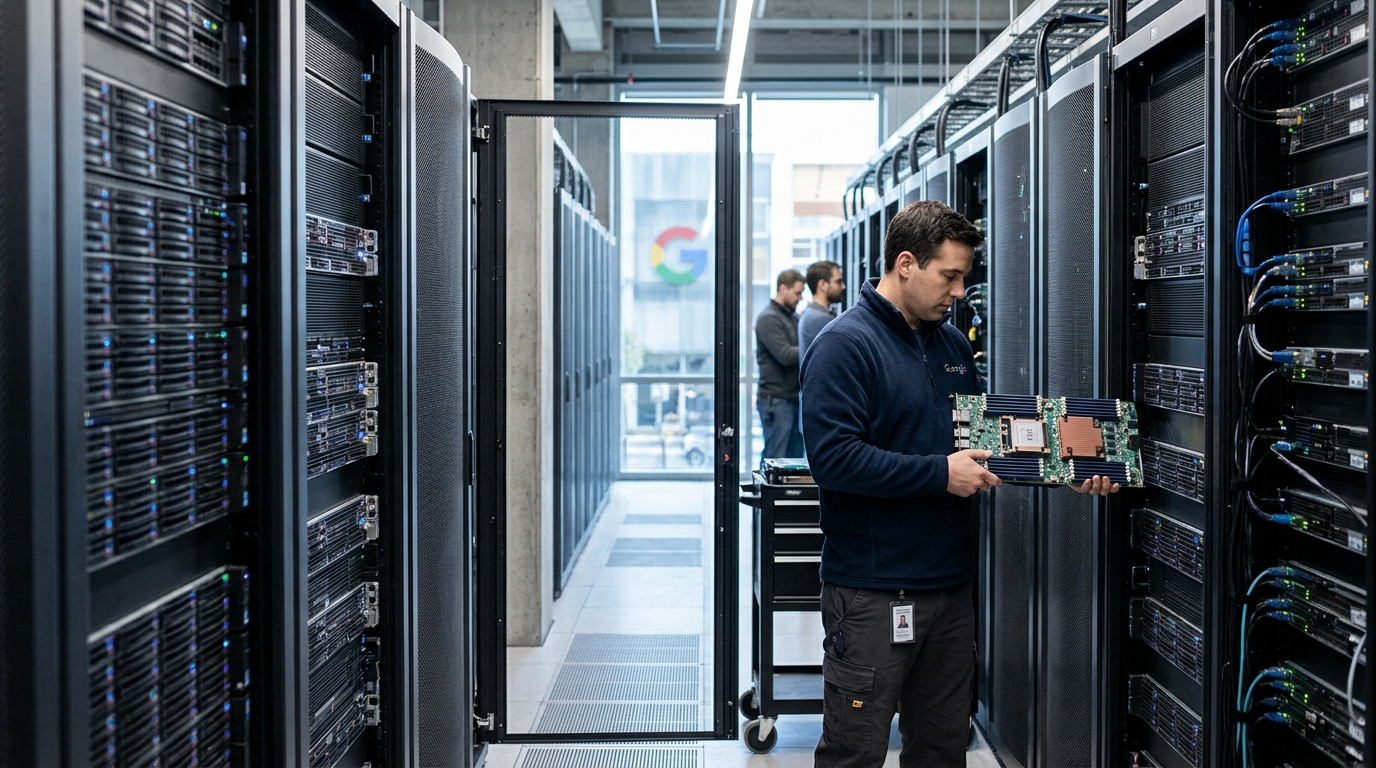
Google introduced its eighth-generation TPU systems, the TPU 8t and TPU 8i, with purpose-built architectures for training and inference. On November 9, it expanded the lineup further with the TPU 8tx and 8i Max, which Google says offer up to 2.7x better training performance and 80% better inference price performance compared to the prior generation. Google now describes TPUs as “a rapidly growing business with nearly 100 customers.”
Part of the appeal is price: TPUs cost about 30% less than Nvidia’s GPUs while doing competitive work in terms of throughput. SemiAnalysis found that Google’s current Ironwood TPU delivers up to nearly three times as much AI output per dollar as Nvidia’s Blackwell chips when running AI agents, though Nvidia’s top system still wins when speed is paramount.
The customer list is not speculative. Named customers include Anthropic and Apple. Anthropic has agreed to access up to one million TPU chips and more than a gigawatt of capacity in 2026, with the deal expanding to around 3.5 gigawatts of compute coming online in 2027. Anthropic’s IPO filing shows roughly $161 billion in lease payments tied to TPUs, while Meta, OpenAI, and Oracle are buyers as well.
Why Wall Street Is Paying Attention
Google Cloud delivered record growth in Q3 2026, with revenue increasing 103% to $30.7 billion, and TPU systems sales were cited as a meaningful contributor to that growth. Cloud operating income reached $11.12 billion at a 36.2% margin, versus $3.59 billion and 23.7% a year earlier. That margin expansion alongside hardware revenue is the signal worth tracking: Google is not just reselling capacity, it is selling chips at improving economics.
The valuation does not reflect any of this. Alphabet’s trailing P/E ratio stands at approximately 14.45, based on an EPS of $19.39 and a share price around $280. Over the past ten years, that multiple has averaged closer to the low-to-mid 20s; the current level sits well below that longer-term norm. The stock is being priced roughly like a mature media company, not one with a chip business that Bloomberg Intelligence expects to grow more than tenfold in two years.
What Could Go Wrong
Google’s TPU profit margins are less robust than what Nvidia generates, according to Bloomberg Intelligence analyst Mandeep Singh. There is also the risk of a broader slowdown in AI infrastructure spending; Singh has warned that backlash against data centers could trim expected spending in 2027. And the Bloomberg Intelligence projections are analyst estimates, not booked revenue. A $50 billion TPU year would require execution at a scale Google has never attempted commercially.
Nvidia, for its part, still runs the larger engine. Its latest quarter showed data center revenue of $107.6 billion, up more than 100% year over year. A new permanent CEO could stabilize customer confidence faster than the market currently assumes.
The Bottom Line
Alphabet sits at roughly 14.5x trailing earnings with Google Cloud doubling and a chip business the income statement barely captures yet. Nvidia beat estimates last night and is still the dominant supplier, but it is running a CEO search while one of its largest potential rivals just expanded its lineup to four chip configurations and nearly 100 paying customers. The risk-reward case for GOOGL does not require Nvidia to collapse. It only requires the market to start valuing what Google is already building.