



A year ago, Burberry was posting an £18 million operating loss. This morning it reported an £18 million operating loss again, though on an adjusted basis it swung to a £19 million operating profit from an adjusted operating loss of £41 million a year earlier. The obvious question for investors is not whether the turnaround is working. It clearly is. The question is what is actually driving it.
Cost cutting brought Burberry back from the edge. The brand responded to its earlier losses with plans for around 1,700 job cuts and the removal of the entire night shift at its Yorkshire raincoat factory. Management has talked about a plan to deliver roughly £100 million in annualised cost savings, and the company has said it achieved £80 million of operating expense savings in fiscal 2026. Those savings are real and they are mostly banked.
What matters more for the investment case today is what is happening on the revenue side. Gross margin was 67.9% in the half, and management attributed the improvement to higher-quality sales. Burberry is selling more at full price and discounting less. Fewer markdowns and shorter sale periods protect full-price integrity, and CEO Joshua Schulman’s approach has been to lean into heritage and let the product, not the price, do the pulling.
The regional split adds texture. Comparable store sales were flat overall in the half, following a steep decline in the prior-year period. European softness is the clearest vulnerability in the numbers, and it is not small: EMEIA is Burberry’s largest geographic exposure. A defensive European consumer remains a drag the company has not solved.
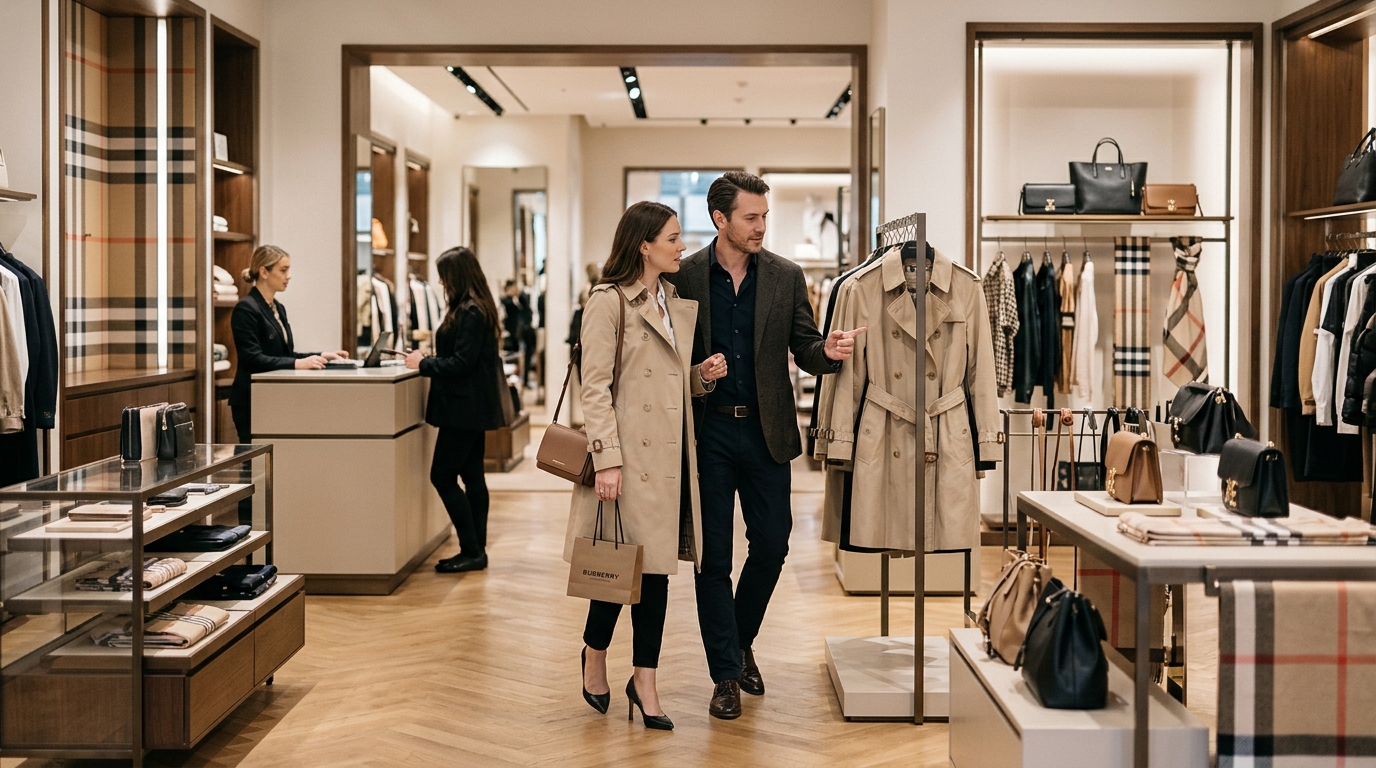
The key outerwear category remains central to the strategy. Under Schulman, Burberry has refocused on its staple outerwear, including its famed trench coats, in a bid to improve its fortunes. That category focus is not just brand positioning. It is a margin decision: core outerwear carries better economics than the push into ultra-high fashion that preceded Schulman’s arrival.
Net operating expenses fell year on year, helped by the transformation programme. That is the balance Schulman has to maintain through fiscal 2027: hold the cost base down while funding the marketing that rebuilt brand visibility. Any slip in that discipline, particularly if comparable sales momentum stalls, would compress margins quickly.
Chair Gerry Murphy is retiring with effect from the interim results in November 2026; William Jackson, a non-executive director since 1 July 2026, succeeds him. Leadership transitions at this stage of a turnaround carry their own risk, though the operational strategy appears well embedded below board level.
The bear case is straightforward. When your strategy is to grow volume on core categories while protecting margin by discounting less, your growth rate is bounded by how many trench coats and scarves the world wants at full price. Peers including LVMH and Kering are competing for the same wallet in a market where European demand is fragile and Chinese growth, while improving, is not a straight line.
What investors should watch in the second half is whether the quality-of-sales improvement holds without leaning on one region. Burberry has pointed investors to further progress against its financial ambitions in fiscal 2027, including revenue growth and margin expansion. Those outcomes are achievable if full-price momentum continues. If EMEIA does not stabilise, the maths gets harder. Today’s results are strong evidence that the turnaround is more than cosmetic. They are not yet proof that it scales.