


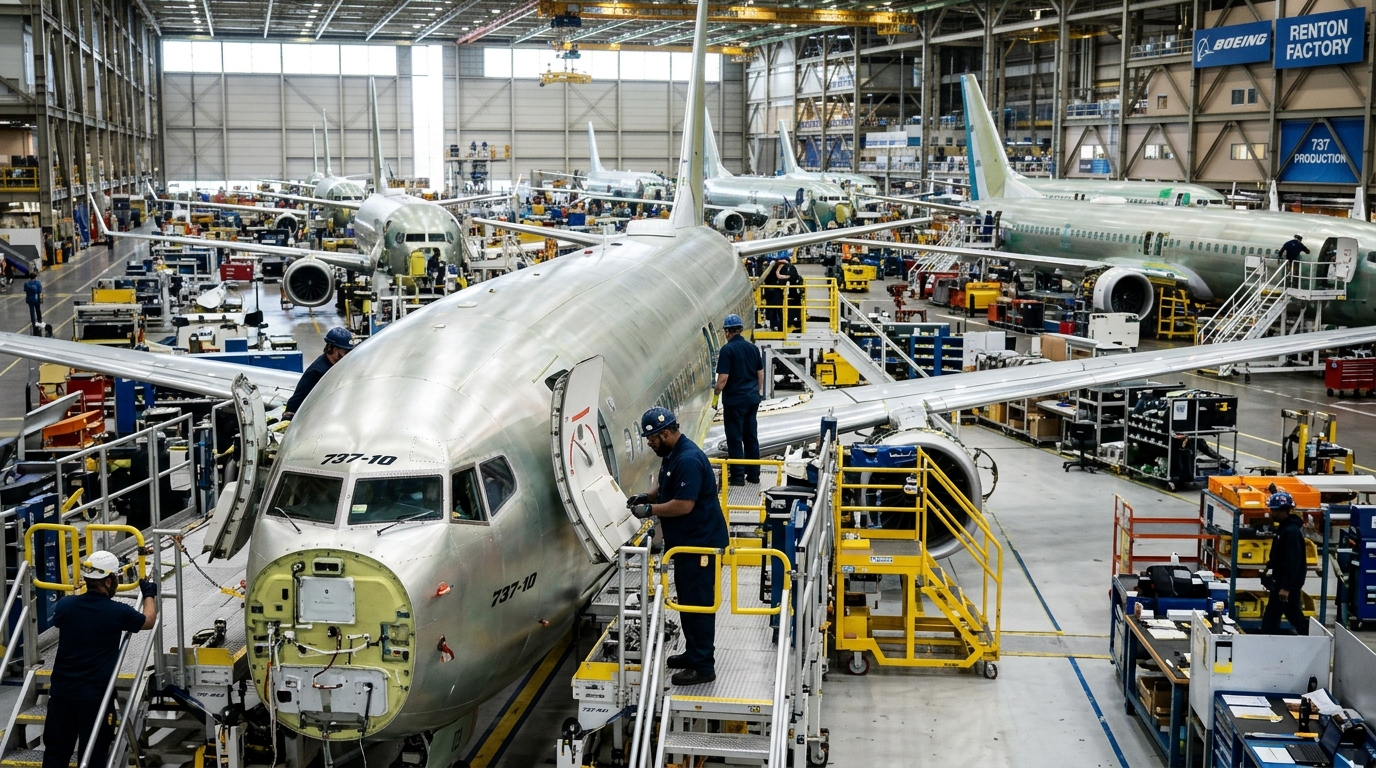
Last week produced one of the more instructive contradictions in commercial aviation. On November 4, Avolon, the Irish aircraft leasing company, finalized the largest single-aisle order ever placed by a lessor: 140 Boeing 737-10 airplanes, a record 737 MAX order by a lessor that increases Avolon’s backlog to more than 240 unfilled orders. Two days later, Bloomberg reported that Boeing likely delivered about 32 of its 737 MAX jets in October, the fewest in almost a year, with the decline based on Cirium data and a Jefferies analyst note, comparing with September’s 43.
Demand and output are moving in opposite directions. For long-term investors, the more important signal is the demand side.
Why the Backlog Is the Business
Boeing’s Commercial Airplanes backlog included over 6,300 airplanes valued at a record $612 billion at the end of the third quarter, the company said in its third-quarter results. That figure does not include Avolon’s freshly finalized 140 jets. It represents years of contractually committed revenue, production schedules already filled, and customers who have no realistic alternative if they want single-aisle jets at scale. Airbus holds the other half of a two-company market. Neither is gaining a third competitor anytime soon.
The moat here is not a brand or a patent. It is the accumulated cost of qualifying a new aircraft type with regulators, building the supplier network, training thousands of maintenance engineers across hundreds of airlines, and financing fleets that depreciate over decades. The 737 family represents about 30% of all financed airplanes, Boeing has said. Lessors do not build a third of their portfolios around a platform they can easily swap out.
Why Avolon’s Move Matters
Avolon’s order is not speculative. The purchase came just weeks after the 737 MAX-10 was certified by the FAA, which removes the program’s longest-standing regulatory overhang. Lessors placed firm orders for more than 230 Boeing 737-10 airplanes in 2026, five times more than the lessor backlog for the largest 737 MAX variant at the end of 2025. That is not a coincidence: certification unlocked conviction, and conviction translated immediately into capital.
According to Boeing, lessors have now ordered more than 1,450 737 MAX aircraft, representing approximately 20% of the 737 MAX backlog. Lessors are sophisticated capital allocators. They buy aircraft because airlines will pay to lease them, and they sign 20-year commitments only when they believe the underlying demand is durable. Boeing has pointed to projected 4% annual passenger traffic growth over the next 20 years as a driver pushing lessors to broaden their single-aisle offerings.
The lessor conviction behind those 1,450 orders depends on engines arriving alongside airframes. GE Aerospace moved to own its casting supplier outright because narrowbody demand has outrun the engine supply chain’s ability to keep pace.
What the Output Numbers Actually Mean
Reuters reported in late October that Boeing said it would miss its target of delivering 500 737s this year and aims to reach a steady output of 47 jets a month in early 2027 and 52 a month in the second half of 2027. Those delays matter for near-term cash flow: the 737 MAX is Boeing’s main cash engine because each delivery triggers a large final payment, so the pace of handovers determines how much free cash flow the company books in a given quarter.
Supply-chain constraints are not unique to Boeing’s assembly lines. GE Aerospace spent nearly $12 billion acquiring a castings supplier because engine makers could not keep pace with demand from outside the bottleneck.
But a single weak month in a multi-year ramp is not the same as a structural demand problem. Boeing has said wing production remains a major constraint. The bottleneck is wings, not orders.
The Mogul Verdict
What Avolon’s record order illustrates is a business with one of the most defensible demand positions in global industry. A $612 billion commercial backlog, covering more than 6,300 aircraft, means Boeing’s revenue visibility stretches across the better part of a decade. Production problems are real and push free cash flow targets further into the future. But they do not change the fundamental arithmetic: airlines need jets, two companies build them, and one of those companies just received the largest lessor order in its most popular family’s history. Patient investors are essentially being asked whether they trust the ramp to come. The backlog says the demand, when it arrives, is already there.