


The Cybertruck is the first vehicle Tesla has ever retired. That fact alone deserves more attention than the obituaries it is getting today.
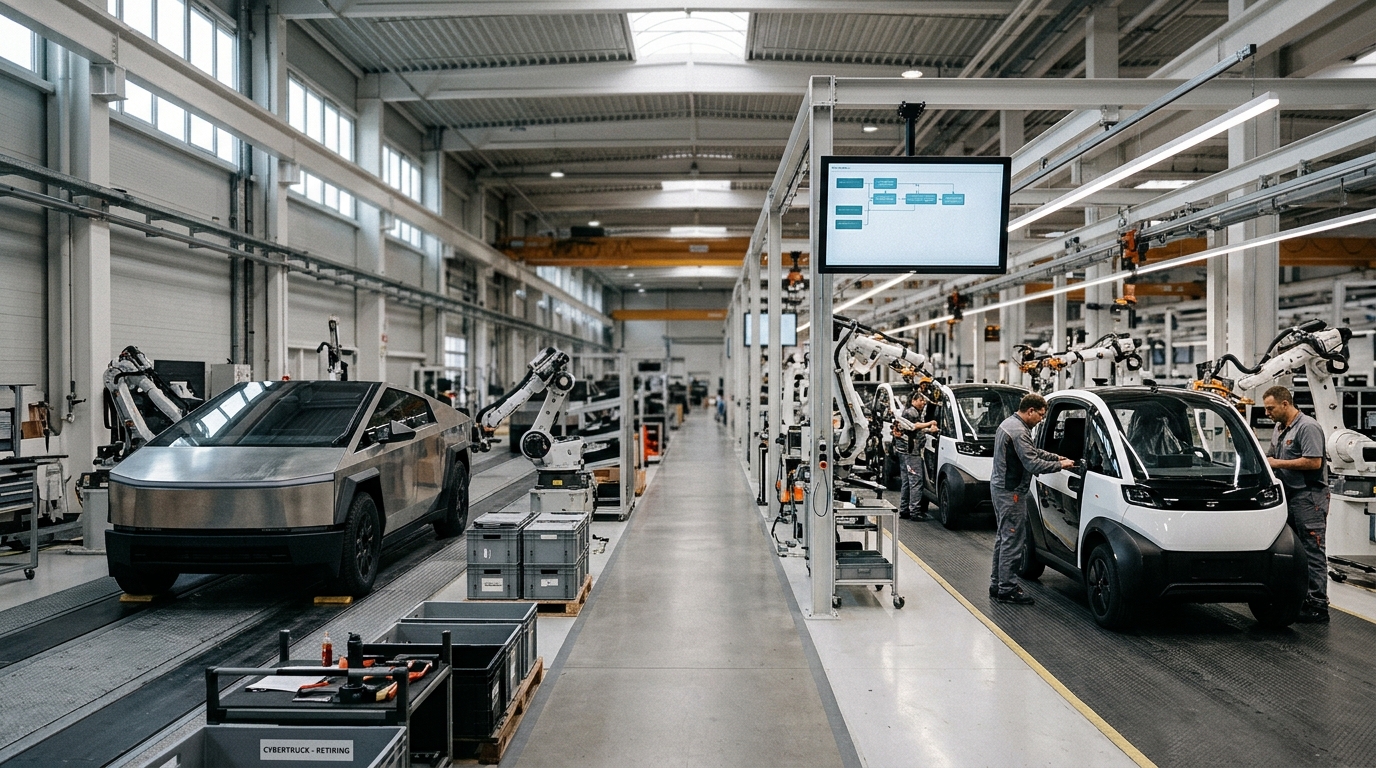
On Friday, Elon Musk posted on X that Tesla will wind down Cybertruck production at Gigafactory Texas around the middle of 2027, roughly three and a half years after the first deliveries, to make room for increased Cybercab output. The announcement came about three and a half years after the first deliveries. The gap between promise and reality is stark. Musk had expected the Cybertruck to sell between 250,000 and 500,000 units per year once production was fully ramped. According to Kelley Blue Book, the company sold only 20,237 Cybertrucks in the US last year, down 48% from 38,965 in 2024. 2026 has run softer still: through the end of September, sales were down about 28% versus the same period a year earlier, according to Kelley Blue Book.
That is roughly a tenth of what Musk said the line would produce. Giga Texas has over 10 million square feet of factory floor, by Tesla’s own count. So the stated reason, making room, does not fully hold up on its own. The real reason is simpler: capital and factory floor chase the highest-conviction bet, and Musk’s conviction has moved on.
This is a pattern worth understanding before judging it. Musk has previously said Tesla expects to wind down Model S and Model X production at Fremont and shift that space toward mass production of Optimus robots. Each time, the retired product carried far less strategic weight than whatever replaced it on the floor. The Cybertruck, like the Model S before it in this sequence, became a consumption of capital that could be redeployed toward a larger prize.
The prize is substantial by any measure. On Tesla’s Q3 2024 earnings call in October 2024, Elon Musk said the Cybercab would reach volume production in 2026 and that Tesla was aiming for at least 2 million Cybercabs a year across more than one factory. Tesla has also guided that 2026 capital expenditures are expected to be in excess of $20 billion. This is what a company that believes in its next product actually looks like: it redirects the factory, increases capex, and tolerates the write-off on the prior generation.
Cybertruck lead engineer Wes Morrill posted on X: “Cybertruck was an incredible technology development platform and lives on through Cybercab.” That framing is deliberate. The stainless-steel body, the structural battery pack, the proprietary steer-by-wire, these were learning exercises that shaped what comes next. Ford and GM spent years defending their truck franchises with incremental upgrades. Rivian built the R1T for a narrow outdoor-adventure buyer. Musk built a vehicle that, by his own admission, was apocalyptic equipment, took the manufacturing lessons, and walked away.
The question for long-term investors is not whether the Cybertruck failed. It did, commercially. The question is whether the Cybercab bet is structurally sound enough to justify abandoning a known revenue stream for an unproven one. The Cybercab, which has butterfly doors and no steering wheel, pedals, or mirrors, is Musk’s key bet in his push to turn Tesla into an AI and robotics company. He sees it as Tesla’s main autonomous model supplying a global network of robotaxis.
That is an enormous strategic leap. The Cybercab is not competing with the F-150 Lightning or the Rivian R1T. It is competing with Waymo, Uber, and every other mobility platform trying to monetize miles rather than vehicles. The addressable market is orders of magnitude larger. The execution risk is too.
Disciplined investors have seen this trade before: a business abandons a low-returning product to concentrate resources on a higher-returning one. When the analysis is correct, that decision compounds wealth for a decade. When the new product fails to scale, the abandoned revenue looks prescient in reverse. Musk is making that bet, in full, with the factory floor as collateral. The Cybertruck’s exit is the clearest signal yet of what Tesla intends to become.