



Editor’s Note: What is the final phase of Elon Musk’s master plan – and why could it mean a massive payday for anyone taking advantage of this ONE ticker? Our friend Larry Benedict, a hedge fund legend who made over $274 million for his clients, says he has the answer. Click here to see the details.
Dear Reader,
After PayPal. After Tesla. After SpaceX.
Elon Musk is now preparing to execute the final phase of one of the most ambitious plans in history.
Click here to discover exactly what he’s planning – and the ONE ticker that could benefit the most.
According to Larry Benedict – the man who delivered a 279% return on cash in 2025 while the S&P returned just 15% – when the “Final Phase of Elon’s Master Plan” is triggered, it could move more money than anything Elon has ever done before.
We’re talking billions – potentially trillions – of dollars flowing into a single ticker.
It’s not Tesla. It’s not SpaceX. It’s not crypto, or AI, or anything Wall Street is currently talking about.
But when the “Final Phase” kicks in, Larry believes it’s positioned to capture the surge.
He’s revealing the name and ticker today – completely free.
Regards,
Lauren Wingfield
Managing Editor, The Opportunistic Trader
SpaceX Bought the Spectrum. Tower Owners Collected the Premium.
The most important thing about Friday’s tower rally is what did not happen. SpaceX did not call Crown Castle. It did not call American Tower. It did not call SBA Communications. It agreed to spend about $8 billion on low-band spectrum and said nothing about steel and concrete, yet Crown Castle surged about 16%, American Tower roughly 9%, and SBA Communications was also sharply higher, while AT&T, Verizon, and T-Mobile, the tower companies’ three biggest customers, all fell.
Markets are forward-pricing machines. What investors priced on October 9 was not a lease. It was a logical chain: low-band 800 MHz spectrum is hard to use from orbit and easy to use from a tower. SpaceX already held the AWS-4, H Block, and unpaired AWS-3 licenses it agreed to buy from EchoStar for satellite-to-phone service. What it lacked was low-band, the frequencies that carry long distances and get through walls. That gap is now filled. The question is how.
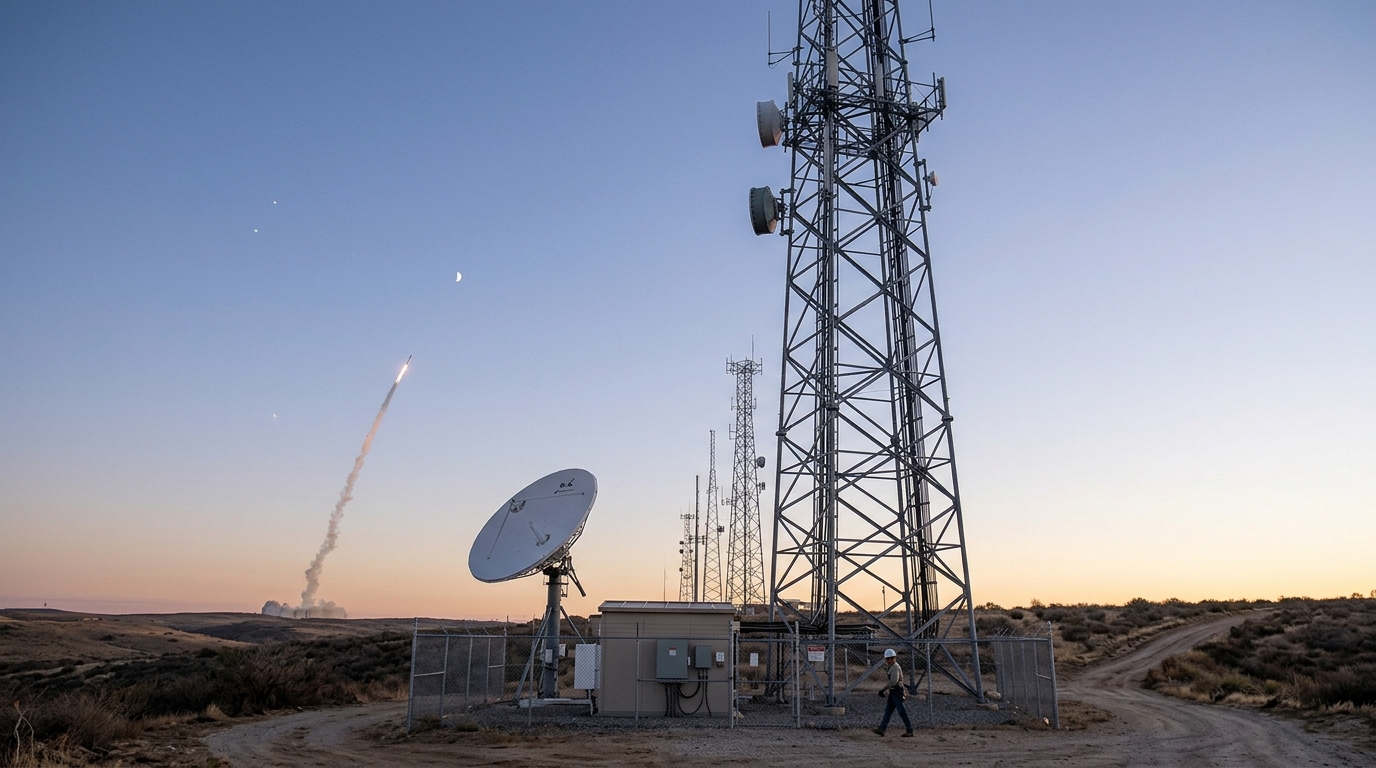
Satellites alone may not be enough to compete with established wireless carriers. To build a nationwide mobile network, SpaceX could also need thousands of ground-based transmission sites, creating a potential opportunity for existing cell tower operators. Morgan Stanley put it plainly: deployments could require towers, rooftops, and small cells. Bernstein was more pointed, saying the deal keeps the tower build option “very much alive.”
This is where a disciplined investor pauses. The Dish Wireless episode is not ancient history. Tower owners have heard this pitch before, and Crown Castle is still in litigation with DISH over alleged non-payment and Crown Castle’s attempted termination of certain DISH leases. Buying spectrum is not building a network. Bernstein also noted that buying spectrum does not commit SpaceX to building more towers. And TD analyst Gregory Williams wrote Thursday that SpaceX “may be bluffing to keep wireless down and get an MVNO agreement, but needs to be taken seriously.”
Taken seriously is the right frame. The asymmetry here favors the tower owners regardless of SpaceX’s final architecture. AT&T, Verizon, and T-Mobile were expected to generate approximately 90% of Crown Castle’s 2025 site rental revenues, and those three fell hard on the day. Yet the towers themselves did not lose a single tenant contract. Crown Castle’s infrastructure remains fully leased to its existing customers. What changed is the ceiling on future revenue. Analysts’ consensus still implies a slow-growth path, so a SpaceX ground build would be growth their estimates leave out entirely.
That is precisely the kind of optionality that exceptional investors find compelling: a durable asset, priced for a slow-growth future, with an unmodeled catalyst sitting in the background. Tower stocks have sagged amid higher interest rates and increased prospects for satellite connectivity. Friday’s move is a violent reminder that the market had compressed those businesses toward obsolescence, and the roughly $8 billion SpaceX is paying for low-band spectrum argues the opposite.
The honest verdict: no lease has been signed. The deal still requires FCC approval. SpaceX may build selectively, not at scale. But tower infrastructure is, by its nature, a long-duration asset. The carriers who pay rent today will continue building density tomorrow. And if SpaceX eventually becomes a fourth nationwide tenant on American Tower’s more than 40,000 U.S. tower sites, current consensus revenue estimates are not a ceiling, they are a floor.


![Dec 8th – Become 1 of 1,806,000 New “Musk Millionaires” [How To Guide]](https://www.stockmoguls.com/wp-content/uploads/2026/10/4ded152d-a6f3-477b-bbee-fc796f4ea4c7-768x429.jpg)