




October 7, 2026
Bonus Content: Drones Are Replacing Medical Couriers. Cleveland Clinic Made It Permanent.
Dear Reader,
You check your balance.
But how closely do you follow the systems behind it?
Four federal information collections touch bank deposits, financial customer-data security, securities-market activity and institutional trade settlement.
Each has a public-comment window closing October 26, 2026.
That gives you a specific reason to look beyond your account statement.
Start with what the proceedings actually cover.
Then watch a public FDIC discussion about explaining the resolution of major financial institutions while maintaining public confidence.
It includes a remark from former Goldman Sachs president Gary Cohn that deserves to be heard in context.
We’ve brought those materials together with our bank-branch closing counter so you can examine the details yourself.
See what the public can comment on before October 26.
Bill Brocius
Author of The Vanishing Dollar and Digital Dollar Exposed
Dedollarize News
Drones Are Replacing Medical Couriers. Cleveland Clinic Made It Permanent.
For a decade, medical drone delivery lived in a cycle of promising trials and cautious retreats. Regulators issued waivers. Health systems ran pilots. Then the programs ended, and couriers kept their routes. That pattern is breaking.
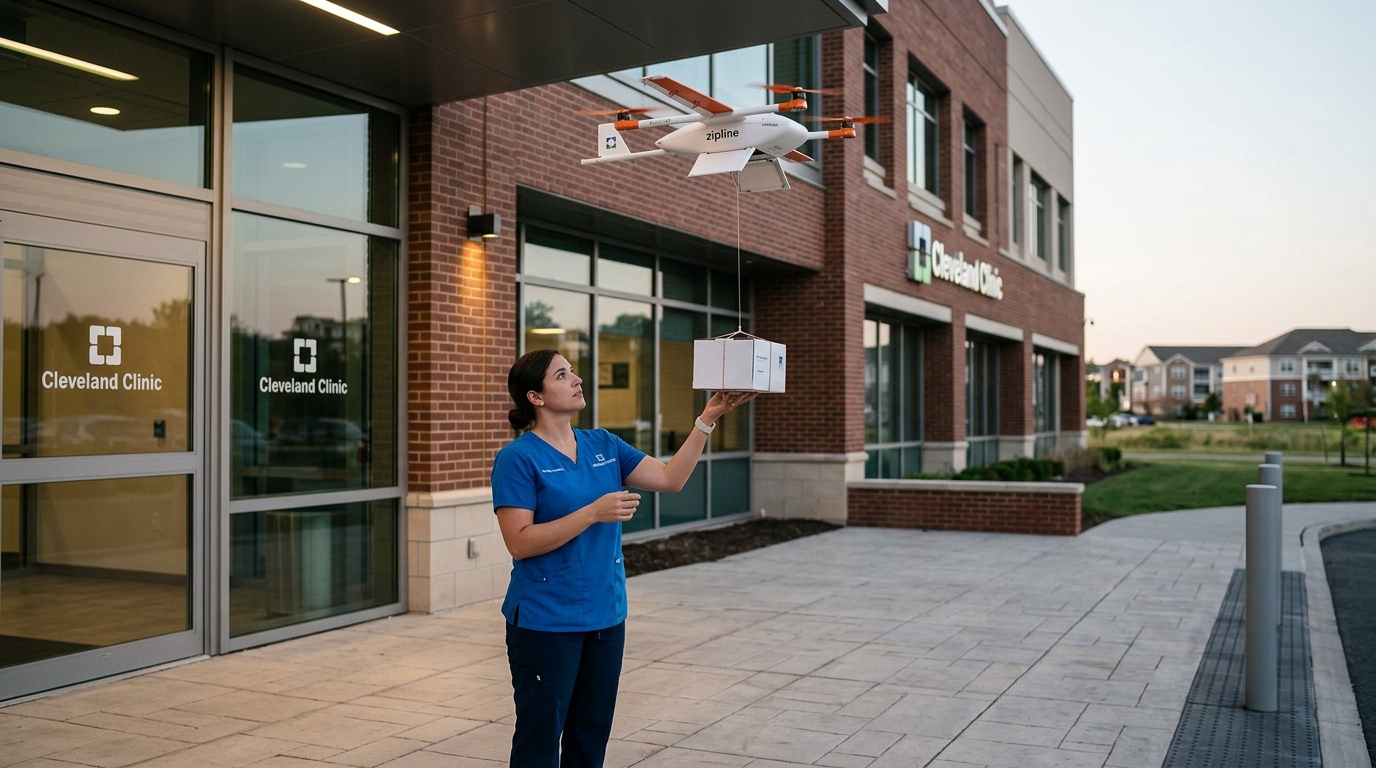
Cleveland Clinic launched what it described as the first long-term deployment of a prescription drug drone delivery program by a U.S. health system on August 3, 2026, operating with Zipline out of its Beachwood Administrative Campus in suburban Cleveland. For years, medical drone delivery in America largely consisted of limited demonstrations or short-term pilots. Cleveland Clinic’s decision to treat drone prescriptions as an ongoing service suggests the technology may finally be moving into the mainstream.
The operational mechanics matter. A team member places a prescription into a secure drop box, an autonomous electric drone retrieves the order and flies it to its destination. The drone does not land in patients’ yards. It can hover up to 300 feet in the air while a pod containing the prescription package descends to the ground from a tether, then ascends back into the drone, which returns to a charging station. Zipline has said its aircraft performs more than 500 safety checks per second while in flight.
The regulatory architecture underpinning this is where investors should focus. By late 2026, the United Kingdom and China had publicized medical drone routes operating in routine service, and Saudi Arabia’s aviation regulator had issued a permit for drone-based medicine delivery during Hajj. In the United States, health systems have announced large planned networks, but Cleveland Clinic’s program is live, and that difference matters.
The economics justify the permanence. Traditional ground couriers run $1.50 to $10 per delivery at the last mile. Drone delivery operators often cite a long-run target of about $1 per delivery at scale. At scale, the math compresses courier margins to near zero on standardized medical routes. Zipline has said a majority of its daily deliveries now take place in the United States, reflecting how quickly the center of gravity is shifting.
The corridor model also has a competitive moat built into its structure. Airspace approvals are not easy to replicate, and the FAA does not publish universal processing timelines for BVLOS approvals. First movers who secure approvals and embed drone infrastructure into hospital campuses, including drone bays for recharging and maintenance like the one SUNY Upstate says it is building into its Pathology Institute project in East Syracuse, accumulate a locational advantage that a second entrant cannot simply buy.
Cleveland Clinic has said it plans to expand the service over time to additional locations and to transport lab samples, medically tailored meals, and other medical supplies. That expansion roadmap is the real thesis. A prescription delivery corridor becomes a specimen corridor becomes a hospital-at-home supply line. The courier contract that took decades to build gets replaced corridor by corridor, and the authorizations compound.
The risk is not technical. It is concentration. Zipline holds a commanding operational position, but competition is forming around healthcare logistics infrastructure and handoff systems. Competitive pressure on corridor pricing will eventually arrive. What will not reverse is the regulatory precedent. Long-term medical drone delivery services are now operating inside U.S. healthcare infrastructure, and the couriers who depended on those routes are running out of runway.