




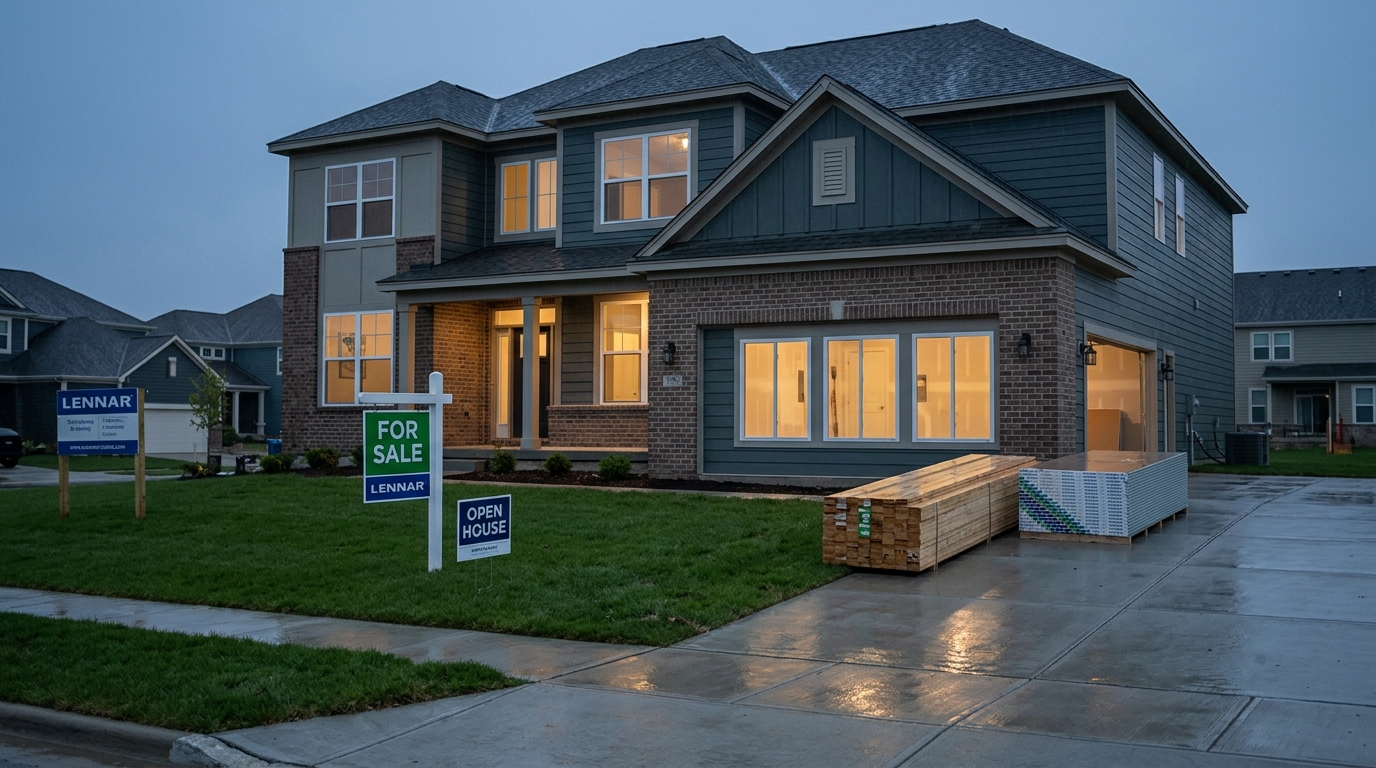
When a company misses earnings, cuts its full-year guidance, and watches its stock sink to a 52-week low, most institutional investors take the opportunity to reduce exposure. Greg Abel did the opposite.
Berkshire began its latest Lennar purchases on Sept. 17, one day after Lennar released its results on Sept. 16, 2026. According to a Form 4 filing with the SEC, Berkshire purchased Lennar shares between September 17 and September 21, covering about 2.7 million shares at weighted-average prices ranging from $74.80 to $79.41 per share. A separate Form 3 disclosed that Berkshire became a 10% owner of Lennar as of Sept. 17, 2026. The position now stands at 23.7 million Class A shares plus 528,217 Class B shares.
The quarter that prompted the selling from everyone else was bad by any standard. Lennar missed Wall Street’s revenue expectations, with sales falling 8.7% year on year to $8.05 billion, and GAAP profit of $1.19 per share came in below consensus estimates. Lennar cut its full-year 2026 delivery target to 80,000 to 81,000 homes, lowered its average sales price to $372,000, and used roughly 12% incentives to sustain volume. Management also guided fourth-quarter gross margin to roughly 15.5% to 16.0%, with CEO Stuart Miller citing 30-year mortgage rates around 6.8% at quarter end, and higher since, as a constraint on affordability that reduces the pool of qualified buyers.
What Abel Is Actually Buying
The framing that dominates the financial press right now is that Berkshire is bottom-fishing a beaten-down housing sector. That misses the more important point. Abel is not buying a cyclical recovery bet, he is buying a cost-advantaged production machine at a price that assumes the cyclical pain is permanent.
Lennar’s results land at a sensitive point for housing: the industry continues to face a structural shortage of homes in many markets, but the near-term economics of producing and financing those homes have become more difficult. Berkshire is buying the gap between those two facts. The shortage is structural. The near-term economics are not.
As Miller himself argued on the earnings call, the fundamental shortage of housing in America has not yet been solved or subsided, demand is real, deferred, and building, and when affordability returns through rates, wages, or serious national action on regulatory barriers, Lennar is positioned to capture it with the lowest cost structure, the fastest cycle time, and the leanest finished inventory.
Lennar delivered 20,840 homes in the quarter, but the drop in profit per share to $1.19 from $2.29 in the third quarter of 2025 reflects just how severely the rate environment has compressed margins. That compression is real but it is not a business verdict. Lennar’s land-light model, which sees it control rather than own most of its land, structurally limits the balance sheet damage in a downturn.
The Berkshire Housing Thesis Runs Deeper Than One Stock
This purchase did not appear in a vacuum. Over recent months, Berkshire acquired homebuilder Taylor Morrison outright for a total enterprise value of approximately $8.5 billion and increased its existing Lennar stake. Berkshire also owns building material companies including paint manufacturer Benjamin Moore and Johns Manville, a building products manufacturer. The Lennar stake crossing 10% is the latest step in a coherent thesis, not an isolated trade.
CFRA Research analyst Catherine Seifert called it a classic Berkshire value play, saying Berkshire likes to buy undervalued assets. That framing is correct, but undersells the conviction. Berkshire ended June 2026 with about $366 billion in cash, cash equivalents, and short-term U.S. Treasury bills. Committing more than $200 million more to one homebuilder, through a missed quarter, at a 10% ownership level, signals that Abel viewed the price as meaningfully below what the business is worth in a normal rate environment.
What Could Go Wrong
The case against is not trivial. Mortgage rates staying elevated well into 2027 would compress Lennar’s margins further and make the current delivery guidance look optimistic. Gross margin has already narrowed to 15.8% from 17.5% as the company leaned on incentives and pricing adjustments to move inventory. A further weakening in consumer confidence or a pickup in resale inventory in key Sunbelt markets could deepen the demand hole. Other major homebuilders including D.R. Horton and PulteGroup have also highlighted incentives and higher cancellation rates in recent quarters. This is an industry problem, not a Lennar-specific one, which means there is no near-term shelter in market share gains alone.
The position also requires patience that many investors cannot afford to supply. Berkshire can. That asymmetry between what Berkshire can hold and what the market is willing to hold is precisely where the opportunity lives, and precisely what Abel is exploiting.