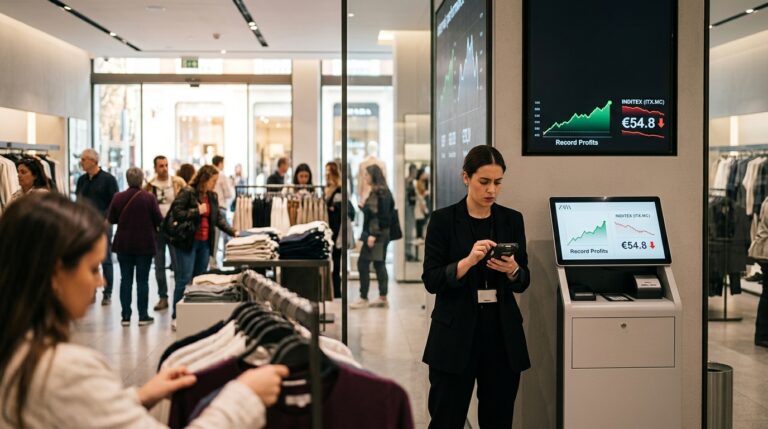




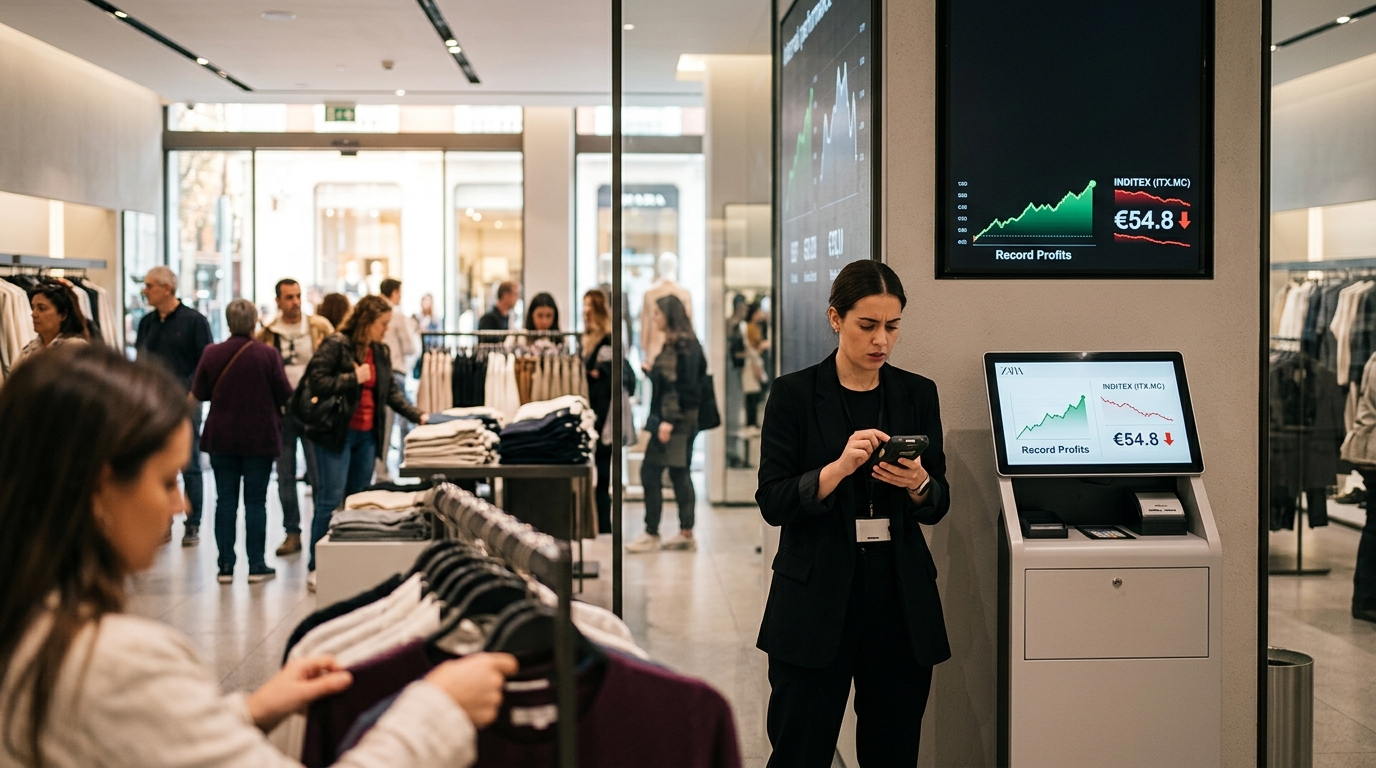
There is a peculiar discipline test baked into owning Inditex. The company posts a record, the shares drop, and investors who paid attention to the wrong number walk away frustrated. That happened again this morning.
Inditex stock dropped 2.8% to trade at €54.8 after the Spanish fashion giant published first-half 2026 results that, while setting all-time records in absolute terms, disappointed the market on profitability metrics. Net profit rose 6.8% to €2,980 million and sales climbed 7.6% to €19,755 million, but both operating profit and net income came in below the consensus estimates analysts had built up ahead of the release.
The margin picture was a key sticking point for investors. Gross margin reached 58.7%, up 40 basis points year-on-year, yet the operating expense ratio crept higher, resulting in a Q2 EBIT miss of roughly 3% versus expectations. Investor concerns centered on operating expenses that grew faster than revenue at 8.3%, driven largely by transport cost pressures from Middle East disruptions.
The market is entitled to its verdict on a given quarter. But the more important read is structural, not sequential. What does Inditex do that its peers cannot credibly imitate, whatever the shares did between now and market close?
The Machine Nobody Has Rebuilt
Inditex went a different way from most of the industry. It keeps design, a large share of manufacturing, distribution, and retail under one roof. That vertical control is what lets the two-week clock exist, because no handoff between separate firms sits in the critical path. Unlike rivals that outsource mostly to Asia, Inditex sources a large share of production from proximity markets near Spain, with about half of supplier factories involved in core garment processes located in Spain, Portugal, Morocco, or Turkey.
The compounding effect of that structure is not just speed. It is inventory discipline. Zara’s vertical integration and shorter supply chain allow the company to be more responsive and avoid excessive risk. Rivals that extended their Asian sourcing footprint to chase unit cost savings are now carrying excess inventory through a demand cycle that punished them for it. Inditex is not.
Inditex’s efficiency is largely attributed to its highly integrated and flexible supply chain, real-time data utilization, strategic logistics, and rapid market responsiveness. These factors allow it to adapt quickly to changing market conditions, minimize waste and inventories, and maintain a competitive edge in the fast-paced fashion industry. The company is not standing still on that infrastructure, either. Inditex committed roughly €900 million a year across 2024 and 2025 in extraordinary logistics investment, aimed squarely at widening distribution capacity. The centrepiece is a second Zaragoza hub, a facility of roughly 2.4 million square feet, already operational and slated for full completion by June 2026, built to run almost autonomously with robotic silos handling storage and sorting.
The Financial Quality the Cycle Cannot Touch
Beyond operations, the balance sheet is a competitive asset in its own right. Inditex reported a net cash position of €10.398 billion at the end of the first half, and said store and online sales in constant currency between August 1 and September 7, 2026 increased 9% versus the same period in 2025. Return on invested capital stands at 23.10%. By almost every financial measure, Inditex is winning over H&M: nearly double H&M’s revenue, more than five times its profit, and roughly seven times its market value.
Management stressed the group’s long-term growth runway, with CEO Óscar García Maceiras emphasizing Inditex’s low market share in a highly fragmented sector, leaving substantial room for expansion. Inditex expects growth of annual gross space in 2026 to be around 5%.
What Could Go Wrong
The honest case against the stock is not today’s EBIT miss. It is the sustained cost pressure from Middle East freight disruptions, which management acknowledged will not reverse overnight. Its biggest competition now comes from ultra-low-cost digital players like Shein and Temu that win on aggressive pricing. If the aspirational consumer who gravitates toward Zara’s mid-premium positioning gets squeezed by ECB rate policy, spending habits could shift down the price ladder faster than Zara’s assortment can chase them. Valuation at roughly 25 to 28 times earnings leaves little room for another quarter of expense overruns without a further rating reset.
The Long-Term Verdict
What today’s sell-off actually confirmed is that the market is applying precision expectations to a business built for resilience across decades, not quarters. The two-week product cycle, the nearshore manufacturing base, the €10.4 billion net cash fortress, and the low global market share overhead are not features that H&M, Lululemon, or any aspiring rival will replicate inside a five-year horizon. After capital expenditure of €1,307 million, free cash flow rose to €2,299 million in the first half, underscoring robust cash generation capability. A business that generates that kind of cash at the trough of a cycle deserves patient capital. The shares may stay under pressure into the ECB decision. The business model will not.