




September 7, 2026
Bonus Content: GM, Ford and Stellantis Ask Washington to Save Them
Below is an important message from one of our highly valued sponsors. Please read it carefully as they have some special information to share with you.
Dear reader,
Michael Burry is the famous hedge fund manager who predicted the 2008 meltdown…
And made $100 million during that crash.
He’s now putting his own money on the line…
Betting that this AI company I just exposed in this shocking new interview will collapse.
He said:
“This bubble looks an awful lot like the dot-com bubble.” [This company] is doomed and hemorrhaging cash.”
After correctly predicting the last two major stock market meltdowns…
I have to say… I agree 100%.
I believe this company is about to go bust…
In a meltdown that will be 10 times bigger than Lehman Brothers.
So please click here to get the details because…
While most people are in the dark…
Some of the best investors on the planet…
Are already preparing for this coming AI meltdown.
For example, tech billionaire Peter Thiel recently sold his entire stake in Nvidia, worth about $100 million.
The giant investment firm SoftBank also sold all of its Nvidia holdings for $5.8 billion.
Ray Dalio’s hedge fund has also been dumping shares of some of the biggest AI players.
He recently cut his Nvidia position by 65%, Google by 52% and Meta by 48%.
And over the past few months Warren Buffett sold $177 billion worth of stocks…
And he’s now holding a record position in cash.
I highly recommend you avoid these hyped-up AI stocks…
Regards,
Jim Rickards
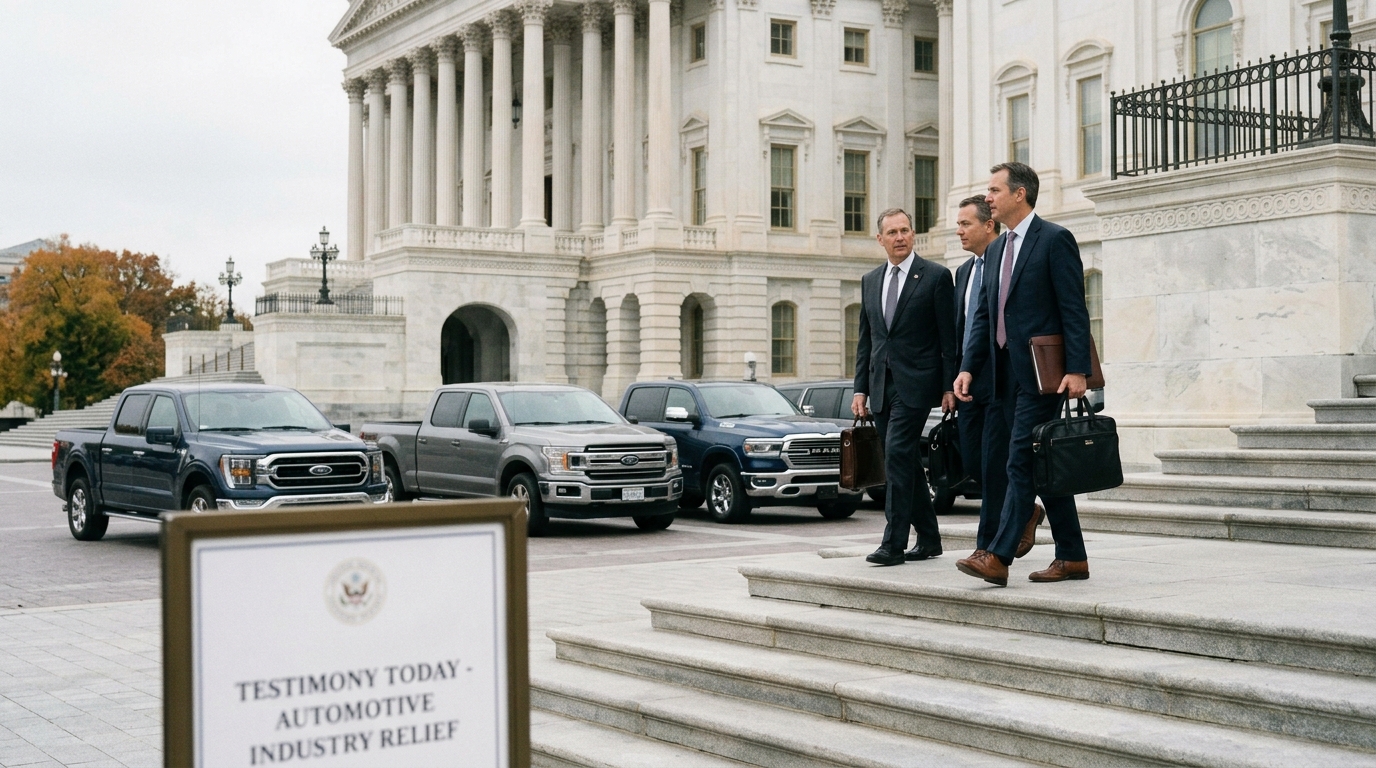
GM, Ford and Stellantis Ask Washington to Save Them
There is a telling detail buried in the Alliance for Automotive Innovation’s September 3 letter to congressional leadership. The Alliance, which represents General Motors, Ford, Stellantis, Toyota, Volkswagen, Honda and other major automakers, did not write to complain that Chinese cars are already taking American customers. As Reuters reported, Chinese automakers have not sold a single connected car in the United States yet. The letter is a request to lock the door before anyone tries to open it.
That distinction matters for investors trying to assess what GM, Ford and Stellantis actually are as businesses.
The Alliance urged congressional leaders to act before the end of the 119th Congress, which is scheduled to conclude on January 3, 2027. The companion House bill, the Connected Vehicle Security Act of 2026 (H.R. 8730), has drawn dozens of co-sponsors from both parties, but not 72 based on the public bill record as of September 7, 2026. The Senate Commerce Committee approved its version by voice vote on July 22. Bipartisan momentum this strong rarely stalls entirely, so some form of restriction is likely. The security argument, at minimum, is genuine: the Alliance’s letter argues that China is capturing market share in Europe, Australia, Southeast Asia, Mexico and South America with vehicles capable of collecting, processing and transmitting sensitive vehicle and consumer data.
But national security and competitive strategy are two different conversations, and Detroit has conflated them. The lobbying campaign is framed in the language of surveillance risk. The underlying anxiety is about cost curves.
Competitive pricing, large-scale production and strong vertical integration continue to support BYD’s market position globally, and the gap between what BYD can build an electric vehicle for and what GM or Ford can build one for is not closing quickly. Ford’s disclosures show its EV business continues to post multibillion-dollar losses, and GM has been working to reduce EV losses as well. Both companies have also signaled a slower EV ramp in response to demand and economics. That retreat reinforces rather than resolves the cost problem: the fixed overhead of EV development does not shrink when volumes do.
A closed home market would relieve pressure in the short term. It would not produce the manufacturing discipline that narrows the cost gap. And the rest of the world is not closing its markets. BYD is capturing market share in Europe, Australia, Southeast Asia, Mexico and South America, markets where GM and Ford still compete. A Detroit that wins through legislation at home while losing ground everywhere else is not a stronger Detroit; it is a smaller one with a protected corner.
The contrast with Tesla and Toyota is instructive. Tesla’s answer to Chinese competition has been to cut prices, invest in manufacturing efficiency and keep pushing software features. Toyota’s battery-electric growth has been significant in some regions, but the claim that Toyota pushed global EV volume up 43% while overall sales slipped is not supported as a global figure; the 43% number commonly cited in recent Toyota releases is tied to specific regional or model results. Neither company signed the lobbying letter asking Washington to manage their competitive problems for them.
None of this makes GM, Ford or Stellantis uninvestable. The Connected Vehicle Security Act framework would restrict connected vehicles and related software and hardware tied to foreign adversaries, and reporting on the House proposal has described a provision that would bar an automaker more than 15 percent owned by a Chinese company from selling vehicles in the U.S. Trucks and SUVs remain deeply profitable, and the Detroit manufacturers still dominate those segments at home. A ban buys time.
The question a long-term investor must answer is what management does with that time. If the protected period accelerates genuine cost reduction and EV capability, the legislation is a bridge to something durable. If it becomes a substitute for that work, the bridge leads nowhere. The letter to Congress, read carefully, does not answer which outcome Detroit intends. That answer will come from capital allocation decisions over the next three years, not from what gets passed on Capitol Hill before January 3.