


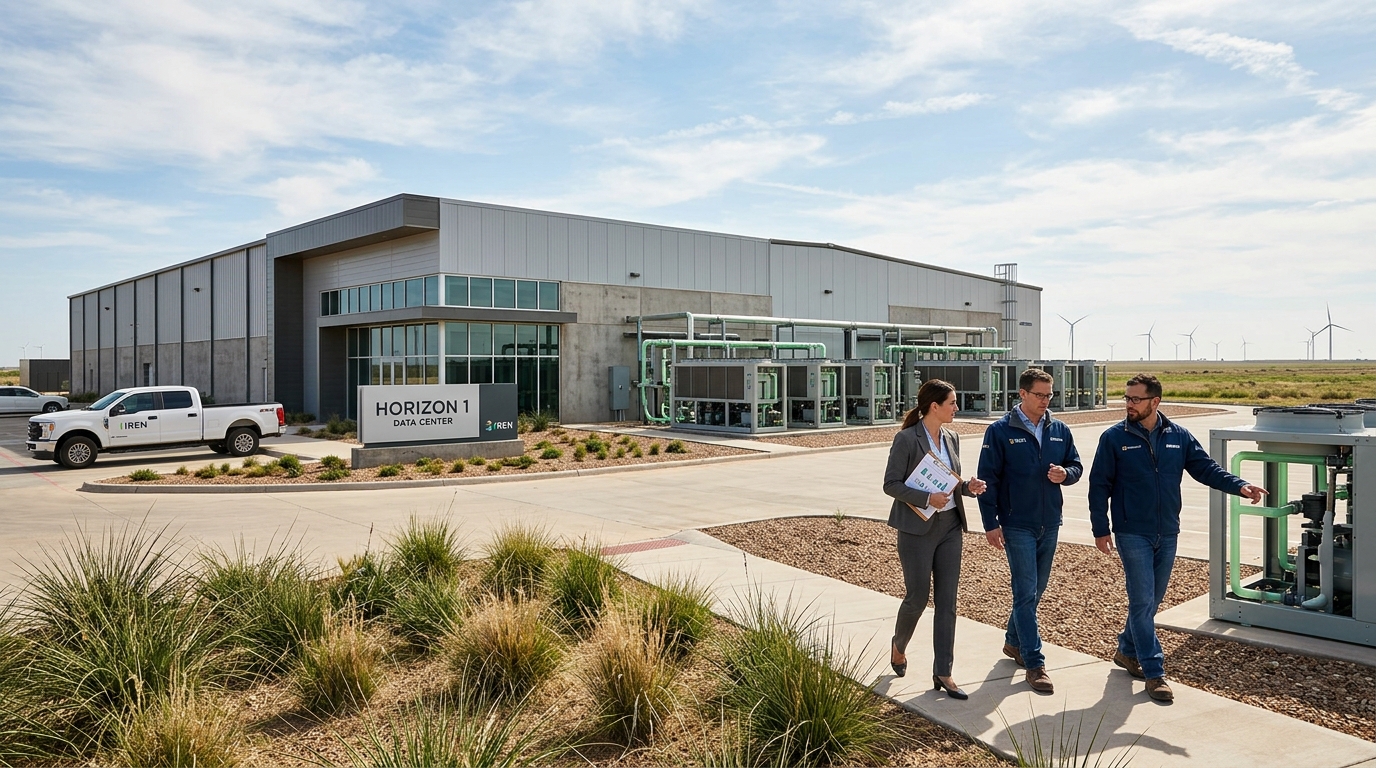
On August 13, Microsoft accepted the first building IREN constructed for it in the Texas Panhandle under their five-year, $9.7 billion cloud services contract. Horizon 1, the first of four 50MW liquid-cooled deployments for Microsoft, has been delivered and accepted. That is the milestone IREN investors have waited for since the contract was announced in November 2025. Thursday, when IREN reports fiscal 2026 results after the close, is when they find out what acceptance translates to in dollars.
The gap between the contractual ambition and the current revenue run rate is the central tension in this stock. IREN will report fiscal 2026 results on August 27, giving investors a view of how quickly its business is shifting from Bitcoin mining toward AI cloud. The March-end quarter showed that transition clearly: revenues fell to $144.8 million, while AI cloud revenue nearly doubled sequentially to $33.6 million. A $33.6 million quarterly AI cloud run rate annualizes to roughly $134 million. The company’s year-end 2026 annualized run-rate revenue target now sits at more than $4 billion. That is the math investors need to square before Thursday.
What the Contracts Say
The booked total is large and getting larger. IREN raised its year-end 2026 annualized run-rate revenue target from $3.7 billion to more than $4 billion after signing $2.8 billion of new multi-year contracts, with about 85% of that target already contracted, making deployment and customer acceptance critical. Management has been explicit that the Microsoft contract revenue will not fully ramp until fiscal Q3, meaning the August 27 report will reflect a period largely before Horizon 1 was accepted. Don’t fixate on the headline revenue number: management already made clear that the Microsoft contract revenue will not ramp until Q3.
Contracted ARR of $3.1 billion represents expected $1.9 billion average annual revenue under the Microsoft contract, expected $0.7 billion average annual revenue under the NVIDIA contract, plus about $0.5 billion ARR under contract from GPU deployments at Prince George. NVIDIA’s involvement adds a second hyperscaler anchor. That combination is what separates IREN from most neocloud peers, whose contracted revenue is thinner and concentrated in fewer relationships.
The Estimate Problem
Estimates for IREN’s 2026 and 2027 earnings have been revised downward in the past 30 days, though the company is expected to report a profit next year. Downward revisions heading into a print where the biggest revenue ramp has not yet started create a specific kind of risk: the report itself lands soft, but the forward guide is the real event. Short interest has been elevated, which makes the stock’s reaction to guidance asymmetric. A credible acceleration in deployment cadence could force covering. A miss on Horizon 2 or 3 timelines could extend the slide.
IREN reported about $7.6 billion of cash and cash equivalents as of June 30, including $1.7 billion of restricted cash tied to Microsoft GPU financing, with recent customer prepayments covering roughly 45% of associated GPU capital expenditure. Liquidity is not the immediate concern. Execution cadence is.
The Bottom Line
The investment case for IREN is not really about this Thursday’s revenue line. It is about whether Horizon 2 through 4 deliver on the same schedule as Horizon 1. Approximately 85% of the $4 billion-plus target is already contracted, which means deployment timelines and customer acceptance now carry significant weight in the investment case. With one Microsoft data center accepted and three more scheduled for delivery in 2026, the next 90 days of construction updates matter more than the fiscal 2026 numbers themselves. Watch the deployment schedule, not the headline.