
Here is a question worth sitting with: if a company’s two largest future revenue commitments involve neither a pickaxe nor a hash rate, what exactly are you buying when you own the stock?
Anthropic has struck a $9.1 billion agreement with Riot Platforms, a bitcoin mining company that has been building out AI data center capacity. The deal got the headline. The stock closed down 5.46% on Monday before the announcement, then surged more than 25% in after-hours trading. But the real investment question is not whether this contract is large. It is whether Riot has quietly engineered one of the most significant infrastructure pivots in the market right now, and whether the market has any idea what to pay for it.
What the Lease Actually Says
Riot’s Rockdale, Texas, campus will supply 191 megawatts of IT capacity under the terms of the 20-year lease, which extends through June 2048. Two five-year extension options could raise the total contract value to $16.1 billion. That is not a vendor agreement. That is a bond-like income stream embedded in a data center operator with a balance sheet still categorized by most screeners as a cryptocurrency miner.
Riot plans to bring capacity online in stages, reaching 96 megawatts by December 2027 and completing the full 191-megawatt buildout by June 2028. To finance the early construction, Riot has said it arranged a $573 million interim financing facility through Morgan Stanley as it works toward putting a permanent credit backstop in place. The construction bill is estimated at $2.1 billion to $2.3 billion. Riot estimates cumulative net operating income of $7.3 billion to $8.2 billion during the base term. That implies average annual NOI of roughly $390 million, a figure no digital asset miner has ever approached from a single lease.
The Business Behind the Stock
For most of its recent history, Riot was a bitcoin miner with real estate ambitions. The ambitions are now contracts. This is Riot’s first data center lease publicly announced in 2026, following a January contract with AMD for an initial 25 MW at the same Texas site, with options that could expand that relationship. Combined, Riot has now committed at least 216 MW to AI-related leasing activity between the AMD lease and the Anthropic agreement, with further expansion dependent on option exercises and buildouts.
The Q2 income statement still looks like a miner’s. Riot has not yet filed its Form 10-Q for the quarter ended June 30, 2026 as of August 11, 2026. The gap between what the income statement says and what the contracted backlog implies is where the investment debate lives.
The Rockdale campus itself is the asset most investors underappreciate. The Texas campus has 700 MW of developed, energized power capacity, along with existing fiber and electrical infrastructure that Riot says can be repurposed for high-density computing. The company has said it intends to convert the site’s capacity toward data center tenants over time. That means the Anthropic deal covers roughly 27% of Rockdale’s total developed power. The rest of the runway is still unleased.
The Bigger Story: Corsicana
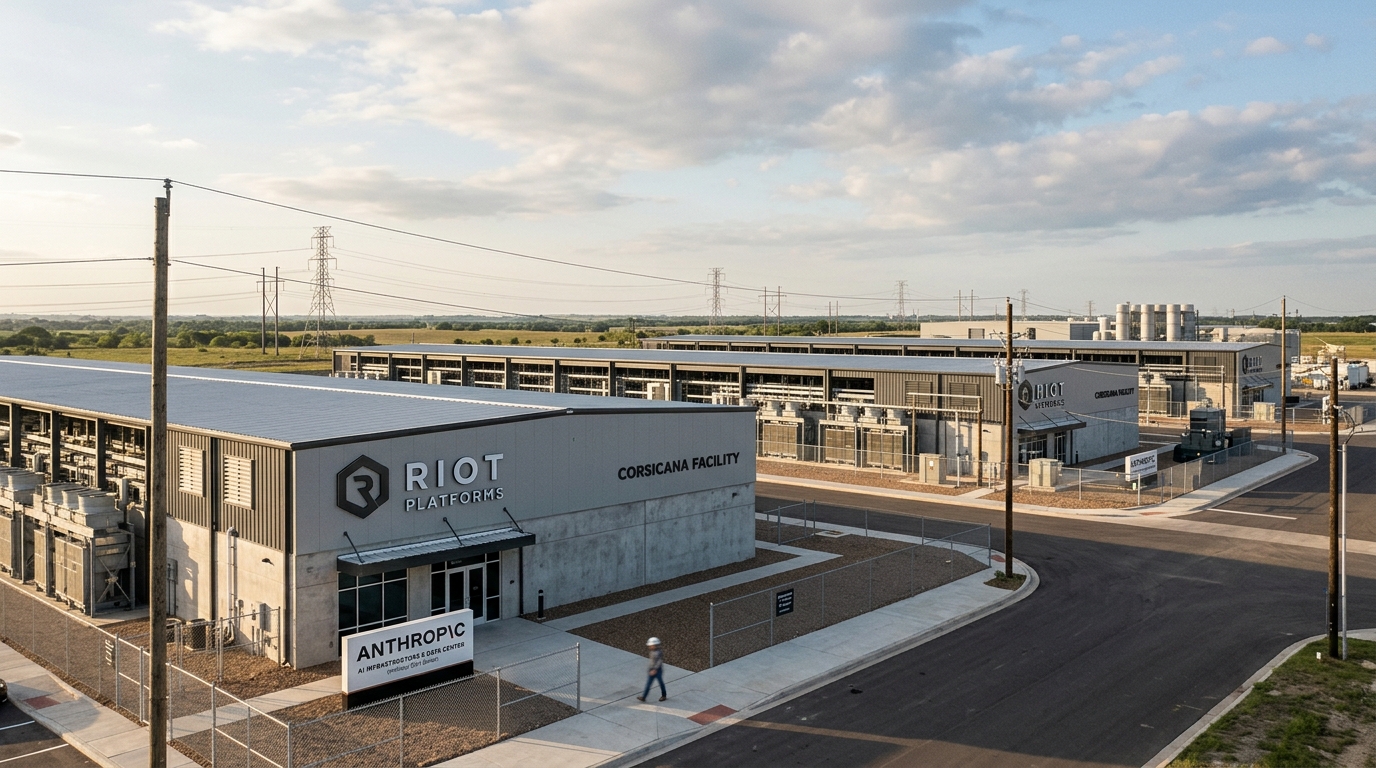
The Anthropic deal grabbed attention. What came alongside it on Monday’s earnings call deserves more. CEO Jason Les disclosed that Riot had signed a letter of intent with an unnamed tenant at the Corsicana facility, a 1 GW site in Texas. A lease for the entire site could represent over $1 billion in annual rent upon full deployment. On the earnings call, analysts immediately asked whether the Corsicana LOI, covering the full site under a single tenant, implied a hyperscaler. Les declined to identify the counterparty but confirmed the company is deeply engaged.
Corsicana is the larger asset. Corsicana has capacity under development toward an ultimate 1 GW target. Executing a build of this size requires substantial design, legal, and commercial work that scales with the megawatts being executed. A binding lease here would push Riot’s contracted infrastructure to a scale most dedicated data center operators have spent decades assembling.
What’s Changing
The Anthropic deal did not arrive in isolation. Anthropic has been spending at a pace that makes the Riot contract look almost modest. The company’s revenue run rate has been reported as surpassing $30 billion, up from approximately $9 billion at the end of 2025. That growth rate is placing severe strain on available compute. Recent deals and reported arrangements have included a $10 billion contract with Volta for capacity in Norway, along with other major computing and infrastructure commitments across the sector. The Riot deal adds 191 MW of Texas-based capacity to a portfolio that now spans multiple continents and technology stacks.
What made Riot an attractive counterparty is precisely what made bitcoin mining valuable for a decade: cheap, large-scale power in proven grid locations. Starboard Value, one of Riot’s large shareholders, published a letter to CEO Jason Les in February arguing that Riot’s Texas data center sites are among the most valuable undeveloped data center assets in the United States, primarily because they have the one thing that cannot be easily built right now: power connectivity at scale. The Anthropic deal is validation of that argument in contract form.
The Risks
Three risks matter here. First, execution. Delivering 96 MW of mission-critical AI data center capacity by December 2027 requires construction precision that bitcoin mining never demanded. A delay does not just miss a milestone; it hands a frontier AI lab a contractual remedy. The $573 million interim financing facility through Morgan Stanley still needs to be replaced by a permanent credit backstop. Until that facility is in place at investment-grade terms, the construction plan carries financing risk.
Second, identity. Bitcoin mining remains a large share of Riot’s revenue in reported results. Every megawatt contractually committed to a long-term AI lease is power that cannot be redirected to Bitcoin mining if hashprice recovers. Riot is locking in AI landlord economics at the expense of optionality on a bitcoin cycle that could still surprise. To fund its buildout, Riot has described relying in part on bitcoin sales alongside operating cash flows, which can reduce its crypto holdings if bitcoin appreciates sharply.
Third, Corsicana uncertainty. The LOI is nonbinding. Multi-year development requires careful planning from both Riot and the tenant to ensure the design meets timelines and specifications for both the first and final phases of delivery. The company is moving through the process as quickly as possible while being diligent. Investors pricing in a Corsicana definitive lease are discounting that risk.
What Investors Should Watch Next
Four milestones define the next 18 months. The first is whether Riot secures its permanent credit facility for the Rockdale buildout at terms that limit equity dilution. The second is the November 2026 delivery of 10 additional AMD megawatts, which will be the first real test of Riot’s data center construction cadence. The third is the Corsicana LOI converting into a definitive lease agreement; CEO Les said the company will update the market in the coming months. The fourth is whether Anthropic’s spending pace holds. Anthropic’s revenue run rate has been reported as surpassing $30 billion, up from $9 billion at the end of 2025, but a compute pullback or competitive pressure from OpenAI would change the calculus on long-term lease economics across the sector.
Bottom Line
Riot Platforms announced a deal worth $9.1 billion Monday evening. The market celebrated the number. The more important observation is structural: Riot is increasingly a power-infrastructure landlord, not just a bitcoin miner. The Anthropic contract locks in two decades of cash flow from one of the fastest-growing AI companies on the planet. The Corsicana LOI, if it converts, would double the scale of that transformation. The income statement will not reflect any of this for another 18 months. That gap between contracted future value and current financial optics is where the investment case sits right now, and investors willing to read past Q2 earnings have a genuinely different picture in front of them than the one being reported.