

October 25, 2026
Bonus Content: Eli Lilly Is Betting $50 Billion on a Pill. Thursday Will Test Whether the Math Still Works.
A SPECIAL INVESTOR STORY – FALL 2026
Are Pesticides the New Tobacco?
An essential global industry is facing a familiar collision of public pressure, regulation and technological change.
For decades, tobacco looked permanent.
It was deeply embedded in daily life, supported by powerful companies and protected by enormous demand. Then the evidence, lawsuits, regulation and public sentiment began to converge.
The industry did not disappear overnight. But capital, consumer behavior and corporate strategy began to move.
THIS TIME, THE INDUSTRY UNDER PRESSURE MAY BE PESTICIDES.
Chemical pest control is essential to agriculture, public health, homes and businesses. Yet concern around conventional formulations continues to grow – from exposure and residues to resistance and environmental impact.
That creates a paradox investors should not ignore:
The world could quit smoking.
It cannot quit controlling pests.
If pressure forces the category to evolve, demand does not vanish. It may migrate toward products designed to meet changing expectations.
One small company has spent years building botanical pest-control products for professional and consumer use. Its name is Med-X, Inc. The company is currently private and has reserved MXRX for possible use following a successful future Nasdaq listing. Its Nature-Cide portfolio sits directly inside this developing conversation.
This is not a prediction that pesticides will become tobacco. It is a question about what happens when an indispensable industry can no longer remain exactly as it was.
Discover the evidence, the market transition and the company positioned inside it.
Eli Lilly Is Betting $50 Billion on a Pill. Thursday Will Test Whether the Math Still Works.
There is a version of Eli Lilly’s future where it becomes one of the great pharmaceutical franchises of the generation. There is another version where it has built a vast industrial complex into a market that is actively changing the prices of the drugs that fill it. Thursday’s Q3 report, before the open on October 29, 2026, will not settle that debate, but it will sharpen it considerably.
The headline numbers going in are striking. Q1 2026 revenue rose 56% to $19.8 billion, driven primarily by volume growth, partially offset by lower realized prices from Mounjaro and Zepbound. Then Q2 topped it: Q2 2026 revenue increased 48% to $23.0 billion, driven primarily by Mounjaro and Zepbound volume. Management subsequently raised full-year 2026 guidance to $82 billion to $85 billion in revenue and $35.50 to $36.50 per share in non-GAAP EPS. For Q3, published consensus estimates have clustered around the mid-$5 range for adjusted EPS and roughly $22 billion to $23 billion in revenue, but the precise figures vary by data provider.
The core tension is visible in those Q1 and Q2 figures: volume is growing around 60% or more, but realized prices are falling 13%. Lilly has recently traded at a premium to Morningstar’s fair value estimate, which Morningstar put at $870 per share in an earnings preview earlier in 2026. That gap only closes if the next generation of drugs expands the franchise faster than price erosion shrinks it.
The Case for the Pipeline
Lilly’s answer to the pricing pressure is two drugs and an enormous factory bet. Foundayo, known generically as orforglipron, received FDA approval on April 1, 2026 for adults with obesity, or overweight with weight-related medical problems. It is a once-daily small molecule oral GLP-1 receptor agonist that can be taken with or without food, and Lilly has marketed it as a pill that can be taken any time of day without food or water restrictions. CEO Dave Ricks told CNBC that Foundayo accounts for about one out of three new starts in the oral GLP-1 obesity category. Lilly has said it expects a broader international expansion over time, but the specific timeline and country count can shift as regulators complete their reviews.
Behind Foundayo sits retatrutide, a triple hormone receptor agonist whose Phase 3 data are genuinely extraordinary. In TRIUMPH-1, participants on 12 mg retatrutide lost an average of 70.3 lbs, or 28.3%, over 80 weeks. Lilly also reported that 45.3% of participants on 12 mg achieved 30% or more weight loss under its efficacy analysis. Lilly has said it is running a broad Phase 3 program across obesity and obesity-related conditions, with additional readouts and regulatory timing still subject to trial completion and agency review.
The Factory Bet
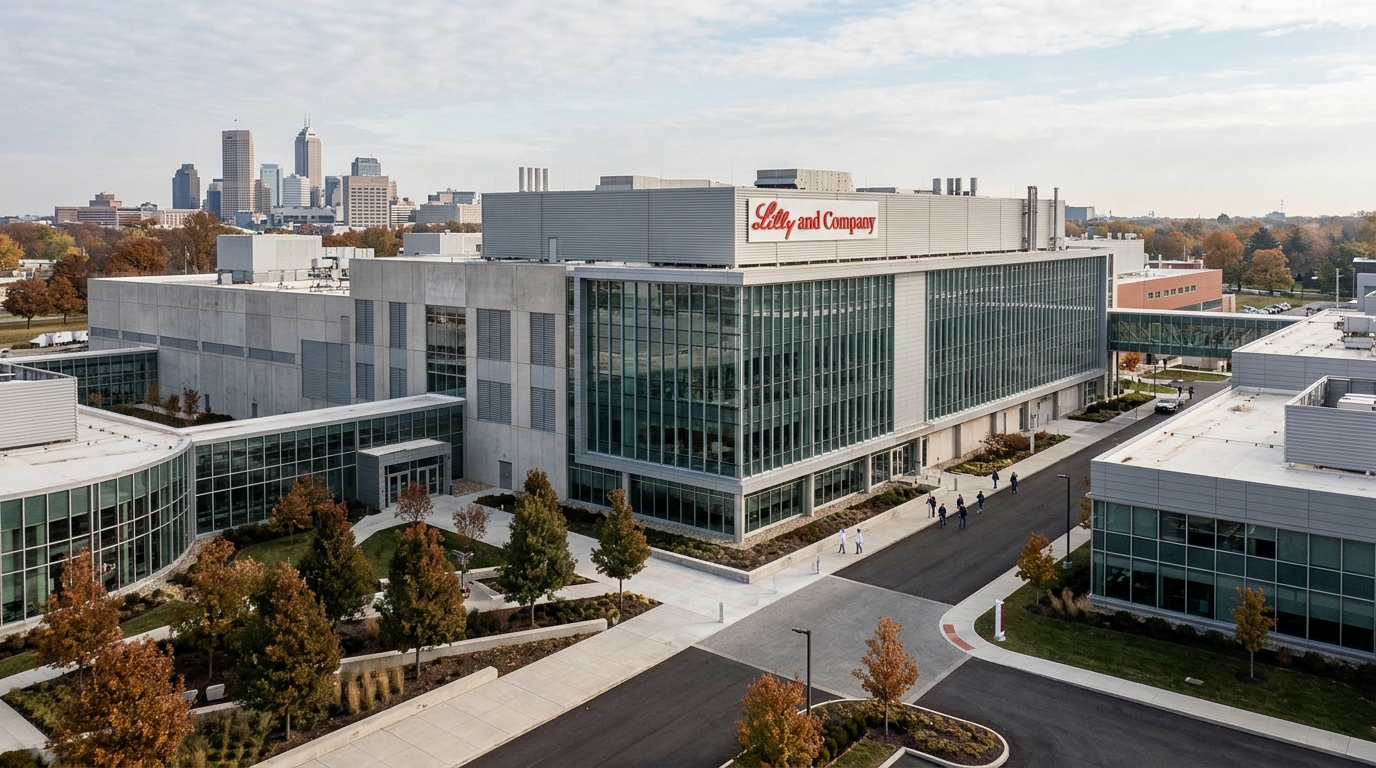
To manufacture a pill at the scale needed to serve a global obesity market, Lilly is spending with the discipline of a capital-intensive industrial company. Since 2020, the company has said it has committed more than $50 billion in U.S. capital expansion commitments, and more recently described total manufacturing commitments since 2020 of more than $55 billion globally. The most recent move: Lilly broke ground on a $6.5 billion active pharmaceutical ingredient manufacturing facility in Houston, Texas, which will produce Foundayo along with other small-molecule medicines. Lilly has also emphasized that small-molecule medicines can be manufactured using more established technologies and can therefore be more readily scaled. That scalability matters. Peptide-based injectables like Ozempic and Zepbound require highly specialized biological manufacturing. A pill does not.
Lilly’s manufacturing sprint does not happen in isolation. The equipment suppliers inside every new pharmaceutical factory face a gap between announced reshoring commitments and actual order flow — a chokepoint that could affect timelines across the industry.
What Could Go Wrong
The honest case against Lilly is not about the science. Morningstar has argued the bar is set very high for Lilly over the long run, with expectations that require the company to maintain an almost impeccable track record in commercialization, pipeline execution, and business development. The pricing dynamic is real: both Q1 and Q2 showed 13% year-over-year declines in realized prices, even as volume soared. If oral GLP-1 competition from Novo Nordisk intensifies, or if further price concessions are extracted by pharmacy benefit managers, Lilly’s capacity build could face headwinds before its Houston plant reaches large-scale output. Lilly and local development materials have pointed to a completion timeframe around 2030 for the Houston site, with operations expected to begin around then.
The valuation leaves little cushion for a miss. On Thursday, the question is whether Q3 volume held up enough to justify a premium multiple and the manufacturing sprint that comes with it.
Lilly is building a franchise designed to outlast any single drug cycle. The pipeline is compelling, the manufacturing commitment is serious, and management has beaten estimates four consecutive quarters. The stock, however, prices in a version of the future where nearly everything goes right. Thursday is where that assumption meets the ledger.