



The question Alphabet is really asking with Project Suncatcher is not an engineering question. It is a resource question. When Sundar Pichai was asked what keeps him up at night, he answered with one phrase: “compute capacity.” Power, land, supply chain constraints: how do you ramp to meet extraordinary demand? Putting chips in orbit is Alphabet’s most literal answer to date.
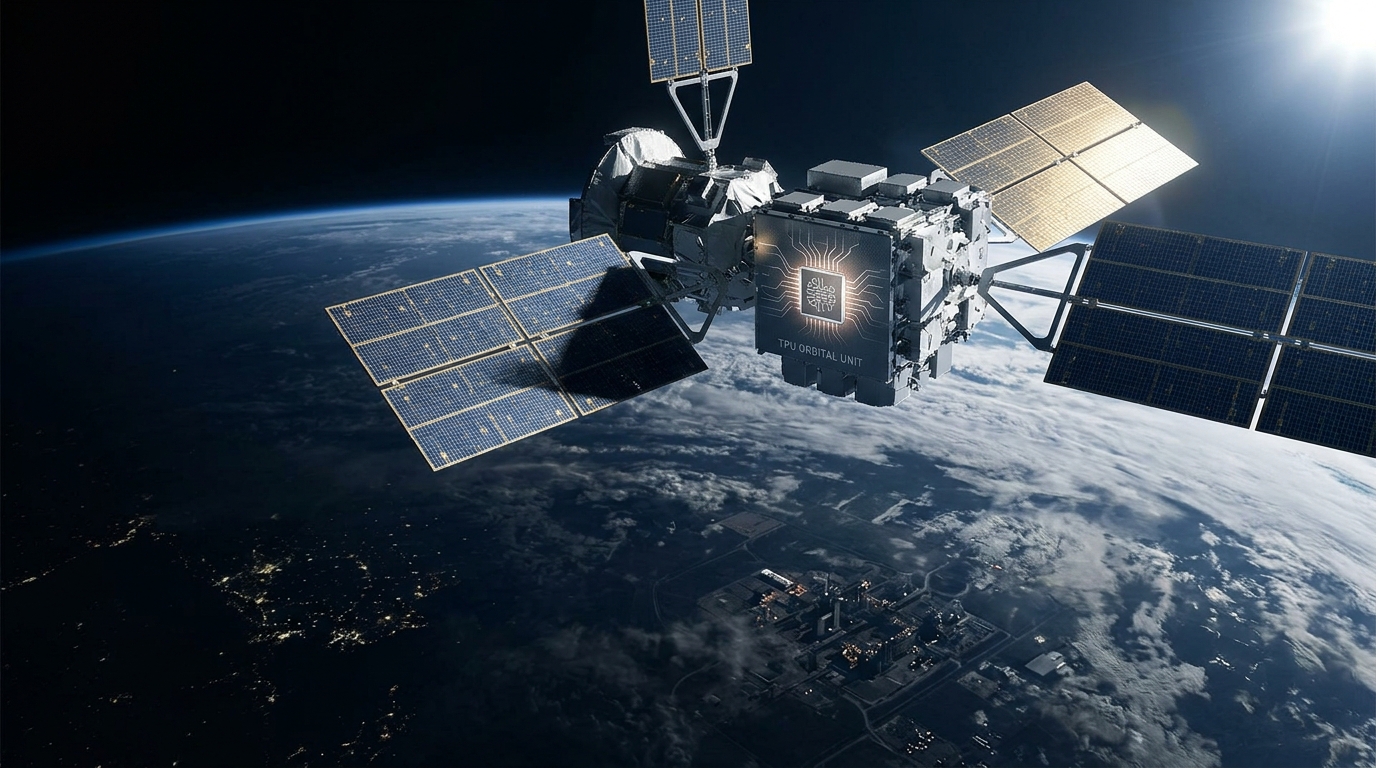
On October 1, a SpaceX Falcon 9 lifted off from Vandenberg Space Force Base carrying a prototype satellite packed with four of Google’s own Tensor Processing Units. The payload is the first hardware test of Project Suncatcher, Google’s research bet that AI computing could one day run in orbit, powered by near-constant sunlight instead of a strained terrestrial grid. By that evening, Google said it had confirmed contact with the satellite and reported it was operating as expected.
Google built the prototype in partnership with Planet, the satellite imaging company known for operating large fleets of small Earth-observation spacecraft. Planet supplied the spacecraft bus and will help operate the satellite in orbit, while Google supplied the compute payload: four Trillium-generation TPUs drawing on roughly one kilowatt of onboard solar power. The goal is for the mission to run for a year.
The physics driving this decision are straightforward. A solar panel in the right orbit can generate several times more usable energy over a year than the same panel on Earth, partly because a sun-synchronous, dawn-dusk-style orbit can have nearly constant access to sunlight. On the ground, the numbers run the other direction. Alphabet, Amazon, Meta, and Microsoft are projected to deploy roughly $700 billion to $725 billion in 2026 on capital expenditures, much of it tied to AI infrastructure, with some projects now expected to wait years for utility power interconnection. The result is a widening gap between announced AI spending and energized megawatts.
According to a 2024 Department of Energy advisory report on powering AI and data center infrastructure, hyperscale facilities are increasingly arriving as 300 to 1,000 megawatt connection requests, with multi-year lead times already straining local grids. In Europe, the constraint is already binding: Irish data centers used about 21% of the country’s electricity in 2024, and that share rose further in 2025, intensifying grid and permitting limits around Dublin. Alphabet has been chasing terrestrial solutions. In December 2025, Alphabet agreed to acquire data center and energy infrastructure company Intersect for $4.75 billion in cash, plus the assumption of debt. Intersect develops large-scale power and data center infrastructure projects, giving Alphabet a way to bring generation and compute online faster. Suncatcher is the acknowledgment that terrestrial fixes alone may not be enough.
Google eventually envisions clusters of satellites orbiting together to form space-based data centers, each carrying many TPU chips and communicating via free-space optical links. Next year, the company plans to put additional satellites into orbit to test laser connections. The research paper behind the project lays out an illustrative 81-satellite cluster with a one-kilometer radius. Google’s own analysis suggests that falling launch costs could make space-based compute economically plausible within the next decade, with prices potentially falling below $200 per kilogram by the mid-2030s, a point at which orbital clusters could become comparable to terrestrial data centers on certain cost-per-power metrics.
The honest assessment is that today’s satellite is not a data center. It is not, by any measure, a working data center. It is four chips in a box, checking whether Google’s AI silicon can survive a rocket launch and then compute reliably in vacuum, cold, and radiation. The early challenge is thermal as much as radiation, with the prototype designed to run compute in short bursts, on the order of 15 minutes at a time. Heat rejection in a vacuum is a harder problem than radiation hardening, and Google has one year to learn how hard.
What Project Suncatcher reveals about Alphabet as an investment is less about satellites and more about the intensity of the resource constraint it is trying to escape. A company that spends $4.75 billion on energy and data center infrastructure, negotiates nuclear power arrangements, and then also puts its own chips in orbit is a company that has concluded the ground-based path alone cannot keep pace. Nvidia has highlighted orbital data center efforts in its ecosystem as well, suggesting growing industry-wide momentum toward space-based AI infrastructure. The race for compute is increasingly a race for the electricity to run it. Alphabet just moved that race off the planet.