


Two automakers, one supply chain problem, two very different answers. The contrast sharpened this week when CNBC reported that General Motors is in the early stages of developing next-generation battery cells designed to reduce American dependence on Chinese materials, just days after Transportation Secretary Sean Duffy sent a letter to Ford CEO Jim Farley demanding the company sever ties with CATL, Geely, and BYD.
Your Power Bill Is Funding the AI Boom
The bulk order that keeps the lights on across 13 states just jumped from $2.2 billion to $14.7 billion – nearly 7x in one year – because data centers are draining the grid. There’s one energy source that runs 24/7 with no fuel, and Washington just preserved its tax credits through 2033 while terminating everyone else’s. Google signed for 15 years. Bill Gates invested $100 million. One company has spent sixty years building it.
The political pressure on Ford is real. Duffy expressed “profound concern” over Ford’s reliance on CATL’s technology at its Marshall, Michigan battery plant, its planned joint venture with Geely in Spain, and its reported talks with BYD on hybrid vehicle components. Ford pushed back, calling the administration’s claims basic misunderstandings and arguing that its Michigan battery plant is proof of the domestic manufacturing push Washington says it wants. The Geely deal would give the Chinese group 34% of a new entity that is expected to begin operations at Ford’s Valencia manufacturing hub in the first half of 2027, with the first new vehicles scheduled to come off the line in 2028. Ford’s position is defensible on the merits, but politically it has become far more complicated.
GM’s position looks cleaner right now. But cleaner is not the same as smarter, and that distinction matters enormously for long-term investors.
GM is in the early stages of developing next-generation battery cells that it believes can reduce U.S. dependence on China. “We’re developing a supply chain such that, two years from now, three years from now, it will be domestic,” Kurt Kelty, GM’s vice president of battery and sustainability, told CNBC. “We think it’s more valuable to develop this all domestically, take advantage of domestic supply chains, and develop a technology that’s actually better than the incumbent technology,” Kelty added. Kelty previously led battery technology at Tesla, which gives his conviction some credibility.
Most stocks under $5 come with a reputation. These don’t.
Each company on this list is tied to major trends like AI, cybersecurity, and next-gen infrastructure.
They may not have the spotlight yet, but they are building real businesses in real markets. That combination is not always easy to find at this price level.
The chemistry GM is betting on is called LMR, or lithium-manganese-rich. GM has said LMR can target energy density close to nickel-manganese-cobalt cells, while aiming for costs closer to LFP. In a truck like the Silverado EV, GM has said LMR could preserve most of the vehicle’s 400-plus mile range while cutting at least $6,000 from the battery cost. If that holds in production, it is a genuine competitive advantage. But LMR is still early, and the gap between lab claims and volume manufacturing has swallowed ambitious battery programs before.
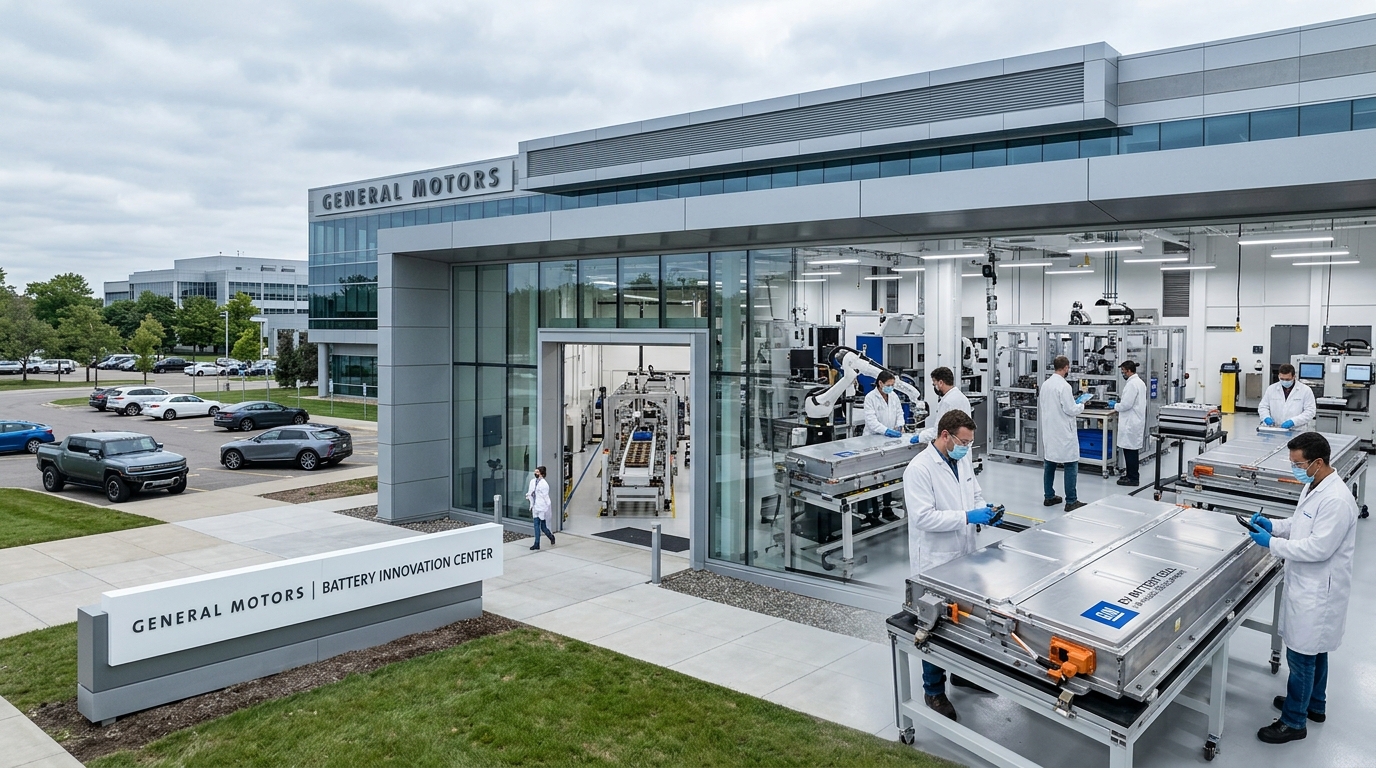
GM is spending $900 million on battery research and development facilities at its Global Technical Center campus in Warren, Michigan, including the Wallace Battery Cell Innovation Center and the Ancker-Johnson Battery Cell Development Center. Its Wallace facility can make batteries in small batches, while the Battery Cell Development Center is designed to help scale and validate what works. These trial-and-error phases help avoid expensive missteps before moving into factories with gigawatt-hours of production capacity. That is serious infrastructure. It is also capital that will not produce revenue for years.
The strategic risk for GM is scale and cost. Most battery cells currently rely on raw materials from China. The International Energy Agency reports China supplied almost 85% of cathode active material and more than 90% of anode active material used in EV batteries, and accounted for about 80% of global battery cell production in 2024. Displacing that kind of structural dominance requires not just a better cell chemistry but an entirely new upstream supply chain. GM has made moves: the company invested $650 million in Lithium Americas’ Thacker Pass mine in Nevada, one of the largest known lithium resources in the United States, with production projected to begin in the second half of 2026.
Governments worldwide are investing billions to revive a proven energy source. Supply chains are tightening, demand is rising, and select companies stand to benefit. The Nuclear’s Second Act report explains what’s happening next.
Ford’s licensed path was cheaper to enter and faster to scale. The Marshall plant is already in pre-production, with Ford saying it is on track to ship LFP batteries in 2026. Ford has said the project is expected to support about 2,500 jobs when production begins, and that hiring is underway. The political liability is real, but the manufacturing reality is also real.
There is also the awkward matter of GM’s own conduct. GM has publicly urged Washington to scrutinize Ford’s Marshall battery deal, and Duffy’s letter echoes some of the same concerns GM raised about technology transfer and competitive dependence. Bill Ford, the company’s chairman, went public in 2023 accusing General Motors of “submarine[ing]” the project. Investors evaluating GM’s domestic battery strategy should understand that regulatory pressure on a competitor is part of the commercial model here, not merely a byproduct of it.
The long-term question is whether GM’s in-house approach produces a cost structure that can compete. If LMR delivers as promised and domestic supply chains mature, GM could hold a durable advantage that no licensing agreement can replicate. If costs stay elevated and the technology takes longer than expected, Ford’s cheaper licensed path may look rational in hindsight. The $900 million is spent either way. That is the bet shareholders are already carrying.