



The sequence is the story. Democrats swept the midterms Tuesday. Wednesday, AI and data-center stocks fell hard even as the S&P 500 rose. Thursday, the broader market caught up: the Nasdaq Composite sank 5.5% into correction territory, while the S&P 500 fell 4.4% and the Dow dwindled 1,833 points, or 3.4%. Then, overnight, the same trade unraveled in every market that had ever bought into it.
Japan’s Nikkei 225 dropped 6.0% to 57,434.77 on November 6, entering a bear market after falling more than 20% from its June peak. In Seoul, South Korea’s Kospi experienced a severe drop of more than 8% during the morning session, which activated circuit breakers to suspend trading for 20 minutes. Following this, South Korea’s government convened an emergency market conditions review meeting, after which the decline in Korean stocks narrowed.
The scale of losses in Asia is not incidental. It tells you precisely who was selling and why. Market participants see Asia’s chipmakers and data center equipment suppliers in South Korea, Taiwan and Japan as especially vulnerable. These markets did not just catch a cold from Wall Street. They were the most concentrated expression of the same bet: that AI infrastructure spending would compound indefinitely, and that the chip supply chain running from Tokyo to Seoul to Taipei would be the clearest beneficiary.
The gap in performance between the tech-heavy Nikkei and the broader Topix has widened, hinting at how heavily the selling has focused on technology stocks. That divergence is a useful signal. This is not macro panic. It is the unwinding of a specific positioning trade, concentrated in a specific set of companies.
In Japan, chip-testing equipment maker Advantest fell about 12%, and SoftBank Group slid about 11%. In Korea, Samsung Electronics fell sharply while SK Hynix also slid. These are not peripheral holdings. They are the core infrastructure names that institutional funds around the world added as proxies for the AI buildout when Nvidia itself looked too expensive or too concentrated.
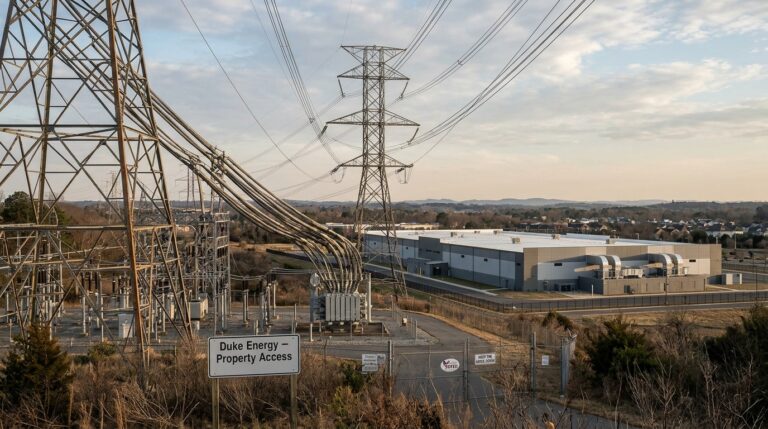
Back on Wall Street, the VanEck Semiconductor ETF (SMH) fell sharply on Thursday. Nvidia, the chip company that quickly became the face of the AI boom, fell 9.3% and closed at $181.60. The catalyst driving all of it: markets are pricing in the midterm results, and rising electricity prices helped turn the rapid construction of power-hungry data centers into a political issue during the midterm campaign, with some Democrats calling for restrictions or pauses on new projects.
The strongest counterargument is that policy fear is outrunning policy reality. “This feels like the capitulation phase for the data center capex beneficiary stocks, especially the semiconductors,” said Jed Ellerbroek of Argent Capital Management, though he added, “the magnitude of the moves is outsized.” Corporate demand for AI chips spans far beyond U.S. data centers, and no legislation has yet passed.
What to watch: Nvidia reports its fiscal Q3 on November 17. That date is now the clearest near-term test of whether the selloff has priced in a real slowdown or merely a political mood. Any guidance cut would validate the bear case. Any reaffirmation of demand would put the question back to Washington, where it belongs.