

November 6, 2026
Bonus Content: Berkshire Hits a Record Ahead of Saturday’s Report
Dear Reader,
By now, you’ve seen the clips of Elon Musk’s flying Roadster…
It’s exactly the kind of spectacle he’s become famous for.
And if you thought that was mind-blowing… wait until you see what he ISN’T talking about.
I’ve spent the past several months collecting a massive dossier of evidence which I believe points to a potentially EVEN BIGGER product launch.
One that I’m convinced is right around the corner…
In an arena you’ve never heard associated with Elon before.
That’s because so far, he hasn’t spoken a word about it.
If anything, he’s tried to divert attention from this next launch…
But what I’ve uncovered points to a fascinating new project that could have a direct impact on your finances, way more so than a car hovering in the air.
I’ve actually seen this exact same pattern before in my hedge fund days…
And if you’d heard me then, you could’ve turned just $1,500 into $1.2 million.
But don’t worry… I think this one could have even greater potential.
Regards,
Josh Baylin
Frmr. Bloomberg Reporter
Frmr. SAC Capital
Senior Tech Expert, Stansberry Research
Berkshire Hits a Record Ahead of Saturday’s Report
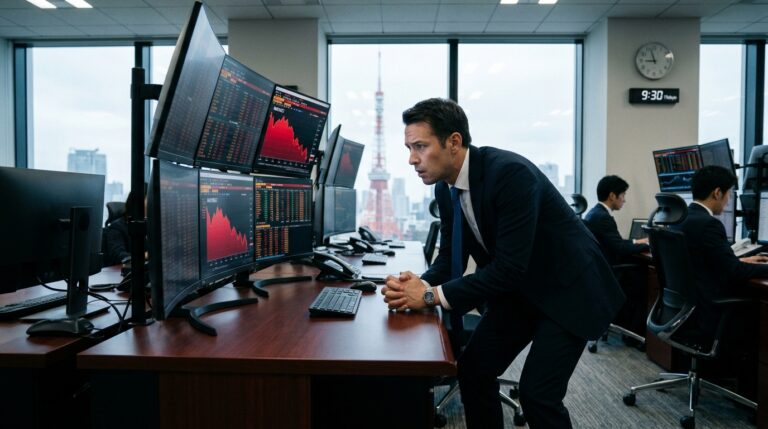
While the Nasdaq fell into correction territory Thursday, dropping more than 10% from its October peak as AI spending fears hammered chipmakers, one stock quietly hit an all-time high. BRK.B reached $586.30 on November 5 as the Dow Jones Industrial Average fell more than 1,800 points and the Nasdaq Composite fell more than 1,400 points. No press release. No filing. No executive comment. The market rotated toward Berkshire because, in moments of genuine uncertainty, the balance sheet matters more than the story.
That balance sheet reports Saturday morning.
Berkshire Hathaway’s third-quarter earnings release and quarterly report on Form 10-Q will be posted on November 7, 2026, at approximately 7:00 a.m. Central time. And the figure worth watching is not operating earnings, though those have been strong. Operating earnings rose to $12.983 billion in Q2, up from $11.160 billion a year ago. The figure that reveals something genuinely important is the cash.
What the Cash Level Actually Tells You
Berkshire is sitting on the largest cash pile in its history: $365.5 billion at June 30, 2026. The pile grew from around $373.3 billion at the end of 2025 to about $397.4 billion at the end of March, then fell as Abel began deploying capital. The fall came when Berkshire finally put money to work: in the second quarter, it bought nearly $20 billion of equities, ending a long stretch of net selling.
That included a $10 billion private placement in Alphabet and the $6.8 billion acquisition of homebuilder Taylor Morrison, which closed on July 24. Berkshire has already disclosed two big uses of cash in 2026, so a pile coming in around $365 billion may mainly reflect deals already announced. The real signal is whether the cash drops materially beyond those known figures.
If the pile falls well under $365 billion, say to the low $350 billions, Berkshire probably kept buying stocks, its own shares, or both after July, which might signal Abel is still finding things worth owning. If the pile rises back toward $380 billion, the second quarter may have been a one-time opportunity built around the Alphabet deal, not a new habit.
The Mogul Mindset: Patience as a Competitive Weapon
What Berkshire is demonstrating, whether intentionally or not, is that patience is not timidity. It is a form of optionality that few institutions can maintain. Berkshire’s businesses brought in about $20.8 billion in net operating cash flows in the first half of 2026, meaning the pile replenishes itself even when Abel is spending. That structural cash generation is one of the most underappreciated moats in American business.
Not everyone reads that structural cash generation as a moat. At least one prominent short-seller has argued the optionality embedded in Berkshire’s cash pile is worth less under Abel than it was under Buffett.
Abel repurchased about $4.5 billion of Berkshire’s shares while deploying billions more into investments in Q2. Berkshire started buying back its own shares in the first quarter for the first time in more than a year, with Abel saying executives found the intrinsic value of those shares exceeded their market price. With BRK.B now at a record, any continued buybacks in Q3 would signal Abel believes the stock is still cheap at these levels. That is a meaningful statement about confidence in the enterprise.
What Could Go Wrong
The bear case is straightforward. Berkshire’s valuation is at the high end of its historic range. A cash pile that earns Treasury-bill yields while the equity markets eventually recover is not a free lunch. If Abel is too slow to deploy, the opportunity cost compounds quietly. The other risk is execution: unlike Buffett, who had six decades of pattern recognition built into every deal, Abel is still establishing his track record as a capital allocator at scale. The Taylor Morrison acquisition and the Alphabet stake are early data points, not a proven record.
Abel’s early acquisition record extends beyond Taylor Morrison. Berkshire also moved aggressively into Lennar after the homebuilder missed earnings and cut guidance, becoming a 10% owner within days of the results.
Still, the week’s events have delivered an unusually clear illustration of what the cash hoard is actually for. Sentiment toward AI-linked stocks deteriorated sharply, with Reuters reporting in late October that more than $2 trillion was set to be wiped from the Nasdaq 100’s market value for the month. Berkshire went up. That divergence is not an accident. It is the result of decades of deliberate construction, and the Q3 filing will show how Greg Abel is choosing to use the tool he inherited.